

Choose Quizlet if you want to find a ready-made set in seconds, study with games, share sets with a class, or use a polished phone app. Choose Active Recalling if your material is your own lecture PDFs, slides, and notes, and you want flashcards, multiple-choice questions, and a mind map built from them, with reviews scheduled by spaced repetition.
We make Active Recalling, so we've kept this Active Recalling vs Quizlet comparison to facts you can check. Quizlet's prices and limits come from its upgrade page, help center, and App Store listing, checked in October 2026. Where Quizlet is the better choice, including on price, we say so.
Active Recalling vs Quizlet at a glance
| Quizlet | Active Recalling | |
|---|---|---|
| Where cards come from | Millions of shared sets, your own typing, or AI from your notes | AI drafts from your PDF, Word file, screenshot, pasted text, or webpage link |
| Study modes | Flashcards, Learn, practice tests, games | Flashcards, 4-option quizzes, mind map, Feynman practice |
| Long-term scheduling | Learn adapts to your answers; no published review algorithm | FSRS spaced repetition |
| Phone use | Native iOS and Android apps | Mobile browser only; no native app |
| Sharing | Public sets, classes, links | Share a folder or chapter by email; the recipient gets a copy |
| Extra help | Expert Solutions (textbook answers) | None |
| Free plan | Limited Learn and practice tests, with ads | 1 folder, up to 3 chapters, all study formats |
| Paid plans | Plus $35.99/yr; Plus Unlimited $44.99/yr | Pro $3.99/month; no yearly plan |
| Moving your data | Export sets you created as text (website only) | No Quizlet or Anki import |
What Quizlet does well
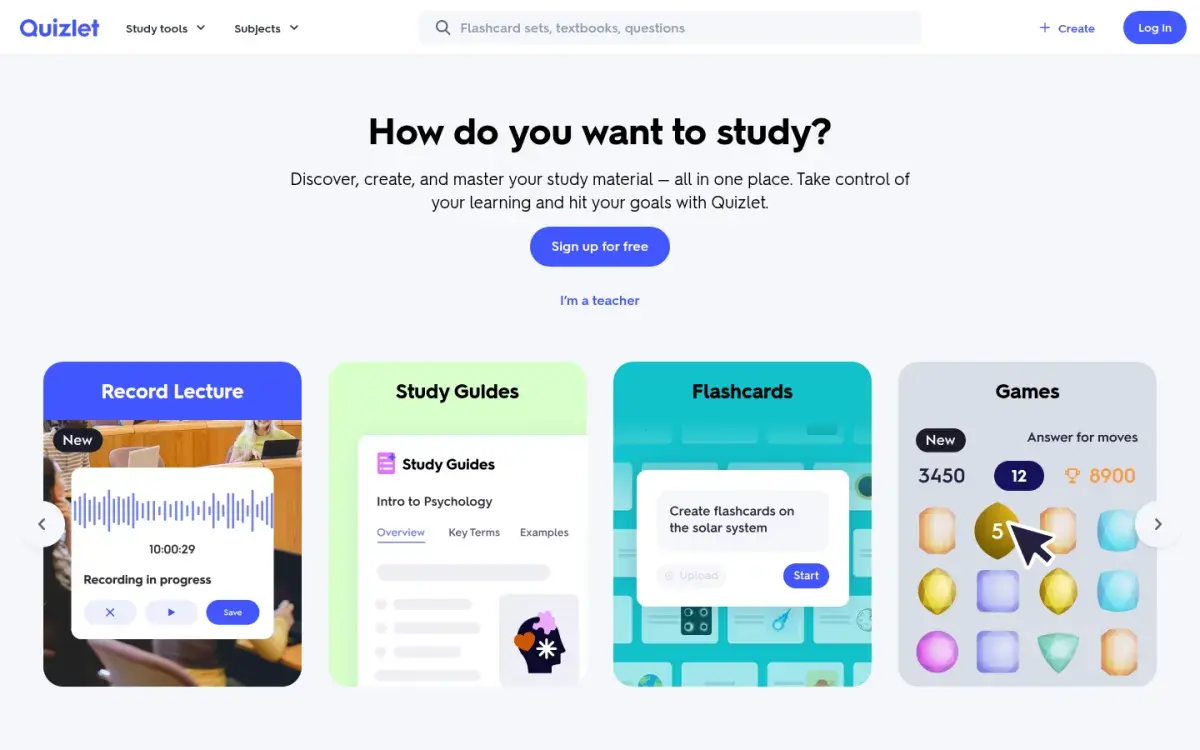
Quizlet's biggest advantage is that someone has usually made your set already. Its upgrade page describes "millions of flashcards" across subjects, and for standard material like Spanish verbs, AP Biology vocabulary, or the bones of the hand, a search gets you studying in under a minute.
Other strengths:
- AI tools from your own notes. Quizlet's AI flashcard maker, study guide generator, and practice test generator accept uploaded notes, slides, or PDFs, so Quizlet is no longer only about other people's sets.
- Games and variety. Study games make vocabulary drills less dull, and the paid plans include unlimited access to all games and activities.
- Classroom features. Teachers can share sets with classes, and students can find their teacher's class.
- A strong phone app. Quizlet's iPhone app is rated 4.8 out of 5 from more than a million ratings in the US App Store, and you can study Flashcards and Match offline.
- Homework help. Expert Solutions offers step-by-step textbook answers, with monthly limits on the Plus plan.
Where Quizlet falls short
The free plan has narrowed. Practice tests and Learn are limited for free users, and the paid tiers advertise ad-free studying, so free accounts see ads. Even Quizlet Plus caps you at 20 rounds of Learn and 3 practice tests a month; only Plus Unlimited removes those caps.
Shared sets have a quality problem too. A set made by another student may contain errors, and it reflects their teacher's emphasis, not yours.
What Active Recalling does well
Active Recalling is built for the student whose exam follows a specific professor's slides and readings. You make a folder for a course, add each lecture as a chapter, and attach the source file. From it, you get editable flashcards, four-option multiple-choice questions, a mind map of how the topics connect, and Feynman practice, where you explain a topic aloud and the app compares your transcribed explanation with your notes.
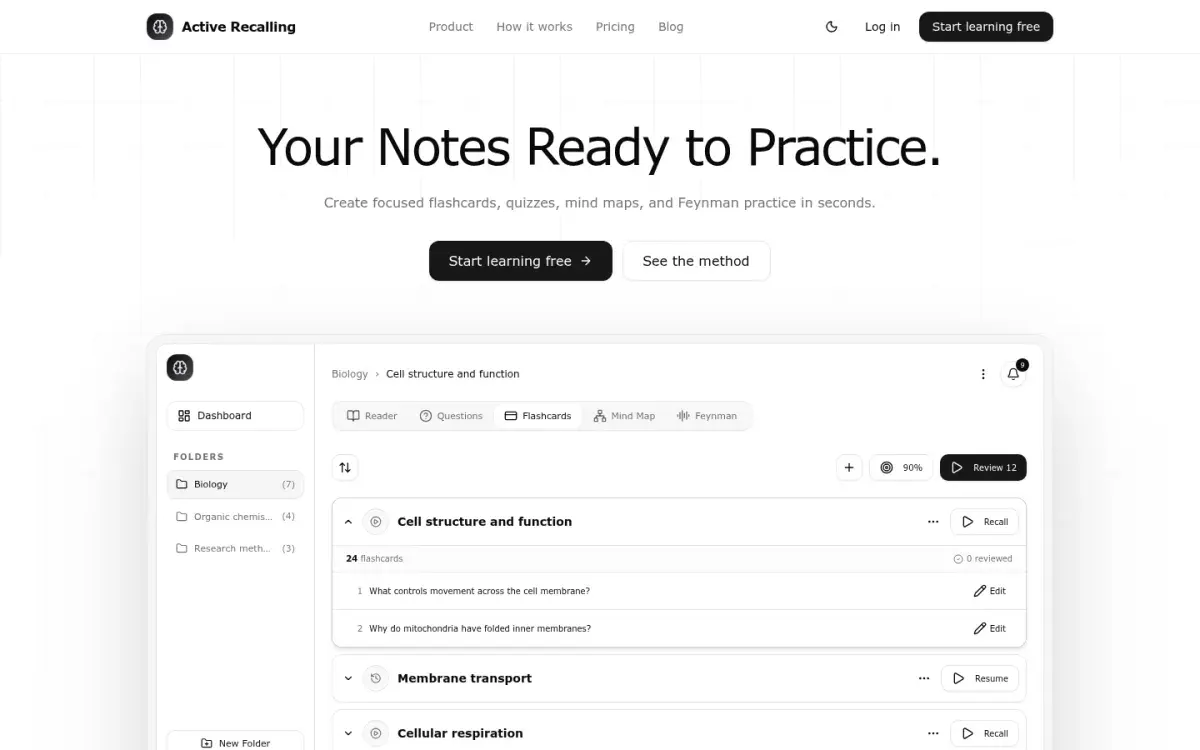
Reviews are scheduled with FSRS, a spaced-repetition algorithm that brings each card back when you're likely to be close to forgetting it. Our spaced repetition guide explains why that beats reviewing a whole set the night before.
What it doesn't have: a public library of sets, games, a native iOS or Android app, offline mode, or Quizlet import. YouTube links aren't supported (paste a transcript instead), and sign-in is with a Google account only. AI-drafted cards also need a quick check against your source before you trust them.
Price: what a year of each costs
Quizlet's annual plans are cheaper than a full year of Active Recalling Pro. Quizlet advertises its annual billing as 62% cheaper than paying monthly, and its 7-day free trial applies only to annual plans.
Cost of twelve months of each paid plan
US dollars, October 2026. Quizlet plans billed annually; Active Recalling Pro billed monthly (no yearly plan).
View data
| Plan | Cost for 12 months (USD) |
|---|---|
| Quizlet Plus | $35.99 |
| Quizlet Plus Unlimited | $44.99 |
| Active Recalling Pro | $47.88 |
The comparison shifts if you only pay during exam season. Active Recalling Pro is $3.99 for any single month, so three months of heavy studying costs $11.97. On Quizlet, the cheapest route is a yearly plan.
What each plan includes matters as much as the price:
- Quizlet Plus ($35.99/yr): ad-free, 20 rounds of Learn and 3 practice tests a month, 3 textbook solutions a month.
- Quizlet Plus Unlimited ($44.99/yr): ad-free, unlimited Learn, complete practice-test access.
- Quizlet Family ($83.99/yr): Plus Unlimited for up to 5 accounts.
- Active Recalling Pro ($3.99/month): unlimited folders and chapters, with every study format.
Who should choose Quizlet?
Quizlet is the better pick if:
- Your course is common. Intro languages, AP classes, and standard vocabulary lists usually have good sets already.
- You're a teacher or your teacher runs class activity through Quizlet.
- Games keep you studying. If a timed game is the only way you'll drill 200 vocabulary words, use it.
- You study almost entirely on your phone. The native app is excellent; Active Recalling runs in a mobile browser.
- You want textbook solutions alongside your flashcards.
- You already have years of sets there and mainly study them before tests.
Who should choose Active Recalling?
Active Recalling is the better pick if:
- Your exams follow your own course files. Upper-level courses often lack reliable shared sets, and your professor's emphasis matters.
- You want to remember material for weeks, not one night. FSRS schedules reviews across the semester, which is what cumulative finals reward.
- You want more than flashcards. Multiple-choice questions can test whether you can apply an idea, a mind map shows a chapter's structure, and explaining aloud exposes gaps flashcards miss. See how to make a quiz from a PDF and the Feynman technique for why each format helps.
- You prefer paying month to month only when you need it.
The same unit in both apps
Say you're in an intro psychology course and the unit test covers your professor's 40-slide lecture on memory.
On Quizlet: search "psychology memory" and you'll usually find sets other students have made. Pick one that uses your professor's terms (encoding, consolidation, retrieval, the serial position effect), run through it with Learn, then take a practice test. It's fast. The risk is that the set includes terms your professor skipped and misses the two studies they spent ten minutes on.
On Active Recalling: save the slides as a PDF, add them as a chapter in a "Psychology" folder, and generate. You get cards drawn from the slides themselves, multiple-choice questions such as A participant remembers the first and last words of a list best. Which effect does this show?, and a mind map linking encoding, storage, and retrieval. Spend ten minutes deleting weak cards and fixing anything off, then review on the FSRS schedule.
If the unit is mostly standard vocabulary, Quizlet's head start wins. If the test asks about what your professor actually taught, building from the slides is safer. Our guide to memorizing vocabulary covers the first case, and mind mapping explains why seeing a chapter's structure helps with the second.
Spaced repetition vs Quizlet's Learn mode
This is the main difference in how the two apps help you remember.
Quizlet Learn works through one set at a time and adapts to your answers until you've got the set down. Quizlet describes it as adaptive and personalized, and it's a fast way to learn a set. But Quizlet doesn't publish a long-term review algorithm, so returning to last month's sets is up to you.
Spaced repetition works across everything you've studied. Each card gets its own schedule: a card you nailed comes back in weeks, a card you missed comes back tomorrow. Over a semester, that's the difference between relearning chapter 2 before the final and still knowing it.
You can get spacing with Quizlet too: keep a calendar and revisit old sets at roughly 1 day, 3 days, 1 week, and 3 weeks after you first learn them. An app with a scheduler just does that bookkeeping for you.
How to move from Quizlet to Active Recalling
There's no direct import, so move selectively.
- Start with your next exam, not your whole library. Pick the one course where you need to start studying now.
- Use the original source if you have it. Upload the lecture PDF, slides, or handout to a new chapter. This usually gives better cards than copying an old set, because the AI sees the full context.
- Export the sets you made yourself. On the Quizlet website, open your set, choose the more menu, then Export, and copy the text. Only a set's creator can export it: sets you copied from other users can't be exported, images don't come along, and export works only on the website.
- Paste the exported text into a chapter as notes. Active Recalling treats it as source material and drafts new cards and questions from it, so it's not a one-to-one copy of your set. Edit as needed.
- Keep Quizlet for what it's best at. Nothing stops you from using Quizlet for a quick vocabulary game and Active Recalling for your lecture-based courses.
If you're still deciding which apps to try, our list of Quizlet alternatives compares eight options, and our Quizlet alternative page summarizes how Active Recalling differs. If you're also weighing Anki, read Active Recalling vs Anki, or our Anki alternative page for a quick summary. If you mostly study on an Android phone, Android flashcard apps compared on price is the more relevant list.
Frequently asked questions
Is Active Recalling better than Quizlet?
It depends on your material. Quizlet is better for common courses with existing sets, classroom use, games, and studying on a native phone app. Active Recalling is better when your exams follow your own lecture files and you want flashcards, multiple-choice questions, and a mind map generated from them, with spaced-repetition scheduling.
Is Quizlet Plus worth it?
Quizlet Plus costs $35.99 a year and removes ads, but still caps you at 20 rounds of Learn and 3 practice tests a month. If you rely on Learn or practice tests, Plus Unlimited at $44.99 a year removes those caps. If you mainly use flashcards and games, the free plan may be enough.
Can I import Quizlet sets into Active Recalling?
Not directly. You can export the text of sets you created on the Quizlet website and paste it into an Active Recalling chapter as notes, and the app will draft new cards and questions from it. For better results, upload the original lecture file or handout instead.
Does Quizlet use spaced repetition?
Quizlet's Learn mode adapts to your answers within a set, but Quizlet doesn't publish a long-term review algorithm like FSRS or SM-2. To get spacing on Quizlet, revisit old sets on a schedule yourself. Apps such as Anki and Active Recalling schedule each card's next review automatically.
Is there a Quizlet alternative for PDFs?
Yes. Active Recalling and RemNote both generate flashcards and quizzes from uploaded PDFs, and Quizlet's own AI tools accept PDFs too. Active Recalling also builds a mind map from the same file and schedules reviews with FSRS. Whatever you use, check generated cards against the PDF before relying on them.
Sources and further reading
Start with the primary research and official guidance below. Links open in a new tab so you can compare the evidence with the article.
- Read source
Upgrade your account: Quizlet Plus plans
Quizlet, 2026
- Read source
Explore our suite of AI tools
Quizlet, 2026
- Read source
Exporting your sets
Quizlet Help Center
- Read source
Studying offline with Quizlet mobile apps
Quizlet Help Center
- Read source
Quizlet: More than Flashcards
Apple App Store, 2026
- Read source
Active Recalling
Active Recalling official site, 2026