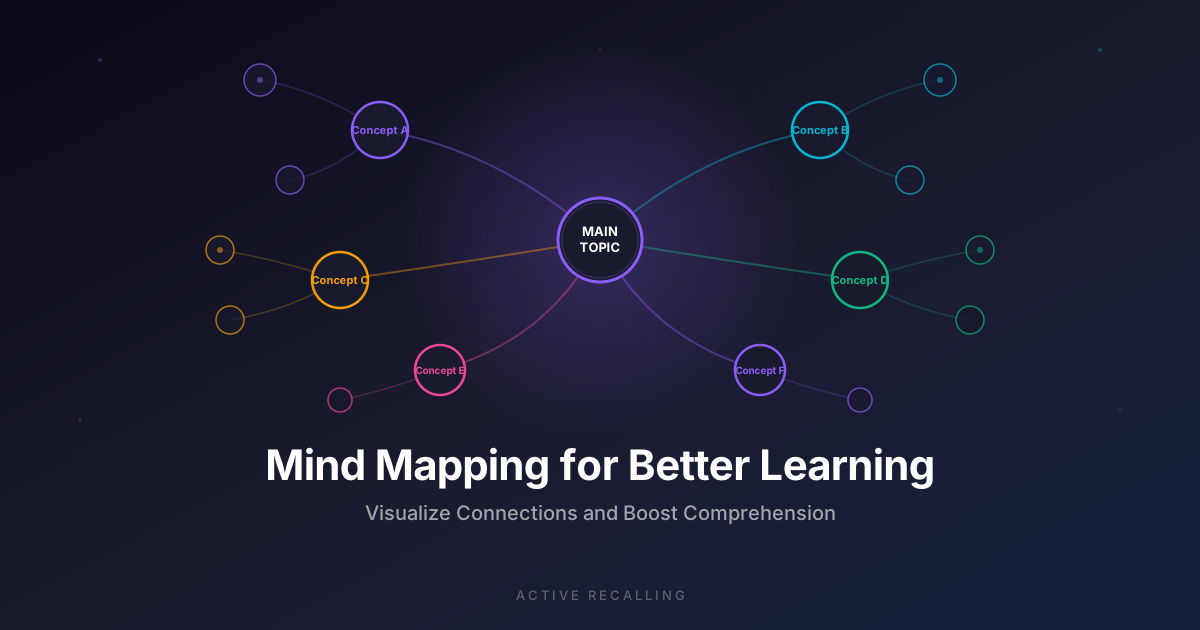
Most students take notes the same way they have since elementary school: line after line of text, maybe with a few bullet points or highlighted passages. But our brains do not process information in neat, linear rows. They work through associations, patterns, and connections. That fundamental mismatch between how we record information and how we actually think is one of the biggest obstacles to effective learning.
Mind mapping offers a different approach, one that mirrors the way your brain naturally organizes knowledge. Instead of forcing ideas into a sequential list, a mind map places a central concept at the core and branches outward into related topics, subtopics, and details. The result is a visual web of information that is easier to understand, easier to remember, and far more engaging to create.
In this guide, we will explore the science behind mind mapping, walk through how to create effective mind maps, and show you how to combine this technique with active recall to supercharge your study sessions.
What Exactly Is a Mind Map?
A mind map is a diagram that visually organizes information around a central idea. From that central node, major themes radiate outward as branches. Each branch can then split into smaller sub-branches, creating a hierarchical yet non-linear representation of a topic.
A mind map about "World War II," for example, might have main branches for Causes, Major Battles, Key Figures, Technology, and Aftermath. The "Causes" branch could further divide into Treaty of Versailles, Economic Depression, Rise of Fascism, and so on. Every piece of information has a clear relationship to the whole.
Unlike traditional outlines, mind maps encourage you to see the big picture and the fine details simultaneously. They reveal connections between ideas that a list would bury, and they make gaps in your understanding immediately visible.
A Brief History: Tony Buzan and the Mind Map Revolution
While people have used diagrams and visual notes for centuries, the modern concept of the mind map was popularized by Tony Buzan in the 1970s. Buzan, a British psychologist and author, studied how the brain processes information and became convinced that traditional note-taking was fundamentally flawed.
Buzan argued that the brain thinks in radiant patterns, not in lines. When you think of a word like "apple," your mind does not produce a list. It fires off associations in every direction: red, fruit, pie, orchard, Newton, health, crunch. Mind mapping was designed to capture this radiant thinking on paper.
His book "The Mind Map Book" became an international bestseller, and mind mapping spread into education, business, and personal productivity. Decades later, the technique remains one of the most widely recommended study strategies by cognitive scientists and educators alike.
The Science of Visual Learning
Mind mapping works because it leverages several well-established principles from cognitive psychology.
Dual Coding Theory
Proposed by Allan Paivio in the 1970s, dual coding theory states that information processed through both verbal and visual channels is remembered far better than information processed through only one channel. When you create a mind map, you are encoding information both as text (the words on each branch) and as a spatial, visual structure (the layout, colors, and connections). This dual encoding creates multiple retrieval pathways in your memory.
Research consistently supports this. A study published in the journal "Learning and Instruction" found that students who used visual organizers like mind maps scored significantly higher on comprehension and retention tests compared to those who used traditional note-taking.
The Picture Superiority Effect
Humans are remarkably good at remembering images. Studies show that people can recall about 65% of visual information after three days, compared to only about 10% of text-based information. Mind maps tap into this by turning abstract concepts into a memorable visual layout. The spatial arrangement of branches, the colors, and even the shapes you use all become part of the memory.
Chunking and Hierarchical Organization
Working memory can only hold about four to seven items at once. Mind maps naturally chunk information into categories and subcategories, reducing cognitive load. Instead of trying to remember 30 isolated facts, you remember a handful of main branches, each of which leads to its own cluster of details.
How to Create an Effective Mind Map
Creating a mind map is straightforward, but there are principles that separate a useful mind map from a messy one.
Step 1: Start with a Central Concept
Place your main topic in the center of the page. Write it clearly, and if possible, add a small image or icon that represents the concept. This central node serves as the anchor for everything that follows.
Step 2: Add Main Branches
Draw thick branches radiating from the center for each major subtopic. Use a different color for each branch to make them visually distinct. Keep the labels on these branches short, ideally one or two words. You are creating categories, not writing paragraphs.
Step 3: Expand with Sub-Branches
From each main branch, add thinner branches for supporting details, examples, and related ideas. These can continue to subdivide as needed. The further you get from the center, the more specific the information should become.
Step 4: Use Keywords, Not Sentences
One of the most common mistakes is writing too much text on a mind map. Each branch should contain a keyword or short phrase, not a full sentence. This forces you to distill information to its essence, which itself is a form of active processing that improves understanding.
Step 5: Add Visual Elements
Colors, icons, small drawings, and varied line styles all enhance memorability. You do not need to be an artist. Even simple symbols like arrows, stars, or question marks can add meaning and make the map more memorable.
Step 6: Draw Connections
Look for relationships between branches that are not directly connected. Draw dotted lines or arrows between related ideas on different branches. These cross-links are where some of the deepest understanding happens, because they reveal how different aspects of a topic relate to each other.
Digital vs. Hand-Drawn Mind Maps
This is one of the most debated questions in the mind mapping community, and the honest answer is that both approaches have strengths.
Hand-Drawn Mind Maps
Drawing by hand engages your motor cortex and creates a stronger memory trace. Research on the "generation effect" shows that information you produce yourself is remembered better than information you passively receive. The physical act of drawing branches, choosing colors, and arranging spatial relationships deepens encoding.
Hand-drawn maps are also completely free-form. There are no software constraints limiting where you can place a branch or how you connect ideas.
The downsides are practical: hand-drawn maps are hard to edit, difficult to share digitally, and can become messy as topics grow more complex.
Digital Mind Maps
Digital tools like MindMeister, XMind, Coggle, and even the mind map feature in Active Recalling offer significant advantages for organization and iteration. You can rearrange branches instantly, collapse sections to focus on specific areas, and share maps with study groups. Digital maps also scale better for complex topics that would overwhelm a single sheet of paper.
The trade-off is that clicking and dragging is less cognitively engaging than drawing by hand. However, you can offset this by actively thinking about structure and relationships as you build the map rather than mindlessly copying notes.
Our recommendation: Use hand-drawn maps for initial learning and brainstorming, and digital maps for organizing complex topics and long-term reference.
Mind Mapping for Different Subjects
One of mind mapping's greatest strengths is its versatility across disciplines.
Sciences
For biology, chemistry, and physics, mind maps excel at showing relationships between systems. A biology mind map might center on "The Cell" with branches for organelles, each linking to functions, structures, and related processes. The visual layout naturally mirrors the interconnected nature of biological systems.
History and Social Sciences
History is full of cause-and-effect relationships, timelines, and interconnected events. A mind map about the French Revolution can show how economic factors, philosophical movements, political structures, and social inequality all contributed to the uprising, and how the revolution in turn influenced subsequent events.
Languages
Vocabulary acquisition benefits enormously from mind mapping. Place a theme at the center (like "food" or "travel") and branch out into related words, phrases, and grammar patterns. The visual clustering helps you remember vocabulary in meaningful groups rather than as isolated translations.
Mathematics
While math is often seen as too abstract for visual mapping, mind maps work well for organizing problem-solving strategies, theorem relationships, and formula derivations. Mapping out when to apply different techniques for integration, for example, gives you a decision framework that a list of formulas cannot provide.
Combining Mind Maps with Active Recall
Here is where mind mapping becomes truly powerful. Most students create mind maps as a form of note-taking, which is useful but passive. The real magic happens when you use mind maps as an active recall tool.
The Blank Map Technique
After creating a complete mind map of a topic, put it away. Take a blank sheet of paper and try to recreate the entire map from memory. Do not peek. Draw the central concept, add every branch and sub-branch you can remember, and try to reconstruct the connections.
When you are done, compare your blank map with the original. The branches you forgot or got wrong are exactly the areas where your understanding is weakest. This is targeted, efficient studying because you are identifying and addressing gaps rather than re-reading material you already know.
Progressive Elaboration
Start with a simple mind map containing only main branches. Over the course of several study sessions, try to add more detail from memory each time. This spaced, repeated recall strengthens the neural pathways associated with the material far more effectively than passive review.
Teaching with Mind Maps
Use your mind map as a guide to explain a topic out loud, as if teaching someone else. Walk through each branch, explain the connections, and elaborate on the details. This combines the retrieval practice of active recall with the elaboration of teaching, two of the most powerful learning strategies known to cognitive science.
Common Mistakes to Avoid
Even experienced mind mappers fall into these traps.
Overcrowding the map. If your mind map is so dense that it is hard to read, it loses its visual advantage. Break complex topics into multiple maps or use a hierarchical system where one overview map links to detailed sub-maps.
Writing too much text. Sentences and paragraphs defeat the purpose. Stick to keywords and short phrases. If you need longer explanations, attach them as separate notes.
Ignoring structure. A mind map without clear hierarchy is just a random collection of words. Make sure the branching structure reflects genuine conceptual relationships, with broader categories closer to the center and specific details at the edges.
Using it only once. A mind map you create and never revisit is a wasted opportunity. Return to your maps, test yourself against them, and update them as your understanding deepens.
Skipping the cross-links. The connections between different branches are often where the most valuable insights hide. Always look for relationships that cross category boundaries.
Getting Started Today
You do not need any special tools or artistic talent to start mind mapping. A blank piece of paper and a few colored pens are enough. If you prefer digital tools, Active Recalling includes a built-in mind mapping feature powered by React Flow that lets you create, edit, and study from mind maps directly within your learning workflow.
The key is to start simple. Pick a topic you are currently studying, place it at the center of a page, and start branching. Do not worry about making it perfect. The act of organizing information visually will already improve your understanding. Then take it further by using the blank map technique to turn your mind map into a powerful active recall exercise.
Mind mapping is not a replacement for other study methods. It is a complement that adds a visual, spatial dimension to your learning. When combined with active recall and spaced repetition, it becomes one of the most effective tools in any student's arsenal. The connections you draw on paper are a reflection of the connections forming in your mind, and those connections are what real understanding is made of.