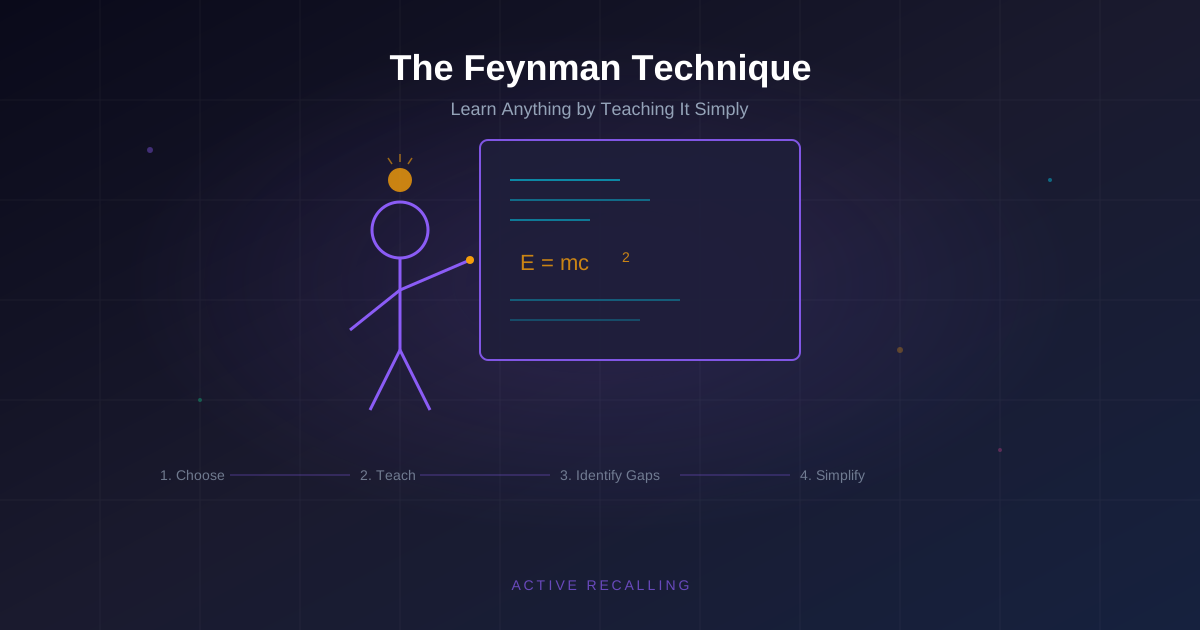
TL;DR: The Feynman Technique is a four-step learning method — choose a concept, explain it in plain language, identify where you get stuck, and refine with analogies. Named after Nobel physicist Richard Feynman, it works by exploiting the generation effect (Slamecka and Graf, 1978): producing an explanation strengthens memory and exposes gaps that passive reading hides.
What Is the Feynman Technique?
The Feynman Technique is a learning method named after Nobel Prize-winning physicist Richard Feynman, who was renowned not just for his groundbreaking work in quantum electrodynamics but also for his extraordinary ability to explain complex ideas in plain language. Feynman believed that if you couldn't explain something simply, you didn't truly understand it — and he turned that belief into a practical learning strategy used by students, professionals, and lifelong learners around the world.
At its core, the Feynman Technique is about using simplification as a diagnostic tool. When you try to explain a concept in the simplest possible terms, every gap in your understanding becomes immediately obvious. You can't hide behind jargon or memorized phrases. You either understand it well enough to explain it to a child, or you don't — and that clarity is what makes this technique so powerful.
Unlike passive study methods such as re-reading or highlighting, the Feynman Technique forces you into an active relationship with the material. You aren't just consuming information; you are transforming it, restructuring it, and testing your comprehension in real time.
The 4 Steps of the Feynman Technique
Step 1: Choose a Concept and Study It
Start by selecting the topic you want to learn. Write the name of the concept at the top of a blank page. Then study the concept using your textbook, lecture notes, articles, or any other resource. As you read, take notes in your own words. Focus on understanding the core ideas rather than memorizing specific phrases.
The key here is intentional engagement. Don't just skim. Ask yourself questions as you read: Why does this work? What is the underlying principle? How does this connect to what I already know?
This first step is where you build the raw material for your understanding. Think of it as gathering ingredients before you start cooking — you need a solid foundation of information before you can begin simplifying.
Step 2: Explain It as If Teaching a Child
This is the heart of the technique. On your blank page, write an explanation of the concept as though you are teaching it to someone who has never encountered it before — ideally, a twelve-year-old. Use plain language. Avoid technical jargon. Use analogies, examples, and simple sentences.
The goal isn't to dumb down the information — it's to translate it into accessible language while preserving accuracy. There is a crucial difference between simplifying and being simplistic. True simplification requires deep understanding.
As you write, you will likely hit moments where your explanation becomes vague, circular, or confused. You might find yourself reaching for a technical term because you don't actually know how to express the idea without it. These moments are gold. They reveal exactly where your understanding breaks down.
For example, if you are studying how photosynthesis works, your simplified explanation might be: "Plants take in sunlight and carbon dioxide, and through a chemical process in their leaves, they convert these into sugar for energy and release oxygen as a byproduct." If you find yourself unable to explain what happens during the "chemical process" without using terms like "Calvin cycle" or "electron transport chain," that signals a gap worth investigating.
Step 3: Identify Gaps and Go Back to the Source
Now review your simplified explanation. Look for areas where you got stuck, where your explanation was weak, or where you resorted to jargon. These are your knowledge gaps.
Go back to your source material and study specifically those areas. This is targeted learning at its most efficient. Instead of re-reading everything, you focus only on the parts you genuinely don't understand. This saves time and directs your energy where it matters most.
This step transforms the Feynman Technique from a simple exercise into a feedback loop. Each pass through the cycle deepens your understanding, and each gap you fill strengthens the overall structure of your knowledge.
Don't rush this step. Sometimes a gap reveals that you need to understand a prerequisite concept first. If your understanding of cellular respiration is weak because you don't understand basic chemistry, take the time to shore up that foundation before proceeding.
Step 4: Simplify and Use Analogies
Once you've filled in your gaps, rewrite your explanation again. This time, make it even simpler. Polish the language. Find better analogies. Organize the information in a way that flows naturally from one idea to the next.
A strong analogy can be worth a thousand words of explanation. Feynman himself was a master of analogies. He described the behavior of subatomic particles using everyday scenarios that made quantum physics accessible to general audiences. You can do the same with any topic.
For instance, you might compare the immune system to a castle's defense: the skin is the outer wall, white blood cells are the soldiers, and antibodies are the scouts that identify invaders. Analogies like these create mental hooks that make information easier to remember and retrieve later.
The final version of your explanation should be something you could confidently share with anyone and have them understand the basic concept. When you reach that level of clarity, you have genuinely learned the material.
Why Simplification Reveals Understanding Gaps
The reason simplification works so well as a learning tool comes down to how our brains process and store information. When you first encounter a new concept, your brain creates a fragile, loosely connected network of associations. You might recognize key terms and have a general sense of the topic, but the connections between ideas are shallow.
Jargon acts as a crutch. When you use technical language, you can give the impression of understanding — even to yourself — without actually having deep comprehension. You might be able to say "mitochondria are the powerhouses of the cell" without truly understanding what that means in terms of energy production, ATP synthesis, or cellular metabolism.
Simplification strips away that crutch. When you force yourself to use everyday language, you must genuinely understand the relationships between ideas. You need to know not just what something is called, but what it does, why it matters, and how it connects to the bigger picture.
Research in cognitive science supports this. The generation effect shows that information you produce yourself (by explaining, summarizing, or creating) is remembered better than information you merely consume. The elaboration effect demonstrates that connecting new information to existing knowledge through analogies and examples strengthens memory traces significantly.
Practical Examples of the Feynman Technique
Example: Understanding Compound Interest
Suppose you want to understand compound interest. Your simplified explanation might go like this: "Compound interest means you earn interest not just on your original money, but also on the interest you've already earned. So if you put 100 dollars in a savings account and earn 10 percent interest, after one year you have 110 dollars. The next year, you earn 10 percent on 110 dollars, not just the original 100. That gives you 121 dollars. Each year, the amount grows faster because the base gets bigger."
If you struggled to explain why the growth accelerates, that's a gap to investigate — specifically, the mathematical concept of exponential growth versus linear growth.
Example: Understanding Natural Selection
A simplified explanation might be: "In any group of animals, there are small differences between individuals. Some of those differences help certain animals survive better — maybe they can run faster or find food more easily. Animals that survive longer tend to have more babies, and those babies often inherit the helpful traits. Over many generations, the group changes because the helpful traits become more common."
If you found it difficult to explain how traits are inherited without using the word "genes," that's a gap to fill.
Combining the Feynman Technique with Other Methods
The Feynman Technique becomes even more powerful when combined with complementary learning strategies.
Feynman Technique and Active Recall
After creating your simplified explanation, close your notes and try to reproduce it from memory. This adds the benefits of active recall — retrieving information strengthens memory far more than re-reading it. The combination forces you to both understand deeply and remember reliably.
Feynman Technique and Spaced Repetition
Use the simplified explanations you create as review material. Revisit them at increasing intervals — after one day, then three days, then a week, then a month. This spaced repetition approach ensures the knowledge moves from short-term to long-term memory.
Feynman Technique and Mind Mapping
Before writing your simplified explanation, create a mind map of the concept. This helps you see the relationships between ideas visually, which can make the simplification process easier. The mind map serves as a structural outline for your explanation.
Feynman Technique and Flashcards
Turn the key points from your simplified explanation into flashcards. On one side, write a question; on the other, write the simplified answer. This creates a bridge between deep understanding (from the Feynman Technique) and efficient review (from flashcard-based practice).
Common Mistakes to Avoid
Using jargon in your explanation. The whole point is to explain without technical terms. If you catch yourself using specialized vocabulary, pause and ask whether you can express the same idea in simpler words.
Skipping the gap-identification step. Many people write a simplified explanation and stop there. The real learning happens when you identify weaknesses and go back to study them. Don't shortcut this process.
Choosing topics that are too broad. "Explain all of biology" is not a productive exercise. Choose specific concepts — how DNA replication works, what causes inflation, or how neural networks learn. The more focused your topic, the more useful the exercise.
Confusing recognition with understanding. Just because you can follow an explanation in a textbook doesn't mean you can produce one yourself. The Feynman Technique tests production, not recognition, and that distinction matters enormously for real learning.
When to Use the Feynman Technique
This technique is particularly effective for conceptual subjects where understanding relationships and processes matters more than memorizing facts. It works exceptionally well for science, economics, philosophy, programming concepts, and any domain where "why" and "how" questions are central.
It's less suited for pure memorization tasks like vocabulary lists or historical dates, although even those can benefit from the deeper processing that explanation requires.
Use it when you feel like you "sort of" understand something but couldn't confidently explain it. Use it when you're preparing for an exam that will test understanding rather than recall. Use it when you're learning something important that you want to truly internalize rather than just pass a test on.
Frequently Asked Questions
Who was Richard Feynman?
Richard Feynman (1918-1988) was an American theoretical physicist who won the 1965 Nobel Prize in Physics for his contributions to quantum electrodynamics. He was famous for his ability to explain dense physics concepts to lay audiences, and this skill inspired the technique named after him.
Does the Feynman Technique actually work?
Yes. While the "Feynman Technique" as a branded method has not been studied as a unit, the underlying mechanisms — the generation effect (Slamecka and Graf, 1978), elaborative interrogation, and self-explanation — are among the best-supported findings in cognitive psychology. Chi and colleagues (1989) found self-explanation improved novel problem-solving by roughly 50 percent.
Can I use the Feynman Technique without a real audience?
Yes. Writing the explanation, speaking to an empty room, or recording yourself all work. The cognitive act of producing the explanation is what drives the benefit, not having a listener. Many practitioners write their explanations in a dedicated notebook or Markdown file.
How long does a Feynman Technique session take?
A single concept typically takes 20-45 minutes: 5 to 10 minutes on initial study, 10 to 15 minutes on the simplified explanation, and another 10 to 20 minutes for gap-filling and refinement. Difficult concepts may require multiple sessions.
What is the difference between the Feynman Technique and active recall?
Active recall is the retrieval of information from memory. The Feynman Technique is a specific form of active recall that requires you to not only retrieve information but also reorganize and simplify it. It is more cognitively demanding than flashcard review but produces deeper understanding.
When should I not use the Feynman Technique?
For pure memorization tasks — vocabulary, historical dates, anatomical names — flashcards with spaced repetition are more efficient. Use the Feynman Technique when understanding relationships and processes matters (for example, science, economics, programming concepts).
Conclusion
The Feynman Technique is deceptively simple: choose a concept, explain it simply, find your gaps, and refine. But within that simplicity lies one of the most effective learning strategies available. By forcing yourself to teach — even to an imaginary audience — you transform passive knowledge into genuine understanding.
Richard Feynman spent his life proving that the deepest truths of physics could be explained in plain language. His technique invites you to do the same with whatever you're learning. The next time you sit down to study, put away the highlighter. Pick up a blank page instead, and start explaining. The gaps you discover will be the most valuable part of your study session.