TL;DR
Spaced repetition is a study technique that schedules reviews at gradually expanding intervals — if you recall an item correctly, you wait longer before seeing it again; if you miss it, it comes back sooner. The expanding intervals exploit a well-documented property of human memory first described by Hermann Ebbinghaus in 1885: each successful retrieval at the edge of forgetting strengthens the memory more than an easy retrieval does. A 2006 meta-analysis of 254 studies by Cepeda and colleagues confirmed that distributed practice beats cramming for long-term retention in virtually every condition tested.
Practically, you have three good options: a physical Leitner box with index cards, a classic SM-2-based app (Anki, Mnemosyne), or a modern FSRS-based tool. All three work — pick the one you'll actually use daily.
What Is Spaced Repetition?
Spaced repetition is a study method in which you review previously learned material at strategically increasing intervals. The core rule: if you got it right, wait longer before reviewing it again. If you got it wrong, review it soon.
That deceptively simple rule produces huge results over time because it aligns your study schedule with how memory actually decays. Instead of re-reading your notes the night before an exam, you're reviewing each item at the moment when it's about to slip — which happens to be exactly when retrieval strengthens it most. Knowledge moves from fragile short-term memory into durable long-term storage, and if you have ever wished you could study less but remember more, this is the method that makes it possible.
Three reasons spaced repetition dominates other review methods:
- It's efficient. You stop re-studying things you already know solidly.
- It's targeted. Weak items automatically come back sooner.
- It's durable. Material studied this way sticks for months or years, not days.
Why We Forget: Ebbinghaus's Forgetting Curve
You spend hours studying for an exam, feel confident walking in, and three weeks later you can barely recall a fraction of what you learned. This isn't a personal failing — it's how the human brain is wired. Our memory system is designed to discard information it deems unnecessary, and without deliberate reinforcement, even well-studied material fades remarkably fast.
In the 1880s, German psychologist Hermann Ebbinghaus conducted pioneering experiments on memory. He memorized lists of nonsense syllables and then tested himself at various intervals to measure how much he retained. His findings, published in 1885, revealed a predictable pattern of memory decay now known as the forgetting curve.
The forgetting curve shows that memory retention drops sharply in the first few hours and days after learning. Without any review, we lose roughly 50% of newly learned information within one day and up to 80% within a week. The curve is steep at first and then gradually levels off, meaning that whatever survives the initial period of rapid decay tends to stick around longer.
What made Ebbinghaus's work groundbreaking was not just the observation that we forget — everyone knows that — but the demonstration that the rate of forgetting is predictable and can be counteracted. Each time you review material at the right moment, you reset and flatten the forgetting curve. The memory becomes more resistant to decay, and the interval before the next required review grows longer. For the full history and research, see our deep-dive on the forgetting curve, explained.
The Research: Why Spacing Beats Cramming
Massed practice (cramming) gives you short-term recognition and long-term regret. Multiple studies have validated the alternative.
A landmark 2006 meta-analysis by Cepeda, Pashler, Vul, Wixted, and Rohrer synthesized 254 prior studies involving over 14,000 participants. Their conclusion was unambiguous: distributing study sessions over time consistently produced better long-term retention than massing the same total study time into a single session. The takeaway is that time between sessions is itself a study tool. Two one-hour sessions on two different days beat a single two-hour session, often by large margins, on tests given a week or more later.
A 2008 study by Karpicke and Roediger demonstrated that spaced retrieval practice led to a 150% improvement in long-term recall compared to massed study. Participants who used expanding retrieval intervals remembered significantly more material one week later than those who crammed.
Earlier still, Pimsleur (1967) proposed one of the first formal spacing schedules for language learning, with intervals of 5 seconds, 25 seconds, 2 minutes, 10 minutes, 1 hour, 5 hours, 1 day, 5 days, 25 days, 4 months, and 2 years. While specific optimal intervals vary depending on the material and the learner, the general principle holds: gradually increasing intervals produce superior retention.
Why does the struggle help? When you have to work slightly to recall something, the act of retrieval strengthens the memory far more than an effortless review would. Psychologist Robert Bjork called this desirable difficulty — and spaced repetition deliberately engineers it by timing reviews at the edge of forgetting.
For a tactical breakdown of the evidence, see our guides on distributed practice vs. massed practice and the direct comparison of cramming vs. spaced study.
How the Algorithms Work
Every spaced repetition system — from a shoebox of index cards to a machine-learning scheduler — answers the same question: when should this item come back? Three approaches matter.
The Leitner System (1972): Spaced Repetition Without Software
Before digital tools made spaced repetition automatic, German science journalist Sebastian Leitner developed an elegant physical system in 1972 that requires nothing but paper cards and labeled boxes.
Box 1 contains new or difficult cards that you review every day. When you answer a card correctly, it moves to Box 2, which you review every three days. A correct answer in Box 2 moves the card to Box 3 (reviewed weekly), then to Box 4 (biweekly), and finally to Box 5 (monthly). If you answer incorrectly at any stage, the card goes back to Box 1.
This system is brilliant in its simplicity. It automatically ensures that:
- Difficult material gets more frequent review because incorrect answers send cards back to earlier boxes.
- Well-known material gets progressively less review because correct answers advance cards to later boxes.
- Your study time is focused where it matters most — on the material you are struggling with.
It's elegant, tactile, and scales surprisingly well for smaller decks, and its underlying logic is the foundation of nearly every modern digital tool. Read our full walkthrough of the Leitner system for flashcards for the exact box schedule and setup.
SM-2: The Classic Algorithm
Developed by Piotr Woźniak in the 1980s, SM-2 is the algorithm behind the original SuperMemo and the most popular variant in Anki. After each review you rate how hard the recall was. SM-2 uses that rating plus the card's "ease factor" to compute the next interval: easier cards stretch further, harder cards come back sooner, and failed cards reset.
SM-2 is old but remarkably effective, which is why it remained the default in most major flashcard apps for decades.
FSRS: The Modern Scheduler
FSRS (Free Spaced Repetition Scheduler) is a newer, open-source algorithm that uses a probabilistic memory model fit to your actual review history. Rather than relying on a fixed formula, it estimates each card's memory stability and difficulty from your performance data, then schedules the next review to hit a target retention rate (typically around 90%).
In practice FSRS tends to show fewer cards per day while holding retention steady, which means less time spent reviewing for equivalent learning. It's now the default in Anki 23.10+ and supported in many modern tools.
Which Should You Use?
For most learners, the difference between SM-2 and FSRS is smaller than the difference between using spaced repetition at all and not using it. Start with whatever your app of choice defaults to. Optimize later.
Ready-to-Use Spaced Repetition Schedules
You don't need an algorithm to start today. Two schedules cover most situations.
The Classic Interval Schedule
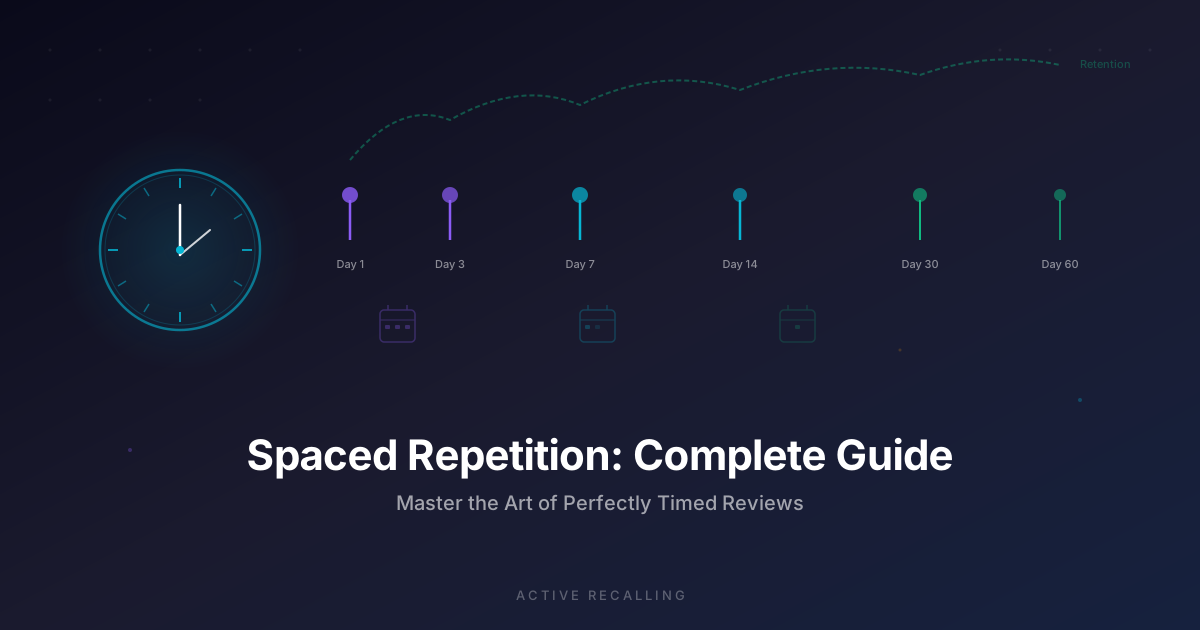
For manual review — a notebook, a spreadsheet, or a Leitner box — use expanding intervals after the day you first learn the material:
| Review | When | What it feels like |
|---|---|---|
| 1st review | 1 day after learning | Memory is fresh; retrieval feels easy |
| 2nd review | 3 days | You have to think harder, but you retrieve it |
| 3rd review | 1 week | The effort to recall strengthens the memory further |
| 4th review | 2 weeks | The concept feels well established |
| 5th review | 1 month | Retrieval is quick and confident |
| 6th review | 3 months | The material is locked into long-term memory |
The exact numbers matter less than the principle: each successful review earns a longer wait before the next one. If you miss an item at any stage, drop it back to the start of the sequence.
A 90-Day Schedule for Students
This schedule assumes you're studying roughly one semester's worth of material (history, biology, a language, etc.) and can dedicate 20–30 minutes a day to review plus any new learning time.
Days 1–14: Loading phase. Add 10–20 new cards per day. Review all due cards before adding new ones. Expect roughly 30 minutes of daily review by the end of week two.
Days 15–30: Stabilizing phase. Slow new card addition to 5–10 per day. Most of your time is now reviews, not new cards. Difficult cards will cycle through frequently — that's the system working.
Days 31–60: Cruise phase. Add new cards only for genuinely new topics. Daily review load should stabilize or decrease. Expect 15–20 minutes daily to clear your queue.
Days 61–90: Deep retention phase. Intervals are now weeks to months. Daily load is minimal. Run a full free-recall session (no cards) once a week to check for gaps the algorithm hasn't caught.
Exam week: Do not cram. Keep your normal daily review. Add one or two full practice tests under timed conditions. Sleep normally. You've already done the work.
Putting a Schedule Into Practice
Whichever schedule you choose, five habits determine whether it works:
1. Break material into discrete units. Spaced repetition works best when information is broken into small, self-contained pieces. Instead of reviewing an entire chapter, create individual items for each concept, definition, formula, or fact. Poor example: "Describe the cardiovascular system." Better example: "What is the primary function of the left ventricle?"
2. Create quality flashcards. Follow the minimum information principle — each card should contain the smallest meaningful piece of information. Use clear, unambiguous questions. Add context or imagery when it aids recall.
3. Start with short intervals. Begin reviewing new material within hours of first learning it. Your initial intervals should be short — same day, next day, then a few days later. As you demonstrate mastery, allow the intervals to expand naturally.
4. Be honest about your recall. Resist the temptation to peek at the answer before genuinely attempting to recall it. Rate your recall honestly; if you struggled, mark the item as difficult so it returns sooner. Self-deception undermines the entire system.
5. Stay consistent. Fifteen minutes daily is far more effective than two hours once a week. Build the habit of reviewing your due items every day, ideally at the same time.
Best Spaced Repetition Apps & Tools
Physical flashcards with the Leitner system offer a tactile, distraction-free study experience — writing cards by hand engages motor memory, which can aid encoding. But analog systems have limits: managing large decks becomes cumbersome, tracking intervals requires manual record-keeping, and carrying hundreds of cards is impractical. Digital tools automate the scheduling algorithm, track your performance, adapt intervals to your individual response patterns, and handle thousands of cards without physical bulk. The advantage is precision — algorithms can calculate optimal review times from your personal history in a way no manual system can match at scale.
Rather than ranking every tool, here's an honest comparison framework. Read our full spaced repetition apps compared post for feature-by-feature notes.
- Active Recalling — designed to combine spaced repetition with automatic flashcard, quiz, and mindmap generation from your own study material (PDFs, notes, URLs). Good fit if you don't want to build every card by hand.
- Anki — the most mature and flexible option, with SM-2 and FSRS support, rich add-ons, and a huge shared deck library. Steeper learning curve.
- RemNote / Obsidian + spaced-repetition plugins — note-first tools with built-in spaced review. Good fit if your notes already live there.
- Quizlet — gentle on-ramp for beginners, but its spaced algorithm is simpler than SM-2/FSRS.
- SuperMemo — the original. Most advanced algorithm, steepest UX.
Pick the one you'll open every morning without friction. The best app is the one you actually use.
Combining Spaced Repetition With Active Recall
Spaced repetition is a schedule. Active recall is the mechanism. Spacing alone — even the best algorithm in the world — doesn't help if every review is passive recognition instead of genuine retrieval. Together they form the most powerful evidence-based learning system available: spaced repetition tells you when to study, active recall tells you how.
The rule: every time a card comes up, actually try to produce the answer from memory before flipping. Out loud, on paper, or just in your head, but deliberately. A five-second honest attempt beats a one-second flip every time. You are not rereading your flashcard and thinking "yes, I knew that" — you are seeing a question, generating the answer from memory, and then checking whether you were correct.
This combination works because it leverages two separate memory-strengthening mechanisms simultaneously. Retrieval practice strengthens the memory trace each time you successfully recall information. Spacing ensures each retrieval event occurs at the optimal moment — difficult enough to be challenging, but not so long after the last review that the memory has fully decayed. A 2011 study by Karpicke and Blunt found that retrieval practice combined with spaced intervals produced the highest long-term retention across all conditions tested.
Real-World Applications
Medical education. Medical students face an enormous volume of factual information that must be retained for years, and spaced repetition has become a cornerstone study method in medical schools worldwide. Studies show that medical students using spaced repetition score significantly higher on board exams and retain clinical knowledge longer than peers using traditional methods.
Language learning. Vocabulary acquisition is perhaps the most natural application. Learning a new language requires memorizing thousands of words and phrases, and spaced repetition ensures each word is reviewed at the optimal interval. Platforms like Pimsleur have built their entire methodology around this principle.
Professional certifications. Whether you are studying for the bar exam, a CPA certification, or a technical credential, spaced repetition helps you manage a large volume of material efficiently by focusing review time on your weakest areas.
Lifelong learning. Anyone who reads nonfiction, attends conferences, or learns new skills can benefit. Creating flashcards from books you read or talks you attend transforms passive consumption into durable knowledge.
Common Mistakes to Avoid
Making cards too complex
Every card should test one atomic piece of knowledge. Multi-part cards break the algorithm — you'll get them "partially right" in ways the system can't interpret. If a card consistently takes more than 30 seconds to review, break it into smaller pieces.
Not starting soon enough
The first review should happen within hours of initial learning, not days later. The forgetting curve is steepest immediately after learning, so early reinforcement has the greatest impact.
Skipping or deleting difficult cards
If a card fails repeatedly, the card is usually the problem, not your brain. Those difficult items are precisely where spaced repetition delivers the most value. Reformulate the question, split it into two cards, or add a hint — keep making it better until it sticks.
Letting reviews pile up
A three-day gap turns a pleasant 15-minute session into a daunting 90-minute backlog. Do the daily review even if it's short. If you're accumulating a backlog, pause new cards, not reviews, until the load is manageable.
Chasing 100% retention
A target retention rate of around 85–90% is where spaced repetition is most efficient. Pushing for 100% dramatically increases your daily review load for diminishing returns.
Using spaced repetition for everything
It excels for factual knowledge, vocabulary, definitions, and procedural steps. It is less suited for skills that require deep conceptual understanding or creative application on their own — use it as one tool in a broader learning toolkit.
Frequently Asked Questions
What is the optimal spaced repetition schedule?
A common schedule is 1 day, 3 days, 1 week, 2 weeks, 1 month, and 3 months after initial learning. Modern algorithms like SM-2 (used in Anki) adjust intervals based on your performance on each card: successful recall extends the interval, a miss resets it. The exact numbers matter less than the principle of expanding intervals.
How is spaced repetition different from active recall?
Active recall is what you do — retrieve information from memory. Spaced repetition is when you do it — at gradually expanding intervals. Each one works alone, but they're dramatically more powerful together: spacing without retrieval degrades into passive review, and retrieval without spacing is less efficient.
Is Anki the best spaced repetition app?
Anki is the most customizable and free option, which is why it dominates medical and language-learning communities. However, it has a steep learning curve. Quizlet and Brainscape are friendlier for beginners, and AI-powered tools like Active Recalling can generate cards from your notes automatically, saving hours of manual creation.
Is FSRS better than SM-2?
FSRS tends to be more efficient — fewer reviews for the same retention — because it fits a probabilistic memory model to your review history instead of using a fixed formula. But the difference is small compared to the benefit of using spaced repetition in any form. Start with whatever your app defaults to and switch only if you run into real limits.
How many cards should I add per day?
Start with 10 to 20 new cards per day and drop that number if reviews become overwhelming — each new card generates multiple reviews over the following months. Most experienced users settle at 5–15 new cards per day, sustained for years. Medical students sometimes push to 50 or more, but they are full-time students; part-time learners should stay conservative.
How long does it take to see results from spaced repetition?
Most learners notice daily review fluency within a week and meaningful long-term retention gains within 3–4 weeks. The compounding benefits become very visible after a full semester.
What if I miss a few days?
Clear the backlog without adding new cards. Do not try to catch up by doing a double session — your retention will suffer and you'll burn out. A week-long break is survivable; a month-long one means some cards will need to be relearned.
Does spaced repetition work for conceptual subjects?
Yes, with the right card design. Instead of date-fact cards, write prompts like "Explain Kant's distinction between phenomena and noumena in your own words" and use your full-sentence answer as the back. Break concepts into atomic question-answer pairs and pair them with problem-solving practice. Combined with the Feynman technique, spaced repetition handles conceptual material well.
Can I use spaced repetition for anything besides flashcards?
Yes. The underlying principle — review at expanding intervals — works for essay prompts, math derivations, code patterns, and concept explanations. Flashcards are simply the most convenient packaging.
Can I use spaced repetition for language learning?
Language learning is the canonical use case. Pimsleur (1967) proposed one of the first formal spacing schedules for language acquisition, and today virtually every serious language-learning platform (Anki, Memrise, Lingodeer, Active Recalling) uses spaced repetition for vocabulary.
Start Today
The most important step is the first one. Open any study app, any notecard stack, any spreadsheet. Add ten cards from whatever you're currently learning. Review them tomorrow. Review them again in three days. That's spaced repetition — the method works because of the underlying cognitive science, not the specific tool.
Keep doing it, and in six months you'll know more, forget less, and study for less total time than the people still re-reading their notes. Spaced repetition is not a shortcut. It is simply the most efficient path between learning something and knowing it permanently.