
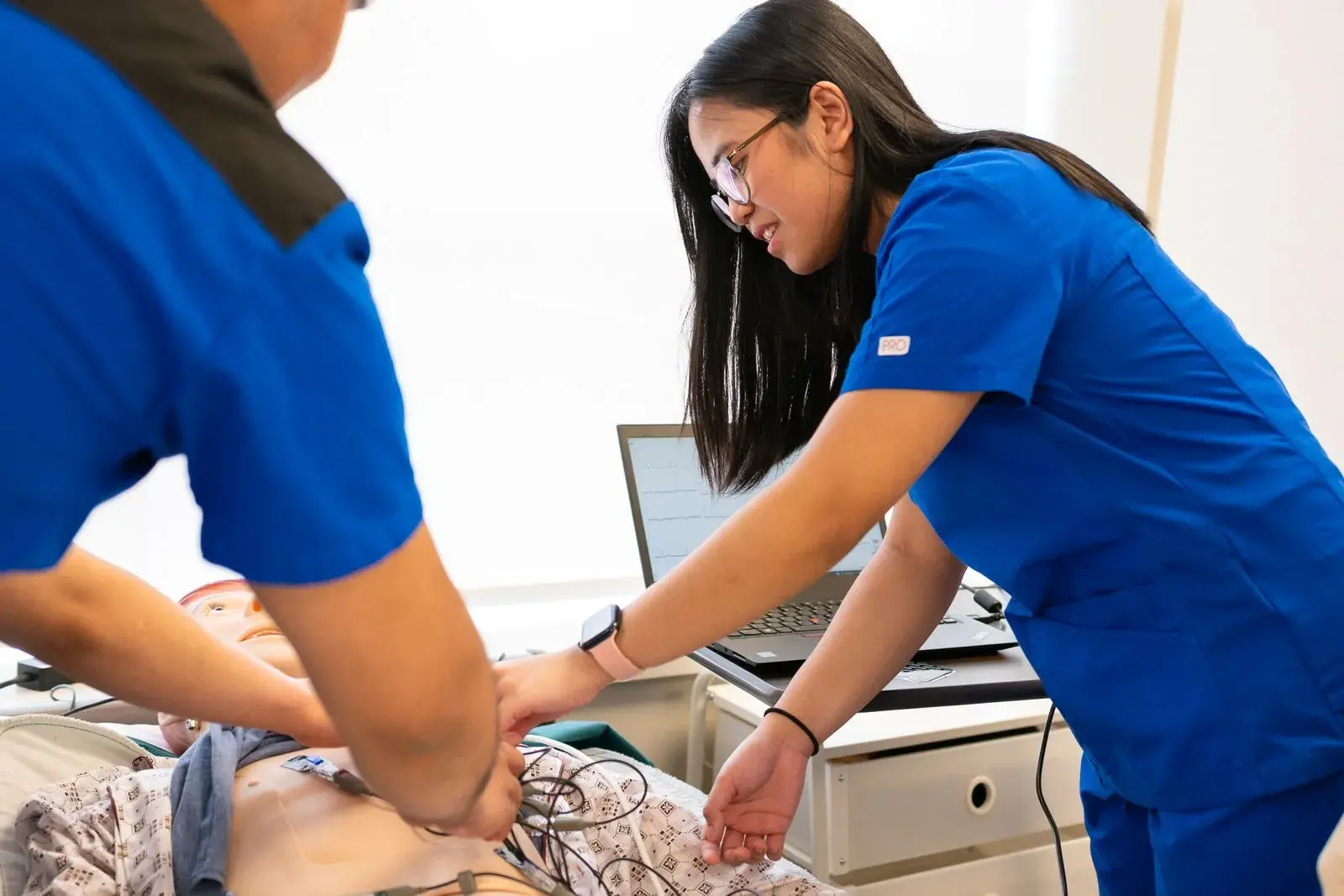
To study in nursing school, practice the decisions your exams test instead of trying to memorize every slide: what's abnormal, what's the priority, what you do first, and how you'll know it worked. In practice that means previewing before lecture, turning your notes into NCLEX-style questions the same day, learning medications and lab values with spaced flashcards, and doing practice questions every week from your first semester.
Nursing exams are written like the NCLEX, where most items are pitched at the application level or higher. Knowing the definition of hypoglycemia won't get you through a question about which client to see first. This guide gives you a method for turning any lecture into questions, a medication card template, an exam-week routine, and a sample weekly schedule.
Why do nursing school exams feel so different?
Most students arrive from prerequisite courses where knowing the material was enough. Nursing exams ask you to apply it to a client. NCSBN, which writes the NCLEX, says most of its items are written at the application level or higher, and many nursing programs write their exams in the same style.
| A prerequisite-style question | A nursing exam question |
|---|---|
| What is the normal range for serum potassium? | A client on furosemide has a potassium of 3.1 mEq/L. Which action should the nurse take first? |
| What are the signs of hypoglycemia? | Four clients are due for assessment. Which one should the nurse see first? |
| What does an ACE inhibitor do? | Which statement by a client taking lisinopril shows a need for more teaching? |
Three formats cause the most trouble:
- Priority questions ("first," "most important," "immediately"). Several answers are correct actions; only one comes first.
- Select all that apply (SATA). There's no fixed number of right answers.
- Teaching questions. You look for the statement that is wrong, which is easy to misread under time pressure.
The fix isn't more reading. It's practicing these exact formats from week one, which also means you'll be well into NCLEX preparation long before graduation.
How to turn a lecture into NCLEX-style questions
For each condition or topic in a lecture, write short questions that follow the six steps of NCSBN's clinical judgment model: recognize cues, analyze them, prioritize, generate solutions, take action, and evaluate outcomes. Then answer them from memory before the next class.
Here's a worked example from a diabetes lecture. The slide says: Hypoglycemia is blood glucose below 70 mg/dL; treat with 15 g of fast-acting carbohydrate and recheck in 15 minutes.
| Clinical judgment step | Your question | Answer |
|---|---|---|
| Recognize cues | A client with type 1 diabetes is shaky, sweaty, and confused before lunch. What do you check? | Fingerstick blood glucose |
| Prioritize | Which client do you see first: glucose 62 mg/dL and sweating, or glucose 250 mg/dL asking for a snack? | The client at 62 mg/dL |
| Take action | The client is awake and can swallow safely. What do you give? | 15 g of fast-acting carbohydrate, such as juice or glucose tablets |
| Take action | What if the client can't swallow safely? | Glucagon, or IV dextrose per protocol or order; don't give anything by mouth |
| Evaluate outcomes | When do you recheck, and what if glucose is still low? | Recheck in 15 minutes; repeat the treatment if it's still below 70 mg/dL |
Five questions take ten minutes to write and turn a passive slide into something you can test yourself on all semester. Our guide to writing good practice questions covers how to write wrong options that are tempting rather than silly. If you'd rather start from a draft, the AI quiz generator can turn a lecture PDF into multiple-choice questions you then edit and check against your notes.
Answering these from memory, rather than rereading the slide, is the point. Retrieval practice and spaced practice are the two study techniques rated "high utility" in a major review of learning research, and the active recall guide explains why.
How to study pharmacology in nursing school
Pharmacology is where most nursing students drown, because it looks like hundreds of unrelated drugs. It isn't. Learn the class through one prototype drug, then attach the rest of the class by suffix and differences.
Use the same card template for every class:
| Field | Example: lisinopril |
|---|---|
| Class and suffix | ACE inhibitor, "-pril" |
| What it does | Blocks the conversion of angiotensin I to angiotensin II, lowering blood pressure |
| Check before giving | Blood pressure; potassium and kidney function results |
| Watch for | Dry cough, angioedema (swelling of the face, lips, or tongue), high potassium, low blood pressure |
| Teach | Rise slowly; report any facial or tongue swelling right away |
Then do the same for the other high-yield classes. Three more in one line each:
- Metoprolol (beta blocker, "-olol"): check apical pulse and blood pressure before giving; watch for bradycardia and hypotension; hold per the order's parameters.
- Furosemide (loop diuretic): watch potassium, blood pressure, daily weight, and intake and output; low potassium is the classic exam answer.
- Heparin vs warfarin: heparin is monitored with aPTT (or anti-Xa) and reversed with protamine sulfate; warfarin is monitored with PT/INR and reversed with vitamin K.
Suffixes have exceptions, so treat them as a memory hook, not a rule. For memorable hooks beyond suffixes, see mnemonics and memory aids.
Practice dosage calculations separately, a few problems several times a week, rather than in one block before the math exam. Example: ordered 500 mg, available as 250 mg per 5 mL, so you give 10 mL. Calculation skill fades without practice, and a misplaced decimal is a medication error.
Use spaced flashcards for what has to be automatic
Some things have to come to mind instantly so your working memory is free for the clinical reasoning: lab values, drug classes, normal vital signs by age, isolation precautions, and A&P terms. Flashcards with spaced review handle these well.
- Keep cards small. One fact or one decision per card.
- Use your program's reference ranges. Lab ranges differ slightly between textbooks; your exams follow your course materials.
- Be careful with shared decks. Premade nursing decks can contain outdated or wrong cards. Check any card against your course materials before you trust it.
- Review daily, 20 to 30 minutes. A spaced repetition app decides which cards are due, so you see each one just before you'd forget it.
The evidence for self-testing in nursing prerequisites is direct. In a 2015 study in a university anatomy and physiology course, students who read a passage, recalled as much as they could, and then reread it retained more a week later than students who read it three times or reread it while taking notes. For more on scheduling, read the spaced repetition guide; for the A&P side, see how to study anatomy. If you're choosing an app, our comparison of flashcard apps for medical and nursing students covers the options.
How to study for nursing exams
Start one week out, and spend that week on questions rather than notes.
- Days 7 to 5: topic-by-topic practice questions on each lecture, 20 to 30 per topic. Untimed. Read every rationale, including for the ones you got right.
- Days 4 to 2: mixed, timed sets across all the exam's topics. Shuffled practice forces you to work out what a question is about before answering it, which is what the real exam demands.
- Day 1: review your error list and flashcards for the topics you missed most. Sleep.
Two habits make the biggest difference on test day:
- For SATA questions, treat each option as a true-or-false statement about the stem. Decide each one on its own; don't hunt for a pattern.
- For priority questions, use a fixed order: airway, breathing, circulation; physical needs before psychosocial ones (Maslow); acute before chronic; unstable before stable; actual problems before potential ones.
If you fail an exam, don't reread the whole unit. Go through the exam review, sort each miss into "didn't know it," "misread it," or "knew it but chose wrong," and fix the biggest category first.
Make clinicals and skills lab part of your studying
Clinical days are the best study material you'll get, because the questions come from a real client.
- Before clinical: look up your client's diagnoses and every scheduled medication using the card template above.
- After clinical: write three questions from your client. "What finding would have made me call the provider?" "Why was this med held?" "What did I teach, and how did I check they understood?"
- Skills lab: say the steps of a procedure out loud from memory, then do it while a partner checks the checklist. Recall first, checklist second.
A weekly study schedule for nursing school
This assumes two lecture courses, one clinical day, and one skills lab. Adjust the hours to your load; keep the structure.
| Day | Study tasks |
|---|---|
| Monday | Lecture 1. Same day: write 5 to 10 questions from your notes. Flashcards (20 min). |
| Tuesday | Lecture 2. Same day: questions. Answer Monday's questions from memory. Flashcards. |
| Wednesday | Clinical prep: look up your client's diagnoses and meds. Flashcards. |
| Thursday | Clinical day. Evening: write three questions from your client. |
| Friday | Skills lab. Answer this week's questions without notes. 10 dosage-calculation problems. |
| Saturday | 30 to 60 NCLEX-style questions on this week's content. Log every miss. Add cards for missed facts. |
| Sunday | Rest, or a 20-minute review of the week's missed questions only. Preview next week's objectives. |
Protect the rest day. Nursing school is long, and a plan you can sustain beats a heroic week followed by a crash; our burnout prevention guide has warning signs to watch for.
Frequently asked questions
How many hours a day should I study in nursing school?
There's no fixed number, because course loads differ, but most full-time students need study time every day rather than long weekend sessions. Plan in tasks instead of hours: same-day questions after each lecture, 20 to 30 minutes of flashcards, clinical prep, and one weekly block of practice questions. If you're scoring well on practice questions, the hours are enough.
What is the best way to study pharmacology in nursing school?
Learn drugs by class, not one by one. For each class, learn one prototype drug with a fixed template: suffix, what it does, what to check before giving, what to watch for, and what to teach. Attach the other drugs in the class by suffix and differences. Review the cards daily on a spaced schedule and practice medication questions every week.
Should I do NCLEX questions in nursing school?
Yes, from your first semester. Nursing exams use the same priority, select-all-that-apply, and teaching formats, and practicing them early builds the clinical judgment that later NCLEX preparation depends on. Choose questions that match what you covered that week, and spend at least as long reviewing the rationales as answering the questions.
How do I answer select-all-that-apply questions?
Read the stem carefully, then judge each option on its own as a true or false statement about that stem. Don't assume a set number of correct answers or look for patterns. If an option is correct only in a different situation, it's false here. Practice SATA questions weekly so the format stops feeling like a trick.
What should I do after failing a nursing exam?
Book the exam review, then sort every miss into three groups: didn't know the content, misread the question, or knew it but chose the wrong priority. Fix the largest group first, with content review, slower reading, or priority practice as needed. Then add weekly practice questions so the next exam isn't the first time you see the format.
Sources and further reading
Start with the primary research and official guidance below. Links open in a new tab so you can compare the evidence with the article.
- Read source
2026 NCLEX-RN Test Plan
NCSBN, 2026
- Read source
Improving students' learning with effective learning techniques
Dunlosky et al., Psychological Science in the Public Interest, 2013
- Read source
Self-testing promotes superior retention of anatomy and physiology information
Dobson & Linderholm, Advances in Health Sciences Education, 2015
- Read source
Test-enhanced learning: Taking memory tests improves long-term retention
Roediger & Karpicke, Psychological Science, 2006
- Read source
Hypoglycemia (low blood glucose)
American Diabetes Association