What Are Mnemonics?
Mnemonics are memory aids — techniques that help you encode, store, and retrieve information more effectively by transforming it into a form that your brain finds easier to remember. The word comes from the Greek goddess of memory, Mnemosyne, and humans have been using mnemonic techniques for thousands of years.
At their core, all mnemonics work by exploiting the same principle: your brain remembers some types of information far better than others. Vivid images, patterns, stories, rhymes, and spatial relationships are all naturally sticky in memory. Abstract facts, random sequences, and disconnected data points are not. Mnemonics bridge the gap by converting the hard-to-remember into the easy-to-remember.
This isn't a shortcut or a gimmick. Research in cognitive science consistently shows that mnemonic techniques lead to significantly better recall than rote memorization alone. A meta-analysis published in the journal Memory and Cognition found that mnemonic strategies improved memory performance by an average of 50 to 75 percent compared to control conditions. The techniques work because they leverage the way human memory actually operates rather than fighting against it.
The key is choosing the right mnemonic for the right type of information. Different techniques suit different learning tasks, and understanding when to use each one is just as important as knowing how.
Acronyms: When You Need to Remember a List
An acronym is a word formed from the first letters of a series of words you want to remember. It compresses a list into a single, pronounceable chunk that serves as a retrieval cue for the full set of items.
Classic Examples
ROYGBIV represents the colors of the visible light spectrum: Red, Orange, Yellow, Green, Blue, Indigo, Violet. PEMDAS helps math students remember the order of operations: Parentheses, Exponents, Multiplication, Division, Addition, Subtraction. SMART goals stand for Specific, Measurable, Achievable, Relevant, Time-bound.
How to Create Effective Acronyms
Start by listing the items you need to remember and writing down their first letters. Then try to arrange them into a pronounceable word. If the natural order of letters doesn't form a word, see if reordering the items is acceptable (it works for unordered lists but not for sequences).
If no real word emerges, you can create a pseudo-word — something that sounds like it could be a word even if it isn't. "CRISPR" (Clustered Regularly Interspaced Short Palindromic Repeats) is a scientific example of this. The pronounceability is what matters, not whether it appears in a dictionary.
When Acronyms Work Best
Acronyms are ideal for short lists (three to eight items) where you need to remember all the components but not necessarily a lot of detail about each one. They're less useful for long lists, where the acronym itself becomes hard to remember, or for information that requires understanding relationships between items.
Limitations
Acronyms tell you the first letter of each word, but they don't always help you recall the full word. If "P" could stand for "Parentheses" or "Powers," the acronym alone won't resolve the ambiguity. For this reason, acronyms work best when the items are already somewhat familiar — the acronym serves as a trigger for knowledge that's already partially encoded.
Acrostics: Turning Lists into Sentences
An acrostic is a sentence or phrase where the first letter of each word corresponds to the first letter of each item you want to remember. Unlike acronyms, acrostics create a complete, memorable sentence, which makes them better suited for longer lists and sequences where order matters.
Classic Examples
"Every Good Boy Does Fine" represents the notes on the lines of the treble clef: E, G, B, D, F. "My Very Excellent Mother Just Served Us Nachos" encodes the order of the planets: Mercury, Venus, Earth, Mars, Jupiter, Saturn, Uranus, Neptune. "King Philip Came Over For Good Spaghetti" represents the taxonomic hierarchy: Kingdom, Phylum, Class, Order, Family, Genus, Species.
How to Create Effective Acrostics
Write down the first letters of your list in order. Then create a sentence using words that start with those letters. The best acrostics are vivid, humorous, or personally meaningful. A sentence that makes you laugh or creates a strong mental image will be remembered far better than a bland one.
For example, to remember the geological time periods (Precambrian, Paleozoic, Mesozoic, Cenozoic), you might create: "Purple Parrots Make Cupcakes." The sillier and more visual the sentence, the better it sticks.
When Acrostics Work Best
Acrostics excel when you need to remember items in a specific order and when the list is too long for a clean acronym. They're widely used in medical and scientific education, where students must memorize sequences of anatomical structures, diagnostic criteria, or procedural steps.
Rhymes and Songs: Leveraging Auditory Memory
Rhyming mnemonics use the natural memorability of rhythm and rhyme to encode information. You probably still remember rhymes you learned as a child, and that persistence demonstrates how powerfully auditory patterns anchor memories.
Classic Examples
"In fourteen hundred ninety-two, Columbus sailed the ocean blue" encodes a historical date. "Thirty days hath September, April, June, and November" helps with calendar recall. "I before E, except after C" is a (mostly reliable) spelling rule.
Why Rhymes Work
Rhymes work for several reasons. First, the rhythm creates a predictable pattern that constrains what can come next, making recall easier — if you remember "ninety-two," the rhyme scheme practically forces "ocean blue" to follow. Second, rhymes are often musical, and music activates multiple brain regions simultaneously, creating richer memory traces. Third, rhymes are fun, and positive emotional engagement enhances memory formation.
Creating Your Own Rhymes
You don't need to be a poet. Simple couplets are enough. Identify the key facts you need to remember and find words that rhyme with the critical terms. The rhyme doesn't need to be elegant — it just needs to be memorable.
For chemistry, you might create: "When diluting acid, here's what you oughta: always add the acid to the water." It's not Shakespeare, but it's effective and potentially safety-critical.
Setting Information to Music
Taking rhymes a step further, you can set information to familiar tunes. Singing the bones of the body to the tune of a popular song or reciting mathematical formulas to a familiar melody leverages the deep neural pathways created by music. Many people find that information learned through song is recalled effortlessly even years later.
The Keyword Method: Bridging Unfamiliar to Familiar
The keyword method is a two-step mnemonic particularly effective for learning foreign language vocabulary, unfamiliar terminology, and name-fact associations.
How It Works
Step 1: Find a keyword. Identify a word in your native language that sounds similar to the word you're trying to learn. It doesn't need to be an exact match — a rough phonetic similarity is enough.
Step 2: Create a vivid mental image. Form a mental picture that connects the keyword to the meaning of the target word.
A Detailed Example
Suppose you're learning the Spanish word "pato", which means "duck." Step 1: "Pato" sounds like "pot." That's your keyword. Step 2: Imagine a duck wearing a cooking pot on its head like a helmet, waddling around your kitchen. The image is absurd, which makes it memorable.
Now when you encounter "pato," your brain follows the chain: pato sounds like pot, pot triggers the image of the duck wearing a pot, duck is the meaning. With practice, this chain becomes automatic and eventually unnecessary as the direct association strengthens.
Research Support
The keyword method has been extensively studied. Research by Atkinson and Raugh in the 1970s showed that students using the keyword method recalled nearly twice as many foreign vocabulary words as students using rote memorization. Subsequent studies have confirmed these findings across multiple languages and age groups.
When the Keyword Method Works Best
This technique is particularly powerful for vocabulary learning in any language, for learning scientific terminology (linking unfamiliar Latin or Greek roots to familiar English words), and for name learning (associating a person's name with a visual feature or characteristic).
It's less suited for abstract concepts or information that doesn't lend itself to concrete imagery. And it requires an initial investment of creative effort that some students find demanding. But the payoff in retention is substantial.
The Peg System: Memorizing Ordered Lists
The peg system is a mnemonic for remembering numbered lists. It works by pre-memorizing a set of "peg words" — one for each number — and then associating each list item with its corresponding peg word through vivid mental imagery.
The Number-Rhyme Peg System
The simplest version uses words that rhyme with each number:
- 1 = Sun (one-sun)
- 2 = Shoe (two-shoe)
- 3 = Tree (three-tree)
- 4 = Door (four-door)
- 5 = Hive (five-hive)
- 6 = Sticks (six-sticks)
- 7 = Heaven (seven-heaven)
- 8 = Gate (eight-gate)
- 9 = Vine (nine-vine)
- 10 = Hen (ten-hen)
How to Use It
Once you've memorized the peg words (which only takes a few minutes), you can use them to remember any ordered list. For each item, create a vivid mental image linking the item to its peg word.
For example, if you need to remember a list where the first item is "constitution" and the second is "economics," you might imagine: (1) A giant sun wearing a powdered wig, signing the Constitution. (2) A shoe overflowing with gold coins and dollar bills.
The beauty of the peg system is that it gives you random access. If someone asks "what was item number 7?", you immediately think "seven-heaven" and retrieve the associated image. You don't need to mentally recite the entire list to reach the seventh item, unlike most sequential memory strategies.
The Number-Shape Peg System
An alternative version uses images that look like each number:
- 1 = Candle (a candle looks like the number 1)
- 2 = Swan (a swan's neck curves like a 2)
- 3 = Handcuffs (the two loops of handcuffs look like a 3)
- 4 = Sailboat (a sailboat viewed from the side resembles a 4)
Choose whichever system feels more natural and memorable to you. The important thing is that the peg words are thoroughly memorized so they come to mind instantly when you think of each number.
When the Peg System Works Best
The peg system is ideal for numbered lists where order and position matter. It's used by memory competitors, students memorizing ranked lists or sequential processes, and professionals who need to recall items by number. It's less useful for unordered information or for lists longer than your set of pegs (though advanced practitioners create peg lists of 100 or more items).
Choosing the Right Mnemonic
Different situations call for different techniques. Here's a guide to matching mnemonics with learning tasks:
For short unordered lists (3-8 items): Use acronyms. Quick to create, easy to recall.
For ordered sequences: Use acrostics or the peg system. Acrostics for sequences you'll always recall in order; the peg system when you need random access by number.
For foreign vocabulary: Use the keyword method. Its phonetic bridging approach is specifically designed for this purpose.
For dates, rules, and facts: Use rhymes. The auditory pattern provides a strong retrieval cue.
For large bodies of structured information: Combine techniques. Use acronyms for top-level categories, acrostics for ordered subcategories, and the keyword method for unfamiliar terminology within each category.
Making Mnemonics Work Long-Term
Creating a mnemonic is only the first step. To ensure the information stays accessible, you need to practice retrieval. Use your mnemonics during active recall sessions — quiz yourself, cover your notes and try to reconstruct the information using only the mnemonic cue.
Combine mnemonics with spaced repetition for maximum effectiveness. Review your mnemonic associations at increasing intervals. The mnemonic provides an efficient retrieval pathway, and spaced repetition ensures that pathway remains strong over time.
Also remember that mnemonics are a bridge, not a destination. The goal is to eventually know the information so well that you no longer need the mnemonic. "ROYGBIV" might help you initially, but after enough practice, you'll simply know the spectrum colors directly. The mnemonic served its purpose by providing scaffolding during the learning process.
Conclusion
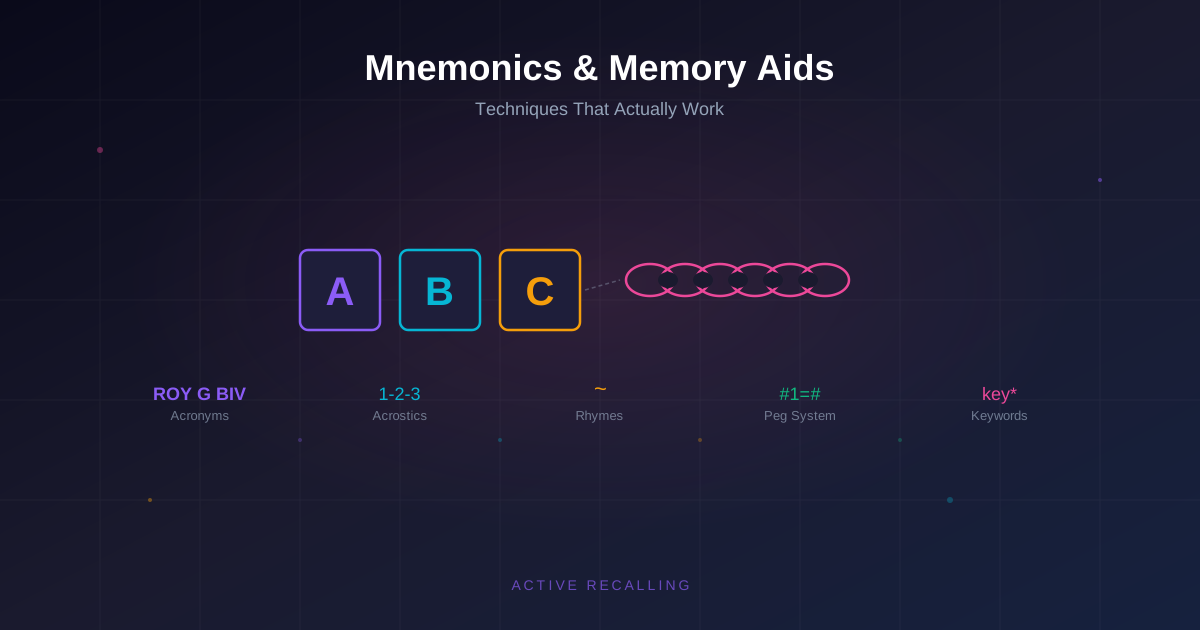
Mnemonics are among the most practical and immediately useful tools in any student's arsenal. They transform the hard work of memorization into a creative exercise that engages your imagination and leverages the natural strengths of your memory system. Acronyms compress lists into retrievable chunks. Acrostics turn sequences into memorable sentences. Rhymes harness the power of auditory patterns. The keyword method bridges the unfamiliar to the familiar. And the peg system gives you numbered hooks for ordered information.
The best mnemonic is the one you actually create and use. Don't just read about these techniques — apply them to whatever you're currently studying. The small investment of time required to craft a good mnemonic pays enormous dividends in recall accuracy and study efficiency. Start with one technique, practice it until it feels natural, and then add others to your toolkit as needed.