
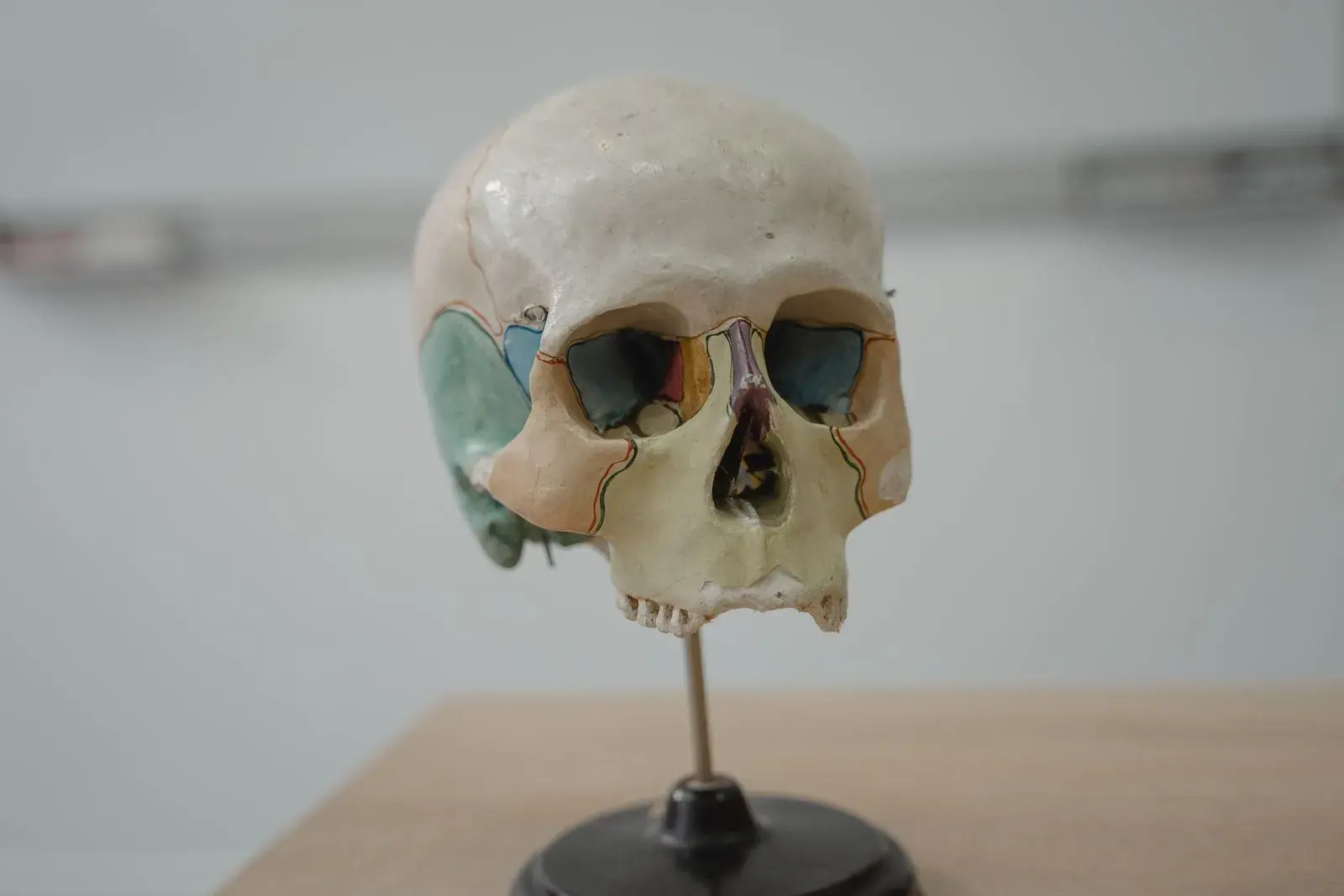
To memorize the cranial nerves, learn the 12 names in order with one mnemonic, add a second mnemonic for which nerves are sensory, motor, or both, then group the nerves by what they do and drill them with flashcards that ask in every direction. Spread it over about a week with spaced reviews, because reciting "Oh Oh Oh" isn't the same as knowing that a drooping eyelid points to CN III.
Twelve nerves, twelve Roman numerals, and three names that start with O. It's a lot at first. The good news? The nerves follow patterns, and once you've seen them the list shrinks fast. You're aiming for the moment a lab practical tags a nerve, or an examiner says "follow my finger" and watches a patient's eyes, and you know which nerves are being tested.
Below you'll find a reference table, the mnemonics worth keeping, card templates, common mistakes, and a 7-day plan. For your wider anatomy method, see how to study anatomy.
What are the 12 cranial nerves?
There are 12 pairs, numbered I to XII. Ten arise from the brainstem; the olfactory and optic nerves begin in the cerebrum. Here's the whole set on one screen. Don't try to swallow it in one sitting: read it once, then let the mnemonics and cards do the heavy lifting.
| No. | Nerve | Type | Main job |
|---|---|---|---|
| I | Olfactory | Sensory | Smell |
| II | Optic | Sensory | Vision |
| III | Oculomotor | Motor | Moves the eye (four of six muscles), lifts the eyelid, constricts the pupil |
| IV | Trochlear | Motor | Superior oblique muscle (helps you look down) |
| V | Trigeminal | Both | Feeling in the face and mouth; chewing |
| VI | Abducens | Motor | Lateral rectus muscle (turns the eye outward) |
| VII | Facial | Both | Facial expression; taste from the front two-thirds of the tongue; tears and saliva |
| VIII | Vestibulocochlear | Sensory | Hearing and balance |
| IX | Glossopharyngeal | Both | Taste from the back third of the tongue; swallowing; parotid saliva |
| X | Vagus | Both | Throat and voice muscles; parasympathetic supply to the chest and abdomen |
| XI | Accessory | Motor | Sternocleidomastoid and trapezius: turning the head, shrugging |
| XII | Hypoglossal | Motor | Moving the tongue |
That's the traditional classification. A few "motor" nerves also carry parasympathetic fibers (CN III constricts the pupil), but you'll add that detail later.
Mnemonics for the cranial nerve names in order
Why use a silly sentence for something this serious? Because a strange sentence sticks, and twelve Greek and Latin names in a row don't. Pick one and don't switch:
- "Oh Oh Oh To Touch And Feel Very Good Velvet, Such Heaven." Olfactory, Optic, Oculomotor, Trochlear, Trigeminal, Abducens, Facial, Vestibulocochlear, Glossopharyngeal, Vagus, Spinal accessory, Hypoglossal. It's an odd thing to say about velvet, and that's exactly why it works.
- "On Old Olympus's Towering Top, A Finn And German Viewed Some Hops." Here "And" is VIII under its older name, the auditory nerve, so the velvet version maps more cleanly to "vestibulocochlear."
In both, "Such" or "Some" is the spinal accessory nerve. Stuck on the middle of the list? Try these hooks:
- I, II, III: smell, see, steer.
- VII to X run face, ear, throat, then deeper. Glossopharyngeal even names its territory: glosso = tongue, pharyngeal = throat.
- XII is "hypo-glossal": under the tongue. It's the tongue mover.
Think of the sentence as training wheels: they're meant to come off. Quiz yourself on what each word stands for, out of order, until you don't need it. Our guide to mnemonics and memory aids covers where acrostics help and where they'll let you down.
Mnemonic for sensory, motor, or both
Once the names are in, the next quiz question's always the same: sensory, motor, or both? The classic answer key gives one word per nerve, where S = sensory, M = motor, and B = both:
"Some Say Money Matters, But My Brother Says Big Brains Matter Most."
Decoded: I S, II S, III M, IV M, V B, VI M, VII B, VIII S, IX B, X B, XI M, XII M.
You don't have to memorize twelve letters, though. There's a shortcut. Learn three patterns:
- Three sensory nerves: I, II, VIII. Smell, sight, and hearing with balance. They don't move anything; they only bring information in.
- Four mixed nerves: V, VII, IX, X. An odd run (5, 7, 9) plus 10.
- The rest are motor: the three eye movers (III, IV, VI) and the last two (XI, XII).
How to remember what each cranial nerve does
Picture a bedside neuro exam. You'll watch the patient identify a smell, read a chart, follow a finger, clench their jaw, smile, listen, swallow, shrug, and stick out their tongue. That's more or less the whole set, top to bottom. Walk down the head the same way:
- Nose: I smells.
- Eyes: II sees. III, IV, and VI move the eye; III also lifts the eyelid and constricts the pupil.
- Face: V feels the face and chews. VII moves the face, tastes the front of the tongue, and drives tears and saliva.
- Ear: VIII hears and balances.
- Throat: IX tastes the back of the tongue and helps you swallow. X runs the throat and voice muscles and carries parasympathetic fibers to the heart, lungs, and gut.
- Neck and shoulder: XI turns the head (sternocleidomastoid) and shrugs the shoulder (trapezius).
- Tongue: XII moves it.
The eye movers: LR6(SO4)3
When an examiner says "follow my finger," they're testing three nerves at once. Write the split like a chemical formula: LR6(SO4)3. It might be the only chemistry you'll be happy to see in anatomy.
- LR6: lateral rectus is supplied by CN VI, the abducens. Abducens sounds like abduct, and that's its job: turning the eye outward.
- SO4: superior oblique is supplied by CN IV, the trochlear. "SO4" looks like sulfate, so it's hard to swap.
- 3: everything else is CN III, the oculomotor: superior, inferior, and medial rectus, inferior oblique, and the levator that lifts the eyelid.
It also explains a complete CN III palsy: only the lateral rectus and superior oblique still pull, so the eye rests "down and out," with a drooping lid.
The four mixed nerves
Give V, VII, IX, and X one extra card each that asks for both halves of the job. Why bother? Exams love asking for the half you've forgotten. For V, that's feeling in the face (through three divisions: ophthalmic, maxillary, mandibular) plus the chewing muscles.
Optional extra: where the nerves leave the brainstem
Does your course test brainstem levels? Then you'll want the 2-2-4-4 pattern:
- 2 above the brainstem: I and II begin in the cerebrum.
- 2 in the midbrain: III and IV.
- 4 in the pons: V to VIII, whose nuclei sit in the pontine tegmentum.
- 4 in the medulla: IX to XII, whose rootlets attach there.
It's a rough map, not an exact exit list: the spinal part of XI comes from the upper spinal cord in the neck. One fact deserves its own card: CN IV is the only cranial nerve that leaves the back (dorsal side) of the brainstem. It's also the smallest cranial nerve, with the longest course inside the skull. Smallest nerve, longest commute.
For skull exits, start with one trio: IX, X, and XI all leave through the jugular foramen.
How to turn the cranial nerves into flashcards
Here's the trap with a list you can only recite in order: it falls apart the moment a question starts at CN IX. Good cards come at each nerve from several directions. You'll find the general rules in how to use flashcards effectively.
| Direction | Front | Back |
|---|---|---|
| Number to name | CN IX? | Glossopharyngeal |
| Name to number | Abducens is CN...? | VI |
| Function to nerve | Which nerve lets you chew? | V (trigeminal) |
| Muscle to nerve | Superior oblique? | IV (trochlear) |
| Lesion to nerve | Drooping eyelid, eye down and out? | III (oculomotor) |
Lesion cards that match exam questions
Board-style questions usually start with a patient, not a number, so you'll want cards that start from the finding:
- One eye can't turn outward. Which nerve and muscle? CN VI, lateral rectus.
- Weakness of the muscles of facial expression on one side. CN VII.
- Taste lost on the front two-thirds of the tongue. CN VII. The back third? CN IX.
- Weak shoulder shrug and trouble turning the head. CN XI.
- The tongue points to the left when stuck out. Left CN XII. With a lesion of the nerve itself, it deviates toward the weak side; a lesion higher in the brain can push it the other way.
When to review
A reasonable starting schedule: the day after you learn the set, then about 3 days, a week, two weeks, and a month later. Any card you've missed goes back to the start. Shuffle, so the nerves don't show up in order.
Does this actually pay off? There's some evidence it does. In a survey of 72 medical students at one school, the number of unique Anki cards a student had seen predicted their USMLE Step 1 score after accounting for MCAT score and grades: about one extra point per 1,700 unique cards. It's a correlation, not an experiment. Spaced repetition in medical school shows how to fit these cards into a bigger deck.
If your lecture slides are a PDF with selectable text, Active Recalling's PDF to flashcards tool can draft cards from them; edit each so it tests one relationship. For other options, see our comparison of flashcard apps for medical students.
Common mistakes when memorizing cranial nerves
Here's the fix for each:
- VII or IX for taste? Think "lower number, front of the tongue": VII takes the front two-thirds, IX the back third.
- IV or VI for the eye muscles? Write LR6(SO4)3 at the top of every blank table until you can't get it wrong.
- Calling VIII mixed because it does two jobs. Hearing and balance are both sensory, so VIII isn't mixed. The vagus (X) is the mixed one; the accessory (XI) is motor.
- Only practicing in order. If you can only reach CN X by counting up from I, you don't really know it yet.
- Stopping at the mnemonic. It gets you the names, and that's it. Exams test functions and lesions, so most of your cards should too.
- Learning everything on day one. Fiber types, nuclei, and foramina can wait until the table's solid.
A 7-day plan to memorize the cranial nerves
You'll need twenty to thirty minutes a day, plus any cards that come due. Start each session by writing the list from memory.
| Day | Focus | Recall task |
|---|---|---|
| 1 | Names in order | Learn one names mnemonic. Write I to XII from memory three times. Make number-to-name cards both ways. |
| 2 | Sensory, motor, or both | Learn the modality mnemonic. Fill a blank table (number, name, type) from memory. |
| 3 | Senses and eye movers | I, II, VIII, then III, IV, VI with LR6(SO4)3. Sketch the six eye muscles and label each nerve. |
| 4 | Face, throat, neck, tongue | V, VII, IX, X, XI, XII. Make the mixed-nerve cards and the taste split. |
| 5 | Lesions | Write 8 to 10 lesion-to-nerve cards. Try a few clinical vignettes from your question bank. |
| 6 | Whole table, out of order | Fill the full table cold in random order. Fix only the misses. Add the brainstem map if needed. |
| 7 | Self-test | Do the 12 questions below without notes. Then spaced review takes over. |
Studying for boards? Slot this week into your USMLE Step 1 study plan. Nursing students can use it for the neuro assessment unit alongside these nursing school study techniques.
Self-test: 12 questions
Cover the table, answer from memory, then check:
- What's CN VII?
- Which number is the glossopharyngeal nerve?
- Which three cranial nerves are purely sensory?
- Which four are mixed?
- Which nerve supplies the lateral rectus?
- Which nerve supplies the superior oblique?
- Which nerve carries taste from the back third of the tongue?
- Which nerve lets you chew?
- A drooping eyelid and an eye that rests down and out point to which nerve?
- The tongue deviates to the right when stuck out, from a nerve lesion. Which nerve, which side?
- Which three nerves leave the skull through the jugular foramen?
- Which cranial nerve is the only one to leave the head and neck?
Anything you've missed becomes a flashcard today.
Frequently asked questions
What is the easiest way to memorize the cranial nerves?
Learn the names in order with one mnemonic and the sensory, motor, or both pattern with a second. Then group the nerves by job and drill them with flashcards in random order, including lesion cards. Short daily sessions over a week tend to stick better than one long cram, and they're easier to fit in.
What is the mnemonic for the 12 cranial nerves?
A widely used one is "Oh Oh Oh To Touch And Feel Very Good Velvet, Such Heaven": olfactory, optic, oculomotor, trochlear, trigeminal, abducens, facial, vestibulocochlear, glossopharyngeal, vagus, spinal accessory, hypoglossal. Another classic, "On Old Olympus's Towering Top, A Finn And German Viewed Some Hops," uses "auditory" for the eighth nerve. Pick one, and practice until you don't need it.
What is the mnemonic for sensory and motor cranial nerves?
"Some Say Money Matters, But My Brother Says Big Brains Matter Most." Each word's first letter gives one nerve in order: S for sensory, M for motor, B for both. It decodes as S, S, M, M, B, M, B, S, B, B, M, M, which means three sensory nerves, four mixed ones, and five that are motor.
How long does it take to memorize the cranial nerves?
You can usually learn the names and types in one or two short sessions. It'll take about a week of 20 to 30 minute sessions to know functions and lesions well enough for an exam, then spaced reviews. You'll forget some details after the first week. That's normal, and each review brings them back faster.
Which cranial nerves control eye movement?
Three: the oculomotor (III), trochlear (IV), and abducens (VI). It's easiest with LR6(SO4)3: the lateral rectus is supplied by VI, the superior oblique by IV, and the remaining eye muscles by III. The oculomotor nerve also lifts the eyelid and constricts the pupil, so when it's damaged, a drooping eyelid can come with the double vision.
Sources and further reading
Start with the primary research and official guidance below. Links open in a new tab so you can compare the evidence with the article.
- Read source
Neuroanatomy, Cranial Nerve
Sonne, Omole & Lopez-Ojeda, StatPearls (NCBI Bookshelf), 2025
- Read source
Cranial Nerve III Palsy (Oculomotor Palsy)
Modi & Singh, StatPearls (NCBI Bookshelf), 2026
- Read source
Neuroanatomy, Cranial Nerve 4 (Trochlear)
Kim, Motlagh & Naqvi, StatPearls (NCBI Bookshelf), 2023
- Read source
Cranial nerves: Anatomy, names, functions and mnemonics
Kenhub, 2023
- Read source
Brainstem: Location, anatomy, parts, function
Kenhub, 2026
- Read source
Cranial Nerves: Function, Anatomy & Location
Cleveland Clinic, 2024
- Read source
Hypoglossal nerve palsy
Radiopaedia, 2026
- Read source
Student-directed retrieval practice is a predictor of medical licensing examination performance
Deng, Gluckstein & Larsen, Perspectives on Medical Education, 2015