

Spaced repetition works in medical school when your daily review load is small enough that you never skip a day. In practice that means adding 20 to 40 new Anki cards a day during preclinical years, doing every due review, turning on the FSRS scheduler at its default 90% retention target, and treating flashcards as support for question banks rather than a replacement.
The catch is that every new card brings reviews with it. The Anki manual's rule of thumb is that learning 20 new cards a day leads to roughly 200 reviews a day once your deck matures. This guide covers what the research shows, how many new cards to add in each phase of school, the Anki settings that matter, AnKing versus your own cards, and how to recover when reviews pile up.
It assumes you're using Anki, as most medical students do. If you're still choosing an app, or want to compare RemNote, Brainscape and AI card generators, start with our best flashcard apps for medical students.
Does spaced repetition help in medical school?
Every study on this is observational, so motivated students who use Anki may simply be motivated students. But the pattern is consistent:
| Study | Who | What they found |
|---|---|---|
| Deng et al., 2015 | 72 students at one US school | After controlling for MCAT and grades, each ~1,700 unique Anki cards was linked to about one extra Step 1 point, and each ~445 practice questions to one point |
| Wothe et al., 2023 | 165 students, University of Minnesota | Daily Anki users had higher Step 1 scores, but not higher Step 2 CK scores |
| Gilbert et al., 2023 | 130 first-year students, Wright State | Anki users scored higher on all four exams studied, including 12.9% higher on the NBME Comprehensive Basic Science Exam |
| Frappa et al., 2026 | Systematic review of 11 studies | Consistent link with Step 1 performance; mixed results for in-house course exams |
Two lessons follow. First, spaced repetition helps most with large bodies of foundational facts, which is what Step 1 and the basic science years test. Second, in the Deng study practice questions were the stronger predictor per item. Cards keep facts available; questions teach you to use them.
Step 1 has been reported as pass/fail only since January 26, 2022. The foundational knowledge still has to be there for Step 1, shelf exams, and Step 2 CK, which is still scored, so retention remains the job. For the timeline around those exams, see the Step 1 study plan and Step 2 CK study plan.
How many new Anki cards a day in medical school?
Pick the number from the review load you can sustain, not from what classmates do. The Anki manual's estimate is about ten reviews a day for every daily new card once a steady state is reached:
Daily reviews you take on with each new-card limit
Approximate daily reviews once you've been adding cards at a steady rate for a while
Illustrative model: the Anki manual's rule of thumb (20 new cards a day ≈ 200 reviews a day) scaled linearly. Real loads vary with retention target, card difficulty, and deck age.
Source: Anki Manual, Deck Options
View data
| New cards per day | Reviews per day |
|---|---|
| 10 | 100 |
| 20 | 200 |
| 30 | 300 |
| 40 | 400 |
| 60 | 600 |
At about 10 seconds a card, 300 reviews is close to an hour before you've learned anything new. That's why the starting points below are modest:
| Phase | New cards a day | What drives the cards |
|---|---|---|
| Preclinical (MS1 to MS2) | 20 to 40 | This week's lectures, or the matching AnKing tags |
| Dedicated Step 1 study | 0 to 20 | Mostly reviews; new cards only for concepts you miss in questions |
| Clerkships | 10 to 30 | Shelf and Step 2 CK content for the current rotation |
| Dedicated Step 2 CK study | Low | Question-bank misses only |
Use one simple rule: if reviews ever push you to skip a day, cut new cards until they don't. The Anki manual gives the same advice for backlogs.
The Anki settings that matter for medical school
You don't need an elaborate setup. These come straight from the Anki manual:
- Turn on FSRS. It's supported in Anki and AnkiMobile 23.10 and later, AnkiDroid 2.17 and later, and AnkiWeb. It predicts when you'll forget each card from your own review history. Our FSRS vs SM-2 comparison explains the difference.
- Keep desired retention at 90%. The manual calls it a good balance of retention and workload, warns that workload climbs quickly above 90%, and calls above 97% potentially overwhelming. Lowering it means fewer reviews but more forgetting.
- Optimize parameters about once a month. Don't copy someone else's parameters; they're fitted to their memory, not yours.
- Keep learning and relearning steps under one day (for example, 10m or 15m) so they can be finished the same day. The manual doesn't recommend steps of a day or longer with FSRS.
- Set the review limit high enough that it never hides due cards. By default the review limit also applies to new cards, so a low limit can silently stop new cards too.
- Bury siblings. AnKing notes often have several cloze cards; burying pushes a note's other cards to the next day so one card doesn't give away its sibling.
Should you use AnKing or make your own cards?
Most students use both.
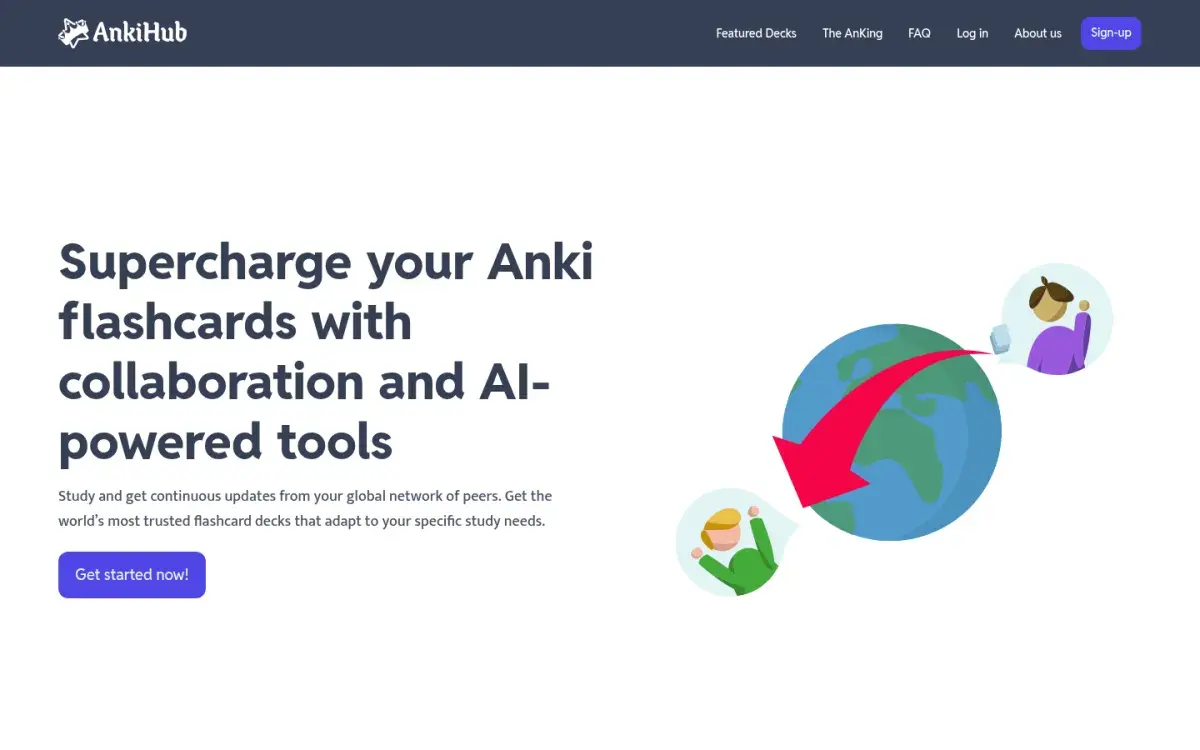
AnKing for boards content. The AnKing Step Deck has more than 30,000 cards covering Steps 1, 2, and 3. It's maintained by a community and distributed through AnkiHub, which syncs corrections and updates into your copy. Access needs a paid AnkiHub plan. The deck is tagged by resource, such as First Aid, Pathoma, Boards and Beyond, and the Sketchy series, so you unsuspend just the cards for what you're covering this week.
Your own cards for everything AnKing doesn't cover:
- School-specific lecture details your in-house exams test.
- Facts from questions you missed, phrased the way you got them wrong.
- Anything you'd confuse with something similar: write a card that asks for the difference.
Keep your own cards small and specific; how to use flashcards effectively covers the rules. If making cards from lecture slides is what you never get to, an AI generator can draft them, but read our guide to flashcard apps for medical students for how to check AI-made medical cards before they enter your queue.
How to pair Anki with a question bank
Questions are where you practice using facts in a vignette. Cards are how you keep those facts from fading. A daily loop that connects them:
- Do a block of questions (20 to 40, timed once you're past the first few weeks).
- For each miss, name the specific fact or concept that would have gotten you there.
- Unsuspend the matching AnKing cards, or write one or two of your own if none exist. The AnKing deck includes tags for some question banks, which makes this faster.
- Review those cards with everything else. FSRS will bring them back on schedule.
A worked example. You miss a question where a patient on lithium develops tremor and confusion after starting a new blood pressure medication. The fact you lacked: thiazide diuretics raise lithium levels. Your cards:
- Why can starting hydrochlorothiazide cause lithium toxicity? Thiazides cause volume depletion, which increases proximal tubule reabsorption of sodium and lithium, so lithium levels rise.
- Name two other drug classes that raise lithium levels. NSAIDs and ACE inhibitors.
Two cards, written from your own mistake, are worth more than twenty you skimmed past. The forgetting curve explainer shows why spacing these reviews beats cramming them before the exam.
What to do when Anki reviews pile up
Everyone falls behind at some point: an exam week, an illness, a hard rotation. Recover without resetting your deck:
- Stop new cards until the backlog is gone. The Anki manual recommends exactly this.
- Show the most-forgotten cards first. With FSRS on, set the review sort order to "Ascending retrievability." It's the FSRS version of "Relative overdueness," the order the manual recommends for large backlogs.
- Clear the backlog in chunks, for example an extra 200 to 300 reviews a day on top of what's due, rather than one 1,500-card day you'll dread.
- Find the cause. Too many new cards, too many sibling cards per note, or cards you don't need for your next exam. Suspend the last group rather than deleting them.
A daily spaced repetition routine for medical school
This fits a preclinical day with lectures. On clerkships, move reviews to the start of the day and do questions in the evening.
| When | What | Time |
|---|---|---|
| Morning, before anything else | All due reviews | 45 to 75 minutes |
| During the day | Lectures or self-study of today's material | Varies |
| Afternoon | New cards tied to today's material (20 to 40) | 20 to 40 minutes |
| Evening | Question block, then cards for every miss | 45 to 90 minutes |
| Weekly | Check Anki stats; adjust new cards if reviews are creeping up | 10 minutes |
| Monthly | Re-optimize FSRS parameters | 5 minutes |
Reviews come first because they're the part that compounds. A day of skipped reviews becomes two days of reviews tomorrow. For how spacing works in general, outside medicine, see the spaced repetition guide.
Frequently asked questions
How many Anki cards should a medical student do a day?
Think in two numbers. New cards: 20 to 40 a day is sustainable for most preclinical students. Reviews: all that are due, which settles at roughly ten times your new-card limit, so 300 or more a day at 30 new cards. If reviews take so long that you skip days, lower the new-card limit rather than the review limit.
Is the AnKing deck enough for Step 1?
AnKing covers a broad range of Step 1 content, but cards alone aren't enough. In research on Step 1 preparation, practice questions were more strongly linked with scores per item than flashcards. Use AnKing to retain the facts, a question bank to practice applying them, and your own cards for the concepts you keep missing.
Is Anki still worth it now that Step 1 is pass/fail?
For most students, yes. Step 1 still requires a passing level of foundational knowledge, and the same material underpins shelf exams and Step 2 CK, which is still scored. Spaced repetition is one of the most efficient ways to keep a large body of facts available over two or more years. Just keep the new-card load modest so it doesn't crowd out questions.
What desired retention should I use in FSRS for medical school?
Start with the default, 90%. The Anki manual describes it as a good balance of retention and workload and warns that the workload rises quickly above 90%. Lowering it reduces daily reviews but means forgetting more, which is a reasonable short-term trade during a heavy rotation. Avoid going near 97%.
Should I make my own Anki cards or use premade decks?
Use both. A well-maintained premade deck like AnKing saves hundreds of hours on standard boards content and gets community corrections. Make your own cards for school-specific lecture material and for concepts you miss in question banks, because writing a card about your own mistake targets exactly what you don't know.
Sources and further reading
Start with the primary research and official guidance below. Links open in a new tab so you can compare the evidence with the article.
- Read source
Student-directed retrieval practice is a predictor of medical licensing examination performance
Deng, Gluckstein & Larsen, Perspectives on Medical Education, 2015
- Read source
Academic and wellness outcomes associated with use of Anki spaced repetition software in medical school
Wothe et al., Journal of Medical Education and Curricular Development, 2023
- Read source
A cohort study assessing the impact of Anki as a spaced repetition tool on academic performance in medical school
Gilbert et al., Medical Science Educator, 2023
- Read source
Anki use and academic performance in medical education: a systematic review of evidence and learning theory
Frappa et al., Medical Science Educator, 2026
- Read source
Deck options
Anki Manual
- Read source
USMLE Step 1 transition to pass/fail only score reporting
USMLE
- Read source
AnkiHub
AnkiHub official site
- Read source
What do all the tags mean in the AnKing Step Deck?
AnkiHub Community wiki