

FSRS and SM-2 are the two algorithms most flashcard apps use to decide when you see a card again. SM-2, from the late 1980s, gives each card an "ease factor" and multiplies its last interval by it. FSRS, created by Jarrett Ye and built into Anki in 2023, fits a memory model to your own review history and schedules each card for the day your chance of recalling it drops to a target you choose, 90% by default.
For most students FSRS is the better pick. Its developers estimate it needs 20–30% fewer reviews for the same retention, and Anki's documentation says it copes much better with late reviews. SM-2 is simpler and more predictable, and it still works. This guide explains both in plain language, what the evidence does and doesn't show, and how to switch.
FSRS vs SM-2 at a glance
| SM-2 | FSRS | |
|---|---|---|
| What it tracks per card | Ease factor (starts at 2.5) and last interval | Difficulty, stability, and retrievability |
| How it picks the next review | Last interval × ease factor | The day predicted recall falls to your desired retention |
| Personalized to you? | Same formula for everyone | Parameters fitted to your review history |
| The setting that matters | Learning steps and interval modifiers | Desired retention |
| Where you'll find it | Default in Anki and RemNote | Anki 23.10+ (switch on), RemNote (optional), Active Recalling |
How does SM-2 work?
Piotr Woźniak wrote SM-2 for an early version of SuperMemo; it ran from 1987 to 1989 and was published in his 1990 thesis. It's short enough to fit on an index card:
- After each review, grade your answer from 0 (blackout) to 5 (perfect).
- The first review comes after 1 day, the second after 6 days.
- After that, each interval is the last interval multiplied by the card's ease factor, which starts at 2.5.
- The ease factor rises by 0.1 after a perfect answer, stays the same after a correct but hesitant one, and drops by 0.14 after a correct answer you struggled with. It never goes below 1.3.
- A grade below 3 (a wrong answer) restarts the card at a 1-day interval.
Here is what that does to three cards answered correctly five times in a row, each graded the same way every time:
| Review | Always "perfect" (5) | Always "hesitant" (4) | Always "struggled" (3) |
|---|---|---|---|
| 1st | 1 day | 1 day | 1 day |
| 2nd | 6 days | 6 days | 6 days |
| 3rd | 17 days | 15 days | 13 days |
| 4th | 50 days | 38 days | 26 days |
| 5th | 150 days | 95 days | 47 days |
| Ease factor after five reviews | 3.0 | 2.5 | 1.8 |
The third card shows SM-2's best-known weakness. A card you keep finding hard loses ease every time, so its intervals grow slowly even after you've learned it. Anki's FAQ describes a related complaint: cards stuck in "low interval hell" after repeated failures. Anki's version of SM-2 softens some of this: it uses four buttons instead of six grades, lets you set your own learning steps, credits you for remembering a card you reviewed late, and doesn't lower ease for failures while a card is still being learned.
How does FSRS work?
FSRS stands for Free Spaced Repetition Scheduler. It describes each card's memory with three numbers:
- Retrievability (R): the probability you can recall the card right now. It falls a little every day.
- Stability (S): how many days it takes for retrievability to fall from 100% to 90%. A stability of 365 means a full year before your chance of recall drops to 90%.
- Difficulty (D): how hard it is to make this card's memory more stable.
Retrievability changes daily; stability and difficulty change only when you review. When you recall a card, its stability grows. It grows more when the card was harder to recall (lower retrievability at the time of review), less when the card is difficult, and less when it's already very stable. That bakes the spacing effect into the math: a successful review just before you'd forget does the most good.
FSRS then schedules the next review for the day retrievability is predicted to hit your desired retention. The model's parameters are fitted to your own review history by an optimizer. Anki's manual suggests re-optimizing about once a month and warns that FSRS works poorly with only a few hundred reviews.
FSRS uses a power-law forgetting curve: forgetting slows over time rather than continuing at a constant rate. The newest versions also let the curve's steepness differ from person to person.
What does desired retention do?
Desired retention is the probability of recall you want at the moment a card comes due. Raise it and intervals shrink; lower it and they stretch. This chart uses the published FSRS-4.5 formula to show the next interval for one card with a stability of 30 days:
How desired retention changes the next interval
Next review interval, in days, for a card with 30-day stability
Calculated example, not measured data. FSRS-6 fits the curve's shape to each user, so real intervals differ.
Source: Calculated from the FSRS-4.5 forgetting curve (Open Spaced Repetition)
View data
| Desired retention | Days until next review |
|---|---|
| 70% | 133 days |
| 75% | 100 days |
| 80% | 72 days |
| 85% | 49 days |
| 90% | 30 days |
| 95% | 14 days |
| 97% | 8 days |
Going from 90% to 95% cuts this interval by more than half, and 97% cuts it to about a quarter. That's why Anki's manual says workload rises steeply near 100% and recommends staying below 97%. The FSRS developers call 70–97% the reasonable range. Lower targets mean fewer reviews but more cards forgotten and relearned.
For most students, 90% is right. Consider 85% if reviews are swamping you, and 92–95% for a few weeks before a high-stakes exam if you can afford the extra time.
Is FSRS better than SM-2? What the evidence shows
The prediction benchmark. The FSRS team runs an open benchmark on review logs from about 10,000 Anki users, scoring roughly 350 million reviews. It measures how accurately each algorithm predicts whether you'll remember a card. Recent FSRS versions score well ahead of older models such as Duolingo's half-life regression and clearly ahead of a baseline that simply predicts each user's average retention.
Some neural-network models in the same benchmark predict better still. SM-2 isn't in the current results table, so the benchmark doesn't give a direct accuracy score for it.
The workload claim. The FSRS developers estimate "20–30% fewer reviews than with SM-2" for the same retention, based on simulations. RemNote's help center repeats the same range. Anki's own FAQ says FSRS users do fewer reviews than with Anki's default algorithm for the same retention.
The research behind it. FSRS grew out of work Jarrett Ye published with colleagues at MaiMemo Inc. in 2022 (ACM KDD) and 2023 (IEEE TKDE), on fitting memory models to large sets of review logs.
What's missing. Almost all of this comes from the people who build FSRS. We found no independent randomized trial comparing students' exam results under FSRS and SM-2. The prediction results are strong and transparent, but "fewer reviews for the same retention" is a simulation result, not a measured classroom outcome.
The honest summary: FSRS is very likely more efficient, and it's the better default today. The gap between the two is still much smaller than the gap between using spaced repetition and cramming.
Which apps use FSRS and which use SM-2?
As of October 2026:
- Anki has offered FSRS since version 23.10, alongside its SM-2-based scheduler, which its FAQ still calls the default. You switch FSRS on at the bottom of the deck options page, and it applies to all your decks. AnkiDroid supports it from version 2.17.
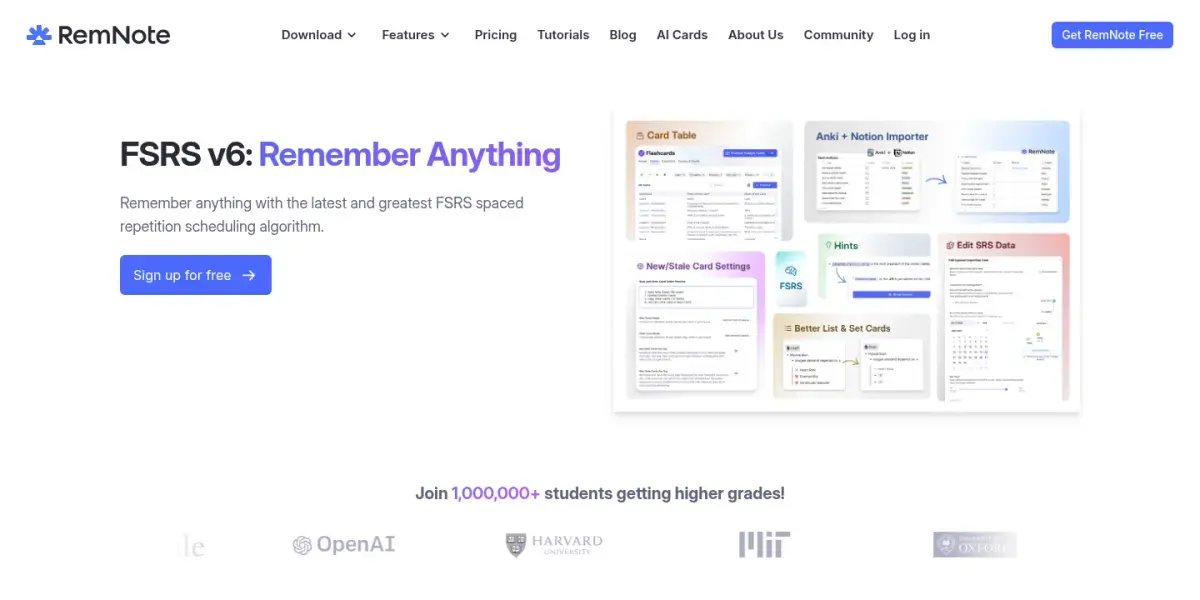
- RemNote uses an Anki-style SM-2 scheduler by default and offers FSRS v6 under Settings > Schedulers. Its help center still labels FSRS a beta feature.
- Active Recalling schedules every flashcard review with FSRS (via the open-source ts-fsrs library); there's no SM-2 option. It's an Anki alternative that drafts the cards from your own material.
- SuperMemo, where SM-2 began, has since moved on to newer algorithms of its own.
If you're choosing an app rather than a setting, see the best Anki alternatives and spaced repetition apps compared.
Common mistakes with either algorithm
Tuning settings instead of fixing cards. If a card fails again and again, rewrite or split it. No algorithm rescues a vague card. See how to use flashcards effectively.
Adding more new cards than you can review. Both schedulers turn today's new cards into next month's reviews.
Changing several settings at once. Change one thing, give it two or three weeks, then judge.
Switching right before an exam. The week before a big exam is a bad time to change schedulers. Switch after it, when a few odd intervals won't hurt.
How to switch from SM-2 to FSRS in Anki
- Update Anki to version 23.10 or later on desktop (AnkiDroid 2.17 or later on Android), and back up your collection.
- Open deck options and scroll to the FSRS section at the bottom. Turn FSRS on. It applies to every preset.
- Leave desired retention at 90% for your first few weeks.
- Click Optimize once you have at least a few hundred reviews, and re-run it about once a month.
- Shorten your learning and relearning steps so they finish the same day (for example, 10m or 15m). Anki recommends against steps of a day or longer with FSRS.
- Leave "Reschedule cards on change" off at first. Turning it on can make a large number of cards due at once.
- Change how you grade. Press Again whenever you forgot, even if the answer felt close. Hard means you remembered, with effort. Anki's manual warns that pressing Hard when you failed to recall makes all intervals unreasonably high.
You don't need to rebuild your deck. FSRS reads your existing review history. Where part of that history is missing, Anki assumes by default that you remembered 90% of those old reviews.
Frequently asked questions
Is FSRS better than SM-2?
For most learners, yes. FSRS fits a memory model to your own reviews, lets you set a target retention, and handles late reviews better. Its developers estimate 20–30% fewer reviews than SM-2 for the same retention, based on simulations. The evidence comes mainly from the FSRS team, and the difference is smaller than the benefit of reviewing consistently with any scheduler.
Does Anki use FSRS by default?
Anki's FAQ still describes its SM-2-based scheduler as the default, with FSRS available since version 23.10. To use FSRS, open deck options, scroll to the FSRS section at the bottom, and turn it on. The switch applies to all presets in your collection. AnkiDroid supports FSRS from version 2.17.
What desired retention should I use in FSRS?
Start with the default, 90%. It balances how much you remember against how many reviews you do. Drop to around 85% if your daily reviews are unsustainable, or raise it toward 95% for a short period before an important exam. Anki recommends staying below 97%, because the review load climbs steeply as you approach 100%.
Do I need to rebuild my deck to switch to FSRS?
No. FSRS uses the review history Anki has already recorded for each card. Turn it on, click Optimize once you have a few hundred reviews, and keep studying. Existing due dates stay as they are unless you choose to reschedule. Back up your collection first in case you want to undo the change.
What is the difference between Hard and Again in FSRS?
Again means you failed to recall the card. Hard means you recalled it, but with real effort. FSRS treats Hard as a success and lengthens the interval, so pressing Hard on a card you actually forgot makes its intervals far too long. If you couldn't produce the answer, press Again.
Sources and further reading
Start with the primary research and official guidance below. Links open in a new tab so you can compare the evidence with the article.
- Read source
Application of a computer to improve the results obtained in working with the SuperMemo method (SM-2)
Piotr Woźniak, SuperMemo, 1990
- Read source
What spaced repetition algorithm does Anki use?
Anki FAQ, 2026
- Read source
Deck Options: FSRS
Anki Manual, 2026
- Read source
ABC of FSRS
Open Spaced Repetition, 2026
- Read source
The Algorithm
Open Spaced Repetition, 2026
- Read source
SRS Benchmark
Open Spaced Repetition, GitHub, 2026
- Read source
A Stochastic Shortest Path Algorithm for Optimizing Spaced Repetition Scheduling
Ye, Su & Cao, ACM KDD, 2022
- Read source
The FSRS spaced repetition algorithm
RemNote Help Center, 2026