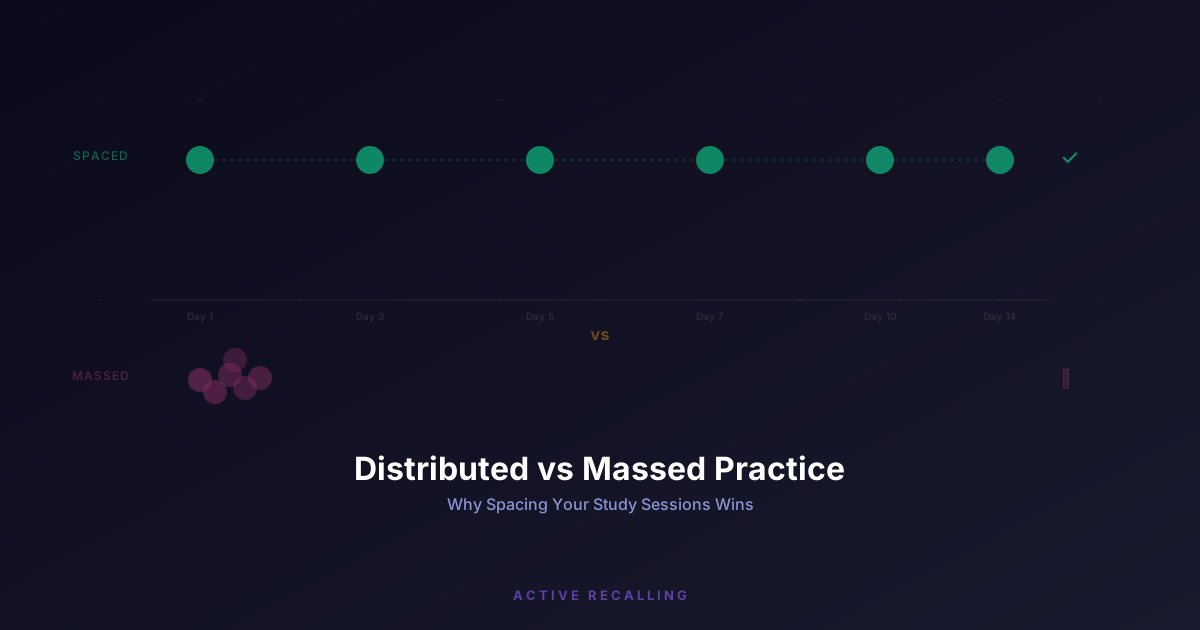
The night before a big exam, millions of students around the world will do the same thing: cram. They will spend hours in a marathon study session, trying to force an entire semester's worth of material into their memory in one sitting. And for many of them, it will seem to work. They will walk into the exam the next morning with the information fresh enough to pass. But within days, most of what they "learned" will be gone. Meanwhile, the students who spread their study across multiple sessions over weeks, studying the same total amount but distributing it over time, will remember the material for months or even years. This is the spacing effect, and it is one of the most robust and powerful findings in the entire history of learning science.
What Are Distributed and Massed Practice?
Massed practice, commonly known as cramming, involves concentrating your study of a particular topic into a single extended session or a few sessions grouped closely together. You study intensively for a short period and then move on.
Distributed practice, also called spaced practice, involves spreading your study of the same material across multiple sessions separated by intervals of time. Instead of studying a topic for four hours in one sitting, you might study it for one hour on four different days spread across two weeks.
The total study time can be identical in both cases. What changes is the distribution of that time. And this seemingly simple change in scheduling produces one of the largest and most reliable effects in learning research.
The Spacing Effect: A Deep Dive Into the Research
Historical Origins
The spacing effect was first documented by Hermann Ebbinghaus in 1885, making it one of the oldest findings in experimental psychology. Ebbinghaus, who famously studied memory using nonsense syllables, found that distributing study sessions across multiple days produced substantially better retention than concentrating the same amount of study into a single session.
What makes this finding remarkable is not just its age but its extraordinary robustness. In the nearly 140 years since Ebbinghaus's original observation, the spacing effect has been replicated in thousands of studies, across every type of material, every age group, and virtually every learning context that has been tested.
Cepeda's Comprehensive Meta-Analysis
Cepeda, Pashler, Vul, Wixted, and Rohrer (2006) conducted a landmark meta-analysis of 254 studies involving over 14,000 participants. They examined the spacing effect across a vast range of conditions, including different types of material (words, facts, concepts, motor skills), different populations (children, adults, elderly), and different study-test intervals (minutes to months).
Their conclusion was unambiguous: distributing practice across time produces substantially better long-term retention than massing practice together. The effect was large, consistent, and applied across essentially all conditions examined. Massed practice sometimes produced slightly better immediate performance, but distributed practice was overwhelmingly superior for long-term retention, which is what truly matters for meaningful learning.
Optimal Spacing Intervals
One of the most important questions in spacing research is: how long should the intervals between study sessions be? The answer depends on how long you need to retain the information.
Cepeda, Vul, Rohrer, Wixted, and Pashler (2008) conducted a large-scale study specifically designed to determine optimal spacing intervals. They tested over 1,300 participants across different spacing gaps and different retention intervals. Their findings revealed an elegant principle: the optimal spacing interval is approximately 10 to 20 percent of the desired retention interval.
This means that if you want to remember something for one week, you should space your study sessions about one to two days apart. If you want to remember something for one month, space your sessions about three to five days apart. If you want to remember something for one year, space your sessions about three to five weeks apart.
The key insight is that the spacing interval should grow as the desired retention interval grows. This is the principle behind expanding retrieval practice, where the gaps between study sessions gradually increase as the material becomes more firmly established in long-term memory.
Classroom Evidence
Sobel, Cepeda, and Kapler (2011) demonstrated the spacing effect in realistic educational settings. Students in a university course who reviewed material in spaced sessions scored significantly higher on final exams than students who reviewed the same material in massed sessions. Similar results have been found in studies of K-12 students learning mathematics, vocabulary, science, and history.
Rohrer and Taylor (2006) showed that spacing practice sessions for mathematical skills by one week produced test scores nearly twice as high as massing the same practice into a single session when tested four weeks later. The massed practice group performed slightly better on an immediate test, but their performance collapsed on the delayed test.
Why Spacing Works
Several complementary mechanisms explain why distributed practice produces superior learning.
The Encoding Variability Theory
The encoding variability theory proposes that each study session encodes the material in a slightly different context. Your mood, environment, thought associations, and mental state differ from one session to the next. When you study a topic across multiple sessions, the memory becomes associated with multiple different contexts, which provides more retrieval cues for accessing the information later.
By contrast, when you study in a single massed session, the memory is encoded in only one context. If your retrieval situation differs from that single encoding context, you may struggle to access the memory.
The Study-Phase Retrieval Theory
When you return to previously studied material after a delay, you must retrieve what you learned in the earlier session before you can study it further. This retrieval from long-term memory, which occurs naturally at the beginning of each spaced study session, strengthens the memory in the same way that deliberate retrieval practice does.
In massed practice, the information is still in short-term or working memory when you continue studying, so no retrieval from long-term memory is required. You miss the memory-strengthening benefit of retrieval because the information never had time to fade.
The Deficient Processing Theory
After extended study in a massed session, your attention and processing quality decline. The material becomes familiar and boring, and you process it more superficially with each repetition. When study sessions are spaced, each session feels relatively fresh, and you process the material with renewed attention and engagement.
Consolidation Opportunities
Memory consolidation, the process by which new memories are stabilized and integrated into long-term storage, occurs primarily during sleep and during periods of rest between study sessions. Massed practice does not allow adequate time for consolidation between exposures. Distributed practice, by providing intervals of rest and sleep between sessions, gives consolidation processes time to work, resulting in more stable and durable memories.
Desirable Difficulty
Spacing introduces a desirable difficulty into the learning process. When you return to material after a delay, it feels harder to recall than it would if you had just studied it moments ago. This difficulty is precisely what stimulates the deeper processing that strengthens long-term memory. The ease of reviewing material in a massed session is deceptive. It feels productive, but the lack of difficulty means less actual learning is occurring.
Why Students Prefer Cramming Despite the Evidence
If distributed practice is so clearly superior, why do so many students continue to cram? The answer lies in a systematic metacognitive illusion.
The Performance-Learning Distinction
During massed practice, performance is typically high. You can recall and recognize material easily because it is still fresh in short-term memory. This high performance creates a feeling of confidence and mastery. During distributed practice, performance is often lower because you must retrieve partially forgotten information, which feels difficult and uncertain.
Students use their performance during study as an indicator of learning, and by this measure, massed practice appears superior. But performance during practice is not the same as learning. Learning is reflected in long-term retention and the ability to use information in future situations, and distributed practice is overwhelmingly superior on these measures.
Immediate vs. Delayed Gratification
Cramming offers immediate gratification. You study, you feel like you know the material, and you perform reasonably well on the next day's exam. The consequences of poor long-term retention are not felt until later, when you need the information for a cumulative exam, a subsequent course, or a professional application. Distributed practice requires patience and planning. The benefits are less immediately visible but far more durable.
Planning and Organization Demands
Distributed practice requires planning ahead. You need to start studying well before the exam and organize your schedule to include multiple study sessions for each topic. Massed practice requires no advance planning. You simply study everything the night before. For busy or disorganized students, the planning demands of distributed practice can feel prohibitive, even though the learning benefits are enormous.
Implementation Tips
Create a Study Calendar
At the beginning of each course or learning project, create a study calendar that schedules multiple review sessions for each topic, spaced over weeks or months. Do not wait until the exam is approaching. Build review sessions into your regular schedule from the start.
Use the Expanding Intervals Approach
Start with shorter intervals between study sessions and gradually increase the intervals as the material becomes more familiar. A typical expanding schedule might look like this: study today, review tomorrow, review again in three days, review again in one week, review again in two weeks, review again in one month. Each successful review at a longer interval indicates that the memory is becoming more durable.
Leverage Spaced Repetition Software
Spaced repetition software automates the scheduling of review sessions based on your performance. Tools like Active Recalling use algorithms that track which items you find easy and which you find difficult, scheduling reviews at optimal intervals for each individual item. This takes the guesswork and planning burden out of distributed practice while maximizing its effectiveness.
Interleave Topics Within Sessions
When you have multiple topics to study, rotate between them within each study session rather than devoting an entire session to a single topic. This introduces spacing within a single session, because each topic gets a break while you study the others, and combines the benefits of spacing with the benefits of interleaving.
Review Before Each New Session
At the beginning of each study session, spend a few minutes retrieving what you learned in the previous session before moving on to new material. This retrieval bridges the gap between sessions and ensures that your cumulative knowledge is being maintained as you progress.
Distribute Practice Across the Week
Instead of studying each subject on one dedicated day per week, study a little of each subject every day or every other day. This ensures that every subject receives distributed practice rather than massed practice.
Use Commute and Transition Times
Short breaks between activities, commuting time, waiting periods, and other transition times can be used for brief review sessions. Reviewing flashcards for five minutes during a commute is a form of distributed practice that adds up significantly over weeks and months.
Spacing and Different Types of Learning
Factual Knowledge
The spacing effect is extremely robust for factual learning, including vocabulary, definitions, dates, and other discrete pieces of information. Spaced flashcard review is one of the most effective methods for this type of material.
Conceptual Understanding
Spacing also benefits conceptual learning. Returning to a concept after a delay forces you to reconstruct your understanding, which deepens comprehension. Each spaced encounter with a concept allows you to integrate it with other knowledge you have acquired in the interim.
Skill Acquisition
Motor skills, mathematical procedures, and other skills benefit from distributed practice. Musicians who practice a difficult passage across several days develop more reliable performance than those who practice it intensively in a single session. Athletes, surgeons, and other skilled performers benefit from the same principle.
Problem Solving
Distributed practice on problem solving allows consolidation of the strategies and schemas that support flexible problem solving. Spacing gives your brain time to abstract general principles from specific problems.
Conclusion
The research on distributed practice versus massed practice delivers one of the clearest and most actionable messages in all of learning science: spread your study out over time. The spacing effect is large, reliable, and applies to virtually every type of learning material and every population of learners. Cramming may produce short-term performance that gets you through tomorrow's test, but distributed practice builds the kind of durable, flexible knowledge that supports long-term academic success and professional competence. The simple act of planning your study schedule to include multiple spaced sessions, rather than single marathon sessions, may be the single most impactful change you can make to your learning habits.