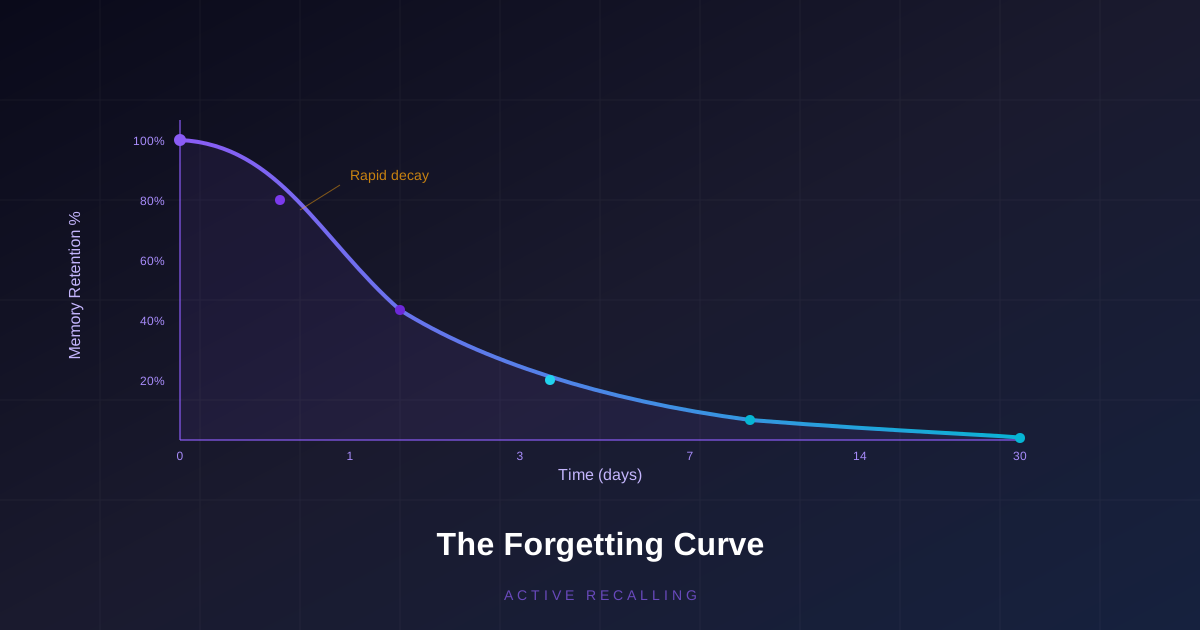
TL;DR: The forgetting curve, first documented by Hermann Ebbinghaus in 1885, shows that humans lose about 50 percent of new information within 24 hours and up to 80 percent within a week without review. Each well-timed review flattens the curve — this is why spaced repetition works.
Have you ever spent hours studying for an exam, only to find that most of the information has vanished from your mind a few days later? You are not alone. This frustrating experience is a universal aspect of human memory, and it was first systematically documented over 130 years ago by a pioneering German psychologist named Hermann Ebbinghaus. His discovery, known as the forgetting curve, remains one of the most important findings in the science of learning.
Understanding the forgetting curve is not just an academic exercise. It is the foundation for some of the most powerful study techniques available today, including spaced repetition and active recall. In this article, we will explore the original experiments, the shape and meaning of the curve, the factors that influence how quickly we forget, and the practical strategies you can use to fight back against memory decay.
The Original Experiments of Hermann Ebbinghaus
In the 1880s, Hermann Ebbinghaus embarked on a remarkable research program. He wanted to study memory with the same rigor that physicists applied to the natural world, so he devised a method that was both simple and ingenious.
Ebbinghaus used himself as his only test subject. To eliminate the influence of prior knowledge and associations, he invented nonsense syllables, meaningless combinations of consonant-vowel-consonant patterns like DAX, BUP, and ZOL. He would memorize lists of these syllables to perfection, then test himself at various time intervals to see how many he could recall.
His approach was painstaking. He controlled for the time of day, his level of fatigue, and the number of repetitions during learning. Over many months, he collected data that allowed him to plot the relationship between time elapsed and the percentage of information retained.
The results were published in 1885 in his landmark work, "Uber das Gedachtnis" (On Memory). What he found was striking and, for many learners, somewhat disheartening.
The Shape of the Forgetting Curve
The forgetting curve is a graph that plots retention (the percentage of learned material still remembered) against time since learning. The curve has a distinctive shape that reveals an important truth about how memory works.
Rapid Initial Decline
The most dramatic feature of the forgetting curve is the steep drop that occurs in the first hours after learning. Ebbinghaus found that within just 20 minutes of learning, roughly 40 percent of the material was already lost. After one hour, about 55 percent had been forgotten. By the end of the first day, approximately 67 percent of the information had faded.
Gradual Leveling Off
After the initial rapid decline, the rate of forgetting slows considerably. The curve begins to flatten out, indicating that the remaining memories are more resistant to decay. After about a week, the curve becomes relatively stable, with the remaining information persisting for a much longer period.
This pattern can be described mathematically. The forgetting curve roughly follows a logarithmic function, meaning that the rate of forgetting decreases over time. The information you still remember after a week is likely to stay with you for a much longer period than the information you forgot in the first hour.
What the Curve Really Means
The forgetting curve tells us something fundamental about the nature of memory. New information is inherently fragile. Without reinforcement, the neural connections that encode a new memory weaken rapidly. However, not all memories are equally vulnerable. The curve represents an average, and many factors influence where any particular memory falls on that curve.
Factors That Affect the Rate of Forgetting
Ebbinghaus himself recognized that his use of nonsense syllables represented something of a worst-case scenario. Meaningful material is forgotten more slowly than random, meaningless information. Modern research has identified several key factors that influence the speed of forgetting.
Meaningfulness of the Material
One of the most powerful influences on memory retention is how meaningful the information is to the learner. Material that connects to your existing knowledge, that you understand deeply, and that has personal relevance is retained far longer than isolated facts. This is why studying for understanding, rather than rote memorization, produces more durable memories.
Depth of Initial Encoding
How you learn something matters as much as what you learn. Information that is processed at a deeper level, involving analysis, evaluation, and connection-making, creates stronger memory traces than information that is only superficially processed. Reading a passage once is shallow encoding. Explaining that passage in your own words is deep encoding.
Emotional Significance
Memories associated with strong emotions, whether positive or negative, tend to be retained much longer than emotionally neutral information. The amygdala, a brain structure involved in emotional processing, enhances memory consolidation when emotions are present. This is why you can vividly remember certain life events from decades ago while forgetting what you had for lunch last Tuesday.
Sleep and Consolidation
Sleep plays a critical role in memory consolidation, the process by which short-term memories are transformed into long-term ones. Research has shown that sleeping after learning significantly reduces the rate of forgetting. During sleep, the brain replays and strengthens newly formed neural connections. Students who study before sleeping often retain more than those who study at the start of the day.
Prior Knowledge
Your existing knowledge base acts as a scaffold for new learning. When new information can be integrated into an existing schema or mental framework, it is retained more effectively. An experienced programmer learning a new language will forget less than a complete beginner because they already possess relevant mental structures.
Stress and Health
Chronic stress, poor nutrition, lack of exercise, and substance use can all accelerate forgetting. The stress hormone cortisol, while helpful in small doses, impairs memory formation and retrieval when present in excess. Maintaining good physical and mental health supports optimal memory function.
Modern Research on the Forgetting Curve
Since Ebbinghaus, researchers have refined and extended our understanding of forgetting in several important ways.
Individual Differences
Modern studies have confirmed that the basic shape of the forgetting curve is remarkably consistent across individuals, but the exact rate of forgetting varies from person to person. Some people naturally retain information longer than others, likely due to a combination of genetic factors, prior knowledge, and habitual learning strategies.
The Testing Effect
One of the most important modern discoveries is the testing effect, also known as retrieval practice. Research by Roediger, Karpicke, and many others has shown that the act of retrieving information from memory actually strengthens that memory. Testing yourself is not merely an assessment tool; it is a powerful learning strategy that flattens the forgetting curve.
Spaced Repetition and the Spacing Effect
Building directly on Ebbinghaus's work, modern researchers have developed spaced repetition systems that optimize the timing of review sessions. The key insight is that reviewing information just as you are about to forget it produces the strongest memory reinforcement. Each successful retrieval after a longer interval makes the memory more durable, effectively resetting and flattening the forgetting curve.
Contextual and Interference Effects
Modern research has also shown that forgetting is not simply a matter of memory traces fading with time. Interference from other memories plays a significant role. New information can interfere with older memories (retroactive interference), and older memories can interfere with new learning (proactive interference). Understanding these effects helps explain why cramming is so ineffective.
Combating the Forgetting Curve: Evidence-Based Strategies
The forgetting curve may seem like bad news, but it actually provides a roadmap for more effective learning. Here are strategies supported by research that can help you retain more of what you learn.
Practice Active Recall
Instead of passively rereading notes, practice active recall by testing yourself on the material. Close your textbook and try to write down everything you remember. Use flashcards. Answer practice questions. Each act of retrieval strengthens the memory and makes it more resistant to forgetting.
Use Spaced Repetition
Distribute your study sessions over time rather than cramming everything into one session. Review material at increasing intervals: first after a day, then after three days, then after a week, then after two weeks. This spacing effect takes advantage of the forgetting curve by reinforcing memories at the optimal moment.
Elaborate on What You Learn
Connect new information to what you already know. Ask yourself why the information is true, how it relates to other concepts, and what examples illustrate the principle. This elaborative encoding creates multiple retrieval pathways and makes the information more meaningful.
Teach Others
One of the best ways to combat forgetting is to teach what you have learned to someone else. Teaching forces you to organize the information, identify gaps in your understanding, and retrieve the material from memory, all of which strengthen retention.
Get Adequate Sleep
Prioritize sleep, especially after learning new material. Even a short nap can boost memory consolidation. Avoid the temptation to sacrifice sleep for extra study time, as this is almost always counterproductive.
Interleave Your Practice
Rather than studying one topic exhaustively before moving to the next, interleave different topics within a single study session. This approach feels more challenging, but research shows it produces better long-term retention and the ability to discriminate between different types of problems.
The Forgetting Curve and Technology
Modern technology has made it easier than ever to apply the lessons of the forgetting curve. Digital spaced repetition software can automatically schedule reviews at optimal intervals, taking the guesswork out of when to study. Active recall platforms generate questions and flashcards that force retrieval practice, directly combating the steep initial decline of the forgetting curve.
These tools are not a replacement for understanding and engagement, but they are powerful supplements that align your study habits with the science of memory.
Frequently Asked Questions
Who discovered the forgetting curve?
German psychologist Hermann Ebbinghaus discovered the forgetting curve in the 1880s. He used himself as his test subject, memorizing lists of nonsense syllables (consonant-vowel-consonant combinations like DAX and BUP) and testing recall at various intervals. He published the findings in 1885 in Uber das Gedachtnis (On Memory).
How much do we forget in 24 hours?
According to Ebbinghaus's original data, about 50 to 70 percent of newly learned information is forgotten within 24 hours without any review. The rate depends heavily on how meaningful the material is — nonsense syllables decay fastest, while personally relevant or emotionally salient information decays much more slowly.
Is the Ebbinghaus forgetting curve accurate?
The basic shape (rapid initial decline, then leveling off) has been replicated many times and is considered reliable. However, the exact numbers vary by material, learner, and conditions. A 2015 replication by Murre and Dros confirmed Ebbinghaus's core findings using modern methods.
How do I counteract the forgetting curve?
The two most effective methods are spaced repetition (reviewing at expanding intervals) and active recall (retrieving information from memory rather than re-reading). Combined, they flatten the curve dramatically. Sleep, elaborative encoding, and emotional engagement also help.
Does the forgetting curve apply to skills?
The standard forgetting curve describes declarative memory (facts and concepts). Procedural memory (skills like riding a bike or typing) follows a different, much flatter curve and is far more resistant to decay once the skill is well-learned.
What is the best review schedule based on the forgetting curve?
A widely used schedule is 20 minutes, 1 day, 3 days, 1 week, 2 weeks, 1 month, and 3 months after initial learning. Spaced repetition apps like Anki and Active Recalling automate this by adjusting intervals based on your recall performance.
Conclusion
The forgetting curve, first documented by Hermann Ebbinghaus in 1885, remains one of the most important discoveries in the science of learning. It tells us that memory is inherently fragile, that forgetting is rapid at first and then slows over time, and that without active intervention, most of what we learn will be lost.
But the forgetting curve is not a sentence. It is an invitation. By understanding how forgetting works, you can adopt strategies like active recall, spaced repetition, and elaborative encoding that transform the curve from an enemy into a guide. The science is clear: you do not have to accept forgetting as inevitable. With the right approach, you can remember more, learn faster, and retain knowledge for the long term.