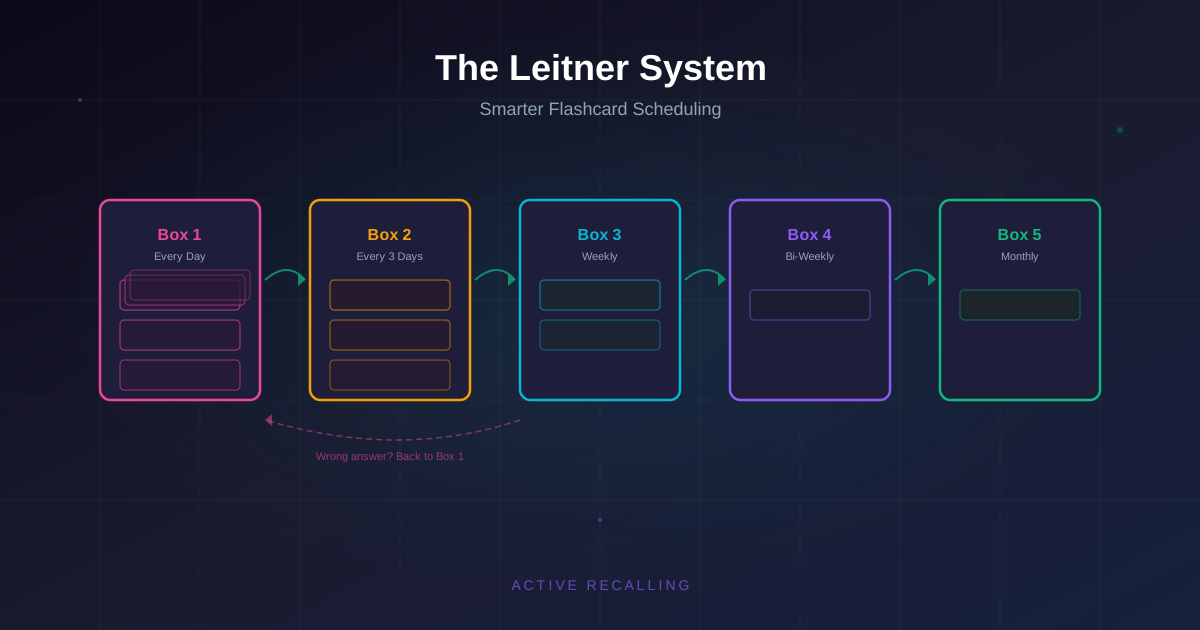
TL;DR: The Leitner System is a flashcard-based spaced repetition method invented by Sebastian Leitner in 1972. It uses 5 boxes with expanding review intervals — correct answers promote cards forward, incorrect answers reset them to Box 1 — operationalizing the spacing effect first documented by Ebbinghaus in 1885.
What Is the Leitner System?
The Leitner System is a flashcard-based learning method developed by German science journalist Sebastian Leitner in the 1970s. It takes the simple concept of flashcards — a question on one side, an answer on the other — and adds an intelligent scheduling layer that ensures you spend the most time on the material you find hardest.
Most students who use flashcards make a critical mistake: they review every card with equal frequency. This means they waste time going over cards they already know well while not spending enough time on the ones they struggle with. The Leitner System solves this problem by introducing a graduated interval system based on your performance.
The fundamental idea is straightforward. Cards you answer correctly move forward to a box with less frequent review. Cards you get wrong move back to the first box for immediate, intensive review. Over time, well-known cards are reviewed rarely while difficult cards get repeated often. This simple mechanism aligns your study time with your actual needs, making every minute count.
How the Box System Works
The Basic Structure
The traditional Leitner System uses five boxes, though you can adapt it to use three, four, or more depending on your needs. Each box has a different review frequency:
Box 1 — Review every day. This is where all new cards start and where cards return when you get them wrong. It contains your most challenging material and gets the most attention.
Box 2 — Review every two days. Cards that you successfully recalled from Box 1 move here. They're slightly more familiar but still need regular reinforcement.
Box 3 — Review every four days. Cards promoted from Box 2 land here. You're building confidence with this material, but it still needs periodic check-ins.
Box 4 — Review every week. Material in this box is well on its way to long-term memory. You know it fairly well but benefit from occasional review.
Box 5 — Review every two weeks. These are cards you've mastered. They only need infrequent review to maintain the memory.
The Movement Rules
The rules governing card movement are what make the system work:
Correct answer: The card moves forward one box. If you correctly recall a card in Box 2, it advances to Box 3. This means the interval between reviews increases, which is exactly what spaced repetition research recommends.
Incorrect answer: The card moves all the way back to Box 1, regardless of which box it was in. This might seem harsh, but it reflects an important reality — if you couldn't recall the information, your memory of it is weaker than you thought, and it needs intensive review.
This asymmetric movement — one step forward for success, all the way back for failure — is a key feature of the system. It creates a natural filter where truly mastered material gradually moves to the back boxes while problematic material stays where it gets the most attention.
A Practical Example
Imagine you're studying Spanish vocabulary. You have 50 flashcards, all starting in Box 1.
On Day 1, you review all 50 cards. You get 35 correct and 15 wrong. The 35 correct cards move to Box 2. The 15 incorrect cards stay in Box 1.
On Day 2, you review the 15 cards in Box 1 (daily review). You get 10 correct, which move to Box 2. Five stay in Box 1. You don't review Box 2 yet because it's only been one day.
On Day 3, you review the 5 cards in Box 1 and the 45 cards in Box 2 (two-day interval). From Box 1, you get all 5 correct — they move to Box 2. From Box 2, you get 40 correct (they move to Box 3) and 5 wrong (they go back to Box 1).
You can see how the system quickly sorts your material. Easy cards fly through the boxes. Difficult cards keep circling back to Box 1 until you truly learn them.
The Science Behind the System
The Leitner System works because it naturally implements two of the most powerful principles in learning science: spaced repetition and active recall.
Spaced Repetition
Research by Hermann Ebbinghaus in the 1880s first demonstrated that memory fades in a predictable curve — the forgetting curve. Information is lost rapidly in the first few hours and days, then more slowly over time. The most efficient way to combat this is to review information at gradually increasing intervals, catching the memory just before it fades.
The Leitner System's box structure creates exactly this pattern. Cards in Box 1 are reviewed daily because they're fresh and fragile. As they prove more stable by being recalled correctly, the review interval increases. This mirrors what cognitive science tells us about optimal review timing.
Active Recall
Every time you look at the question side of a flashcard and try to produce the answer from memory, you're engaging in active recall. This retrieval practice strengthens the neural pathways associated with that memory far more effectively than simply re-reading the information.
The Leitner System forces active recall on every single review. There's no way to passively flip through cards — you must attempt to produce the answer before checking it. This makes every study session an exercise in memory strengthening.
Desirable Difficulty
The system also leverages what psychologist Robert Bjork calls desirable difficulty. By increasing the interval between reviews as cards advance through boxes, the system makes retrieval progressively harder. This added challenge, counterintuitively, leads to stronger and more durable memories. Easy practice feels good but doesn't build lasting knowledge the way challenging retrieval does.
Setting Up Your Leitner System
Physical Setup
For a physical Leitner System, you need flashcards and five containers (small boxes, envelopes, or sections of a shoebox work well). Label each container with its number and review schedule:
- Box 1: Every day
- Box 2: Every 2 days
- Box 3: Every 4 days
- Box 4: Every 7 days
- Box 5: Every 14 days
Create your flashcards with a clear question on one side and a concise answer on the other. Place all new cards in Box 1 and begin your first review session.
Creating Effective Cards
The quality of your flashcards determines the quality of your learning. Here are principles for creating cards that work well with the Leitner System:
One concept per card. Don't put three vocabulary words on one card. Each card should test exactly one piece of knowledge. This makes the sorting mechanism more precise — you can identify exactly which concept is giving you trouble.
Keep answers brief. The answer side should be something you can recall in a few seconds. If your answer requires a paragraph, break it into multiple cards.
Use your own words. Writing the question and answer in your own language forces you to process the information, which improves initial encoding.
Add context when helpful. For vocabulary cards, include an example sentence. For concept cards, include a brief explanation of why the answer is correct.
Make questions specific. "What is biology?" is too vague. "What is the difference between mitosis and meiosis?" is more useful because it targets specific knowledge.
Digital Adaptations of the Leitner System
While the physical box system has a satisfying tangibility, digital tools can enhance the Leitner System in several ways.
Advantages of Digital Implementation
Automatic scheduling. Digital systems track when each card is due for review and present only the cards you need to see on any given day. You don't have to manually check which boxes need review.
Algorithm refinements. Modern spaced repetition software often uses more sophisticated algorithms that adjust intervals based on your response time, the number of times you've seen a card, and other factors. These build on Leitner's core insight while adding granularity.
Multimedia cards. Digital flashcards can include images, audio, and even video, which can be especially valuable for language learning (hearing pronunciation) or visual subjects (recognizing artwork or anatomical structures).
Progress tracking. Digital tools can show you statistics about your learning — how many cards you've mastered, which topics give you the most trouble, and how your retention rate changes over time.
Portability. Your entire collection of thousands of cards fits in your phone. You can review during commutes, lunch breaks, or any spare moment.
Popular Digital Tools
Several applications implement Leitner-style spaced repetition. Anki is perhaps the most well-known, using a modified version of the SuperMemo algorithm that follows similar principles to the Leitner System but with more nuanced interval calculations. Other tools like Quizlet, Brainscape, and dedicated platforms like Active Recalling offer their own takes on flashcard-based spaced repetition.
When choosing a digital tool, look for one that allows you to create your own cards (pre-made decks are less effective than self-created ones), supports the spaced repetition scheduling that makes the Leitner approach work, and provides review statistics so you can monitor your progress.
Tips for Maximum Effectiveness
Be Consistent with Reviews
The Leitner System only works if you follow the review schedule. Skipping days causes cards to pile up and disrupts the spacing pattern that makes the system effective. Set a specific time each day for your review session — many people find that first thing in the morning or right before bed works best.
Don't Add Too Many Cards at Once
A common beginner mistake is creating hundreds of cards and dumping them all into Box 1. This creates an overwhelming daily review load. Instead, add 10 to 20 new cards per day and let them work through the system naturally. You can always add more once your daily review load is manageable.
Be Honest with Yourself
When you review a card, be truthful about whether you actually knew the answer. If you hesitated significantly, if your answer was partially wrong, or if you only remembered after seeing a hint, send the card back to Box 1. The system works best when you maintain strict standards for what counts as a correct answer. Self-deception only hurts your own learning.
Review the Card Before Moving It
When you get a card wrong, don't just glance at the answer and move on. Study the correct answer for a moment. Try to understand why you got it wrong. Was it a similar-sounding word? A confusing concept? Understanding your error pattern helps you learn more effectively.
Retire Mastered Cards Periodically
After a card has been in Box 5 for several successful reviews, consider retiring it to a "graduated" pile. Review these retired cards once a month as a maintenance check. This keeps your active deck manageable while ensuring long-term retention.
Combine with Other Techniques
The Leitner System handles memorization exceptionally well, but understanding is equally important. Before creating flashcards on a topic, make sure you understand the underlying concepts. Use techniques like the Feynman method or mind mapping to build comprehension first, then use the Leitner System to lock that knowledge into long-term memory.
Common Challenges and Solutions
"My Box 1 keeps growing." This usually means you're adding new cards faster than you're learning them, or your cards are too difficult. Slow down on adding new cards and consider breaking complex cards into simpler ones.
"I'm bored reviewing easy cards." This is actually a sign the system is working. Those easy cards are graduating to higher boxes and will appear less frequently. Give it time, and your review sessions will naturally focus on harder material.
"I forgot the schedule." Keep a simple calendar or checklist. Mark which boxes you need to review each day. After a week or two, the pattern becomes second nature.
"Some cards never leave Box 1." These are leeches — cards that resist memorization. Try reformulating the question, adding a mnemonic device, or breaking the concept into smaller pieces. Sometimes the problem is with the card, not your memory.
Frequently Asked Questions
Who invented the Leitner System?
German science journalist Sebastian Leitner introduced the system in his 1972 book So lernt man lernen (How to Learn to Learn). It predates computerized spaced repetition software by over a decade and remains the simplest physical implementation of the spacing effect.
How many boxes should I use?
Five is the classic number, but you can adapt to your needs. Three boxes (daily, weekly, monthly) work for short-term exam prep. Seven or more boxes give finer-grained scheduling for long-term retention. The key is that intervals grow as cards advance.
Should I use the Leitner System or Anki?
Anki uses a more sophisticated algorithm (SM-2) that adjusts intervals based on perceived difficulty, not just pass/fail. For large decks (500+ cards) Anki is more efficient. For small decks or when you prefer physical cards, the Leitner System is simpler and just as effective for its intended use case.
What happens if I skip a day?
Cards accumulate, which can create an overwhelming backlog. Reset rather than trying to catch up all at once: review Box 1 first (most fragile memories), then work through Box 2, and so on. For long gaps (a week or more), consider moving everything back one box.
Can I use the Leitner System for language learning?
Yes — it is one of the most common use cases. Create bidirectional cards (native to target and target to native), keep one concept per card, and shuffle boxes before review so related vocabulary does not cluster.
Why do some cards keep coming back to Box 1?
These are called "leeches." Usually the card is poorly written, too broad, or relies on memorizing exact wording. Reformulate the card into smaller atomic questions, add a mnemonic, or break the concept into prerequisites. Do not keep grinding on a card the system has flagged as broken.
Conclusion
The Leitner System takes one of the oldest study tools — the flashcard — and transforms it into a precision learning instrument. By sorting cards based on your performance and adjusting review frequency accordingly, it ensures that your study time is always spent where it's needed most.
Whether you use physical boxes on your desk or a digital app on your phone, the principle remains the same: review difficult material often, review easy material rarely, and let your performance guide the process. It's a system that respects both the science of memory and the practical reality that study time is limited. Start with a small set of cards, follow the rules honestly, and watch as information that once felt slippery becomes permanently accessible in your memory.