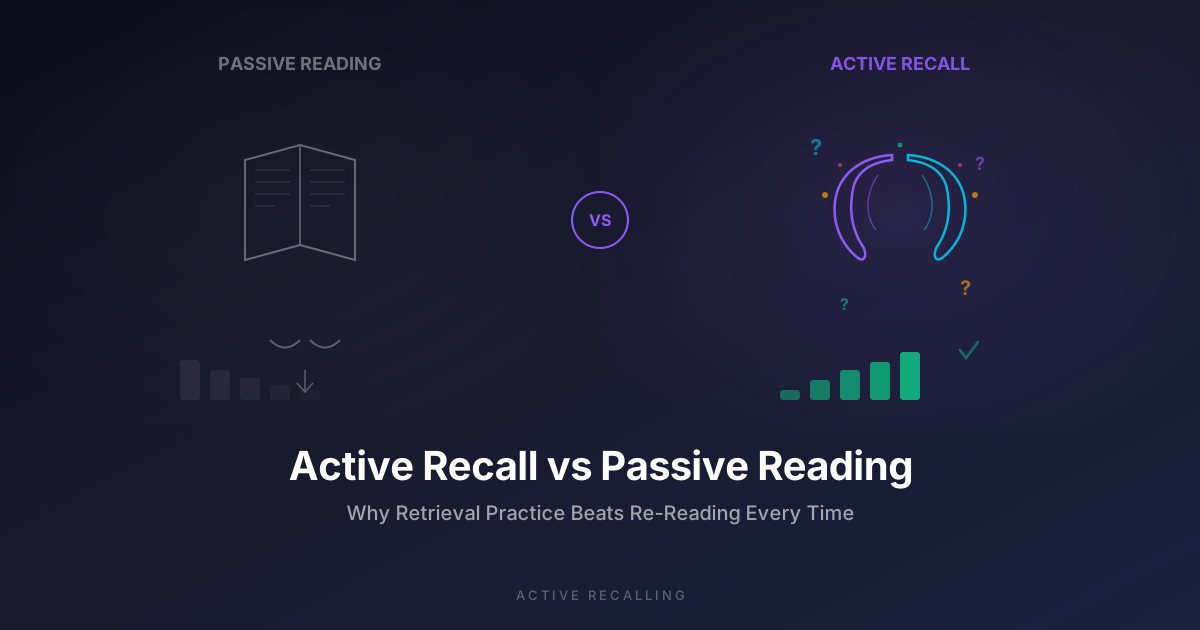
The Study Method That Wastes Your Time
You have probably done it hundreds of times. You open your textbook, read through the highlighted sections, nod along as the information washes over you, and close the book feeling confident that you have studied effectively. The material feels familiar. You recognize the key terms. You remember the general ideas.
Then the exam arrives, and your mind goes blank.
This experience is so universal that researchers have given it a name: the illusion of fluency. It is the false sense of mastery that comes from passive exposure to information, and it is one of the biggest obstacles to effective learning. Understanding why this happens — and what to do instead — can fundamentally transform your academic performance.
The Illusion of Fluency: Why Your Brain Lies to You
When you reread a passage, your brain processes it with increasing ease. The words feel familiar. The concepts seem straightforward. Your brain interprets this fluency as evidence of learning. "I understand this," you think. "I know this material."
But recognition is not the same as recall. Recognizing information when it is presented to you is a fundamentally different cognitive process from retrieving that information from memory on demand. An exam does not ask you to recognize the right answer from a textbook page — it asks you to generate the answer from your own memory.
Psychologist Robert Bjork describes this as the difference between storage strength and retrieval strength. When you reread material, you may increase its storage strength (the depth of encoding in memory), but you do almost nothing to improve its retrieval strength (your ability to access that memory when you need it). It is retrieval strength that determines whether you can actually use the knowledge.
This is why students who spend hours rereading their notes often perform worse than students who spend less total time but use active retrieval strategies. The first group has created an illusion of competence; the second group has built genuine, accessible knowledge.
The Research: Rereading vs. Active Recall
The evidence against rereading as a primary study method is overwhelming. A comprehensive 2013 review by Dunlosky, Rawson, Marsh, Nathan, and Willingham, published in Psychological Science in the Public Interest, evaluated ten common study techniques and rated rereading as having low utility for learning.
Their analysis examined hundreds of studies and concluded that rereading produces minimal benefits for long-term retention. The small gains that rereading does provide diminish rapidly, and the technique fails to promote the kind of deep processing that leads to durable understanding.
In contrast, the same review rated practice testing (a form of active recall) as having high utility — the highest rating given to any technique studied.
The Landmark Karpicke and Roediger Study
One of the most cited studies in learning science was conducted by Jeffrey Karpicke and Henry Roediger in 2008. They asked students to learn Swahili-English word pairs using different study strategies:
- Group 1 studied all pairs and was tested on all pairs repeatedly.
- Group 2 studied all pairs but was only tested on unlearned pairs.
- Group 3 studied only unlearned pairs but was tested on all pairs.
- Group 4 studied and was tested only on unlearned pairs.
The results were striking. Groups 1 and 3 — both of which involved repeated testing on all items — recalled approximately 80% of the word pairs one week later. Groups 2 and 4, which dropped items from testing once they were learned, recalled only about 35%.
The critical finding was that continued retrieval practice was essential for long-term retention, even after items had been successfully recalled once. Simply studying the material without testing produced dramatically worse results.
The Generation Effect
Related research has identified what psychologists call the generation effect: information that you actively generate from memory is remembered far better than information you passively receive. When you read an answer, your brain processes it superficially. When you generate an answer — even if you get it wrong — your brain engages in deeper processing that creates stronger, more durable memory traces.
A 1978 study by Slamecka and Graf first demonstrated this effect, showing that words generated by participants were remembered significantly better than words they simply read. This finding has been replicated hundreds of times across different types of material, age groups, and experimental conditions.
Why Rereading Feels So Productive
If rereading is so ineffective, why does almost every student default to it? The answer lies in metacognition — our ability to monitor and evaluate our own cognitive processes.
Humans are surprisingly poor at judging their own learning. We tend to use fluency as a proxy for understanding. When something feels easy to process, we assume we have learned it. Rereading makes material feel fluent, which creates a powerful (but false) sense of mastery.
Active recall, by contrast, often feels frustrating and difficult. When you close your book and try to remember what you just read, you encounter gaps in your knowledge. You struggle. You fail to retrieve things you thought you knew. This experience feels like evidence of poor learning, when in fact it is the process of learning itself.
This metacognitive illusion is one reason students resist switching from passive to active methods. The strategy that produces the best results feels the worst during practice, and the strategy that produces the worst results feels the best. Awareness of this paradox is the first step toward overcoming it.
How Active Recall Actually Works
Active recall is the practice of retrieving information from memory without looking at the source material. Instead of asking "does this look familiar?", you ask "what do I actually know about this topic?"
The mechanism behind active recall's effectiveness involves several cognitive processes:
Memory Reconsolidation
Each time you retrieve a memory, it enters a labile state where it can be modified and strengthened before being stored again. This process, called reconsolidation, means that every act of retrieval is also an act of re-encoding. The memory that gets stored back is stronger and more accessible than the one you retrieved.
Elaborative Processing
When you attempt to recall information, your brain does not simply retrieve a static file. It actively reconstructs the memory by connecting it to related knowledge, contextual cues, and organizational frameworks. This elaborative processing creates multiple retrieval pathways, making the information accessible from various angles.
Error Correction
Attempting to recall information reveals what you actually know versus what you only think you know. This diagnostic function is invaluable. Failed retrieval attempts, followed by feedback, produce stronger learning than successful retrieval alone. When you discover a gap in your knowledge through active recall, the subsequent correction is encoded more deeply than the original learning.
Transitioning from Passive to Active Learning
Making the switch from passive reading to active recall does not require a complete overhaul of your study habits. You can begin incorporating retrieval practice into your existing routine with these practical strategies.
The Read-Recite-Review Method
After reading a section of your textbook or notes, close the book and recite from memory everything you can remember. Speak out loud or write it down. Then open the book and compare what you recalled with the original material. Note the gaps and repeat the process.
This simple three-step method transforms passive reading into active learning with minimal additional effort.
The Blank Page Method
Before you begin studying a topic, take a blank sheet of paper and write down everything you already know about the subject. Do not worry about organization or completeness — just dump everything from memory onto the page. Then open your materials and identify what you missed, what you got wrong, and what you need to study more carefully.
This technique leverages prior knowledge activation, which prepares your brain to integrate new information with existing knowledge structures.
Question-Based Note-Taking
Instead of copying information from lectures or textbooks, convert key points into questions. Where your notes might say "Mitochondria are the powerhouse of the cell," write instead "What is the primary function of mitochondria?" This transforms your notes from a passive reference into an active study tool.
When you review your notes, cover the answers and attempt to respond to each question from memory before checking.
Flashcard Practice
Flashcards are one of the most direct implementations of active recall. The front of the card presents a prompt, and you must generate the answer from memory before flipping to check. The physical act of flipping (or tapping, in digital tools) creates a natural boundary between the retrieval attempt and the feedback.
Tools like Active Recalling can generate flashcards automatically from your study material, removing the time-consuming step of manual card creation while preserving the retrieval practice benefits.
Teaching What You Learn
Explaining a concept to someone else — or even to an imaginary audience — is one of the most powerful forms of active recall. Teaching requires you to retrieve information, organize it coherently, identify gaps in your understanding, and express ideas in your own words. If you cannot explain something simply, you do not understand it well enough.
Measuring Your Progress
One of the challenges of active recall is that traditional metrics (hours studied, pages read) do not apply. Here are better ways to track your learning:
Retrieval Success Rate
Track the percentage of items you successfully recall during each study session. A success rate between 70% and 85% indicates that you are studying at the right level of difficulty. Below 70% suggests you need more frequent reviews or simpler material. Above 85% suggests you can space your reviews further apart.
Pre-Test and Post-Test Comparisons
Before beginning a study session, test yourself on the material you plan to review. Record your score. After studying with active recall, test yourself again after a delay (ideally the next day). The difference between your pre-test and post-test scores provides a direct measure of learning.
Spaced Recall Checks
Periodically test yourself on material you studied days, weeks, or months ago without any warning or preparation. Your performance on these surprise recall checks is the truest measure of durable learning. If you can retrieve information after a significant delay, it has successfully transferred to long-term memory.
Confidence Calibration
After attempting to recall each item, rate your confidence in your answer before checking. Over time, compare your confidence ratings with your actual accuracy. As your metacognition improves, these ratings should become more aligned — you should become better at knowing what you know and what you do not know.
The Numbers Do Not Lie
The research supporting active recall over passive reading is not marginal — the differences are dramatic. Studies consistently show that active recall produces 50% to 150% better retention compared to rereading, even when total study time is held constant.
A 2011 study by Karpicke and Blunt compared active retrieval practice against elaborative study methods (concept mapping, detailed note-taking). Even against these more sophisticated techniques, retrieval practice produced superior long-term retention. The participants who practiced recall not only remembered more facts but also showed better ability to draw inferences and apply knowledge to new situations.
What makes these findings especially compelling is their consistency across contexts. The advantage of active recall has been demonstrated with children and adults, with simple facts and complex concepts, in laboratory settings and real classrooms, across virtually every subject area studied. It is not a niche technique that works in narrow circumstances — it is a fundamental principle of how human memory operates.
Making the Switch
The transition from passive to active learning is not always comfortable. You will feel less confident during study sessions. You will encounter more moments of frustration and uncertainty. You will occasionally feel like you are studying "less" because you are no longer accumulating the comfortable (but misleading) feeling of familiarity.
Trust the process. The discomfort you feel during active recall is not a sign that the method is failing — it is a sign that genuine learning is occurring. Within a few weeks of consistent practice, you will begin to notice something remarkable: information that previously vanished days after studying now stays accessible for weeks and months.
The choice between passive reading and active recall is not a matter of preference. It is a matter of effectiveness. One method creates the illusion of learning; the other creates learning itself. The research is clear, the evidence is overwhelming, and the practical techniques are straightforward. The only question is whether you are ready to stop feeling productive and start actually learning.