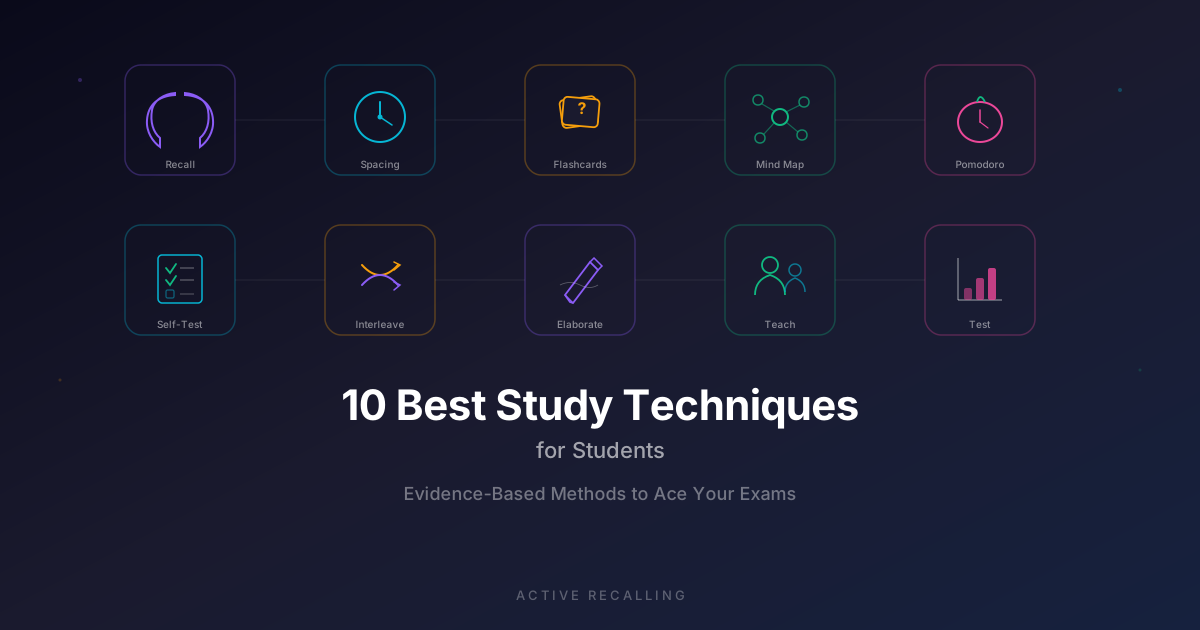
Not All Study Techniques Are Created Equal
Most students rely on a handful of study methods they picked up in middle school — highlighting textbooks, rereading notes, and cramming the night before an exam. These habits feel productive, but decades of cognitive science research reveal that many popular study strategies are remarkably ineffective.
In 2013, a team of psychologists led by John Dunlosky published a landmark review in Psychological Science in the Public Interest, evaluating the ten most common study techniques against rigorous scientific criteria. Their findings challenged conventional wisdom and provided a clear roadmap for anyone who wants to study smarter, not harder.
Drawing on that research and subsequent studies, here are the ten best study techniques ranked by scientific effectiveness — along with practical guidance on how to implement each one in your daily routine.
1. Active Recall (Practice Testing)
Effectiveness: Very High
Active recall is the practice of retrieving information from memory without looking at the source material. Rather than rereading your notes, you close the book and attempt to remember what you learned. This can take the form of flashcards, practice questions, blank-page brain dumps, or self-quizzing.
What the Research Says
The Dunlosky review rated practice testing as having high utility — the highest rating assigned to any technique. A 2006 study by Roediger and Karpicke found that students who used retrieval practice retained 50% more material after one week compared to students who simply reread the same passages. The benefits hold across age groups, subject areas, and types of material.
How to Use It
After studying a section of material, put away your notes and write down everything you can remember. Use flashcards to quiz yourself on key concepts. Before reading a new chapter, test yourself on the previous one. Tools like Active Recalling can automatically generate quiz questions and flashcards from your study material, making it easy to incorporate active recall into every study session.
The discomfort you feel when struggling to remember something is not a sign of failure — it is the mechanism through which lasting memories are formed.
2. Spaced Repetition (Distributed Practice)
Effectiveness: Very High
Spaced repetition involves spreading your study sessions out over time rather than concentrating them into a single session. Instead of studying a topic for four hours on Sunday, you study it for one hour on four different days across two weeks.
What the Research Says
The Dunlosky review rated distributed practice as having high utility. A meta-analysis by Cepeda et al. (2006) examined 254 studies and found that spaced practice consistently outperformed massed practice for long-term retention. The optimal spacing between sessions depends on when you need to recall the information, but even short gaps between study sessions produce significant improvements.
How to Use It
Create a study calendar that revisits each subject at increasing intervals. Study new material today, review it tomorrow, again in three days, then a week later, and finally after a month. Digital spaced repetition systems automate this scheduling based on your individual performance, showing you material right before you would otherwise forget it.
The critical rule is to never cram. Even if you have an exam tomorrow, distributing your study over the preceding weeks will always produce better results than a single all-night session.
3. Interleaving
Effectiveness: High
Interleaving is the practice of mixing different topics, subjects, or types of problems within a single study session rather than focusing on one type at a time. Instead of practicing 20 multiplication problems followed by 20 division problems, you alternate between them randomly.
What the Research Says
A 2014 study by Rohrer, Dedrick, and Stencil found that students who interleaved math practice scored 72% higher on a surprise test compared to students who practiced in blocked (single-topic) fashion. Research by Kornell and Bjork (2008) showed similar advantages for interleaved study of art styles, where participants learned to identify painters more accurately when training was interleaved rather than blocked.
How to Use It
During each study session, rotate between two or three different subjects or topic areas. When practicing problems, mix different problem types together. When reviewing flashcards, shuffle them so that related concepts do not appear consecutively.
Interleaving feels harder than blocked practice, and you will feel like you are learning less effectively. This is another instance of desirable difficulty — the added challenge forces your brain to engage in deeper discrimination and retrieval processes, producing stronger long-term learning.
4. Elaborative Interrogation
Effectiveness: High
Elaborative interrogation involves asking yourself "why" and "how" questions about the material you are studying. Instead of passively accepting that a fact is true, you actively seek to understand the underlying reasons and mechanisms.
What the Research Says
The Dunlosky review rated elaborative interrogation as having moderate utility, though subsequent research suggests its effectiveness may be higher when combined with other techniques. Studies show that generating explanations for facts improves memory by 30% to 50% compared to simply reading the facts.
How to Use It
For every key concept you study, ask yourself: "Why is this true?" and "How does this work?" Then attempt to answer the question from your existing knowledge before looking up the explanation. For example, if you learn that "arteries have thicker walls than veins," ask yourself why this is the case and generate an explanation (arteries handle higher blood pressure from the heart's pumping action).
This technique is especially powerful when you already have some background knowledge in the subject, as it forces you to connect new information with what you already know.
5. Self-Explanation
Effectiveness: High
Self-explanation involves explaining to yourself how new information relates to what you already know, or explaining the steps you are taking while solving a problem. It goes beyond elaborative interrogation by requiring you to articulate your reasoning process explicitly.
What the Research Says
Research by Chi, Bassok, Lewis, Reimann, and Glaser (1989) found that students who self-explained while studying worked examples solved 50% more novel problems than students who did not self-explain. The technique has been shown to improve learning across subjects ranging from biology to physics to programming.
How to Use It
As you work through study material, pause regularly and explain to yourself — out loud or in writing — what you just learned, how it connects to previous concepts, and why the information makes sense. When solving problems, narrate each step: "I am using this formula because the problem involves constant acceleration, and this formula relates distance, initial velocity, and time under constant acceleration."
Self-explanation is particularly valuable for complex, procedural material where understanding the reasoning behind each step is essential.
6. Practice Testing Under Realistic Conditions
Effectiveness: High
While basic self-testing (#1 on this list) involves any form of retrieval practice, practice testing under realistic conditions means simulating the actual exam environment as closely as possible. This includes timing yourself, using the same format (multiple choice, essay, etc.), and working without notes or resources.
What the Research Says
Research on transfer-appropriate processing shows that memory retrieval is most effective when the conditions during testing match the conditions during study. A 2009 study by Putnam and Roediger demonstrated that students who practiced with the same question format they would encounter on the exam performed significantly better than those who practiced with different formats.
How to Use It
Obtain or create practice exams that mirror the format and difficulty of your actual test. Set a timer and work through them without any aids. After completing the practice test, review your errors carefully and restudy the material you missed. Repeat this cycle multiple times before the real exam.
Active Recalling's quiz feature generates multiple-choice questions from your study material, providing a ready-made way to practice test yourself under realistic conditions.
7. The Feynman Technique
Effectiveness: High
Named after Nobel Prize-winning physicist Richard Feynman, this technique involves explaining a concept in the simplest possible language, as if you were teaching it to someone with no background in the subject.
What the Research Says
While the Feynman technique as a named method has not been studied as extensively as some other techniques, its underlying mechanisms — active recall, self-explanation, and elaboration — are all strongly supported by research. Studies on the protege effect show that preparing to teach material improves learning by 10% to 20% compared to preparing to take a test on the same material.
How to Use It
Choose a concept you want to understand. Write the concept name at the top of a blank page. Explain the concept in plain language, as if you were teaching a twelve-year-old. When you encounter a point where your explanation becomes vague, unclear, or overly technical, you have found a gap in your understanding. Return to the source material, fill the gap, and simplify your explanation again.
The goal is not to produce a perfect explanation but to identify and eliminate gaps in your understanding through the process of simplification.
8. Mind Mapping
Effectiveness: Moderate to High
Mind mapping involves creating a visual diagram that connects related concepts around a central topic. Starting from a core idea, you branch outward to subtopics, and from those subtopics to supporting details, creating a hierarchical web of connected information.
What the Research Says
A 2006 meta-analysis by Nesbit and Adesope found that concept mapping and mind mapping improved learning outcomes by an average of 12% to 20% compared to standard study methods. The benefits were strongest for tasks requiring understanding of relationships between concepts and for material with a clear hierarchical structure.
How to Use It
After studying a topic, create a mind map from memory (combining mind mapping with active recall for maximum benefit). Place the main topic at the center and draw branches for each major subtopic. Add details, examples, and connections between branches. Use colors and visual elements to highlight relationships.
Active Recalling can generate mind maps automatically from your study material using interactive, node-based diagrams. These visual representations help you see the big picture and understand how individual concepts fit together.
9. Elaborative Note-Taking (Cornell Method)
Effectiveness: Moderate
The Cornell note-taking method divides your page into three sections: a narrow left column for cues and questions, a wide right column for detailed notes, and a bottom section for summaries. After taking notes in the right column, you generate questions in the left column that your notes answer, then cover the right column and use the questions to test yourself.
What the Research Says
Research by Mueller and Oppenheimer (2014) demonstrated that students who took longhand notes (requiring them to process and rephrase information) outperformed students who typed notes verbatim on conceptual questions. The Cornell method specifically has been shown to improve exam performance by 10% to 15% compared to standard note-taking in several controlled studies.
How to Use It
During lectures or while reading, take notes in the right column using your own words — do not transcribe verbatim. After the session, review your notes and generate questions or key terms in the left column. Write a brief summary at the bottom. When reviewing, cover the right column and use the cues in the left column to practice active recall.
The power of this method lies in its built-in review system. The question column transforms passive notes into an active study tool.
10. The Pomodoro Technique
Effectiveness: Moderate
The Pomodoro Technique, developed by Francesco Cirillo in the late 1980s, structures study time into focused 25-minute intervals (called "pomodoros") separated by 5-minute breaks. After four pomodoros, you take a longer break of 15 to 30 minutes.
What the Research Says
Research on attention and cognitive fatigue supports the principle behind the Pomodoro Technique. Studies show that sustained attention declines significantly after 20 to 30 minutes of continuous focus. Brief breaks help restore attentional resources and prevent the diminishing returns that come with prolonged study sessions. A 2011 study by Ariga and Lleras found that brief diversions from a task dramatically improved focus on that task for prolonged periods.
How to Use It
Set a timer for 25 minutes and commit to focused, uninterrupted study. When the timer rings, take a genuine 5-minute break — stand up, stretch, get water. After four cycles, take a longer break. During each pomodoro, use one or more of the higher-ranked techniques on this list (active recall, self-testing, elaboration) to maximize the effectiveness of your focused time.
The Pomodoro Technique does not directly improve memory encoding, but it creates the conditions for effective study by managing attention, preventing burnout, and maintaining the focus necessary for deeper learning techniques to work.
How to Combine These Techniques
The most effective study system does not rely on a single technique but combines several methods synergistically. Here is a practical framework:
Before studying: Use the Pomodoro Technique to structure your time. Prepare your materials and decide which topics to cover.
During studying: Take elaborative notes using the Cornell method. Interleave different topics within each session. Ask yourself "why" and "how" questions (elaborative interrogation). Explain concepts to yourself in simple terms (Feynman technique and self-explanation).
After studying: Close your materials and practice active recall. Create mind maps from memory to visualize connections. Generate flashcards for key facts and concepts.
Between sessions: Use spaced repetition to schedule reviews. Take practice tests under realistic conditions. Revisit your mind maps and flashcards at increasing intervals.
The Bottom Line
The gap between the most effective and least effective study techniques is not small — it can mean the difference between retaining 80% of what you study and retaining 20%. The good news is that the most effective techniques are not harder or more time-consuming than ineffective ones. They simply require you to study differently.
Active recall and spaced repetition sit at the top of the evidence hierarchy for a reason. They directly target the mechanisms of memory formation and retrieval. But every technique on this list contributes something valuable, and the most successful learners draw from multiple methods depending on the material and the situation.
Start by replacing one passive habit with one active technique. Instead of rereading your notes tonight, close them and try to write down everything you remember. That single change, practiced consistently, will produce results that years of highlighting and rereading never could.
The science of effective learning is settled. The only variable is whether you apply it.