Imagine trying to solve a math problem in your head. You need to hold several numbers in mind simultaneously, perform operations on them, and keep track of intermediate results, all while remembering what the original problem asked. This mental juggling act takes place in your working memory, one of the most important cognitive systems for learning and academic success.
Working memory is often described as the brain's mental workspace, a limited-capacity system that temporarily holds and manipulates information needed for complex cognitive tasks like reasoning, comprehension, and learning. Understanding how working memory works, and more importantly, how to work within its constraints, can transform how effectively you study and learn.
What Is Working Memory?
Working memory is not the same as short-term memory, although the two are related. Short-term memory is a passive storage system that briefly holds information, like remembering a phone number long enough to dial it. Working memory is an active system that not only holds information but also processes and manipulates it.
Think of the difference this way: short-term memory is like a sticky note where you jot down a number. Working memory is like a whiteboard where you write down numbers, rearrange them, perform calculations, and erase intermediate steps as you go. It is the system that allows you to think.
Working memory is involved in virtually every cognitive task that requires conscious effort. Reading comprehension requires holding the beginning of a sentence in mind while processing the end. Following a lecture requires holding previous points in mind while integrating new ones. Solving problems requires holding the problem state in mind while exploring potential solutions.
Baddeley's Model of Working Memory
The most influential model of working memory was proposed by Alan Baddeley and Graham Hitch in 1974, and later refined by Baddeley. This model describes working memory as a multi-component system with distinct parts that serve different functions.
The Central Executive
The central executive is the control center of working memory. It directs attention, coordinates information from different sources, and manages the flow of information between working memory and long-term memory. Think of it as a conductor directing an orchestra, deciding which instruments play when and how loudly.
The central executive is responsible for some of the most demanding aspects of cognition, including switching attention between tasks, inhibiting irrelevant information, and updating the contents of working memory as new information arrives. When you feel mentally exhausted after a period of intense concentration, it is largely the central executive that has been taxed.
The Phonological Loop
The phonological loop is a component specialized for processing verbal and acoustic information. It has two parts: a phonological store that holds sound-based information for about two seconds, and an articulatory rehearsal process that refreshes this information through internal speech, like silently repeating a phone number to yourself.
The phonological loop is why you can hold about seven digits in mind by rehearsing them. It is also why it is harder to remember words that sound similar (like "man, mat, map, cap") than words that sound different. The similar-sounding words create confusion within the phonological store.
The Visuospatial Sketchpad
The visuospatial sketchpad handles visual and spatial information. It allows you to form and manipulate mental images, navigate your environment mentally, and process visual input. When you imagine rotating a three-dimensional object in your mind, or when you plan a route through a familiar building, you are using the visuospatial sketchpad.
This component is relatively independent of the phonological loop, which is why you can simultaneously hold a verbal instruction in mind while navigating visually. This independence has important implications for learning and instructional design.
The Episodic Buffer
In 2000, Baddeley added a fourth component: the episodic buffer. This component integrates information from the phonological loop, the visuospatial sketchpad, and long-term memory into coherent episodes or scenes. It serves as a binding mechanism that combines different types of information into unified representations.
The episodic buffer explains how you can combine what you hear, what you see, and what you already know into a single, coherent understanding of a situation. It is the component that brings everything together.
The Capacity Limits of Working Memory
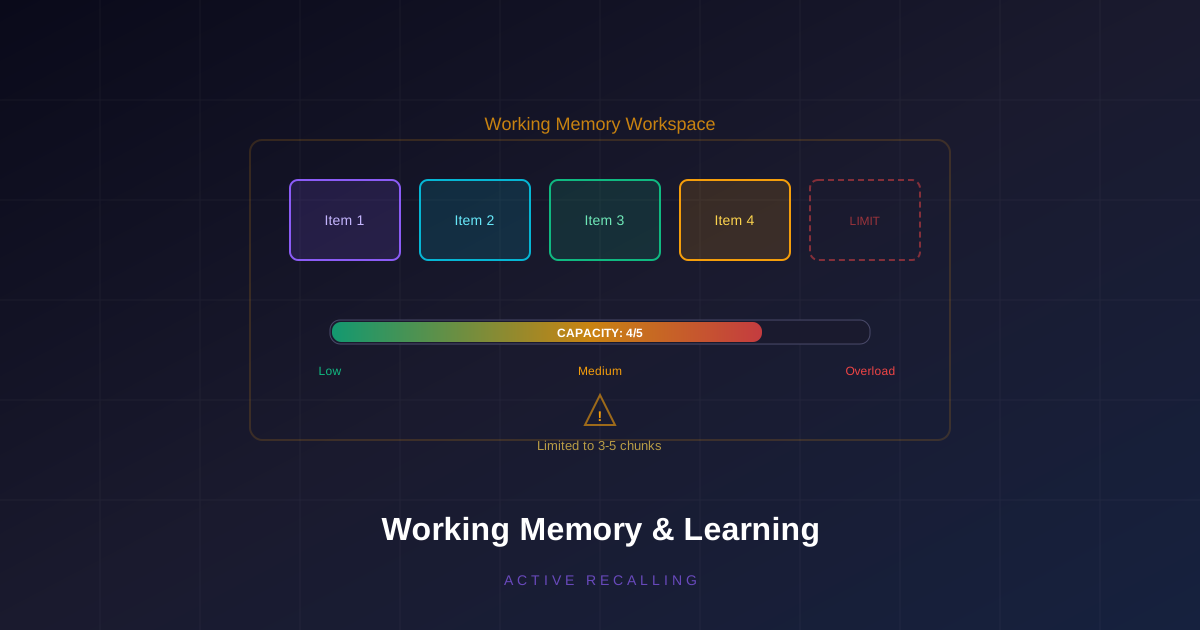
One of the most important facts about working memory is that it has severe capacity limitations. Understanding these limits is essential for effective learning.
The Magic Number
In 1956, George Miller published his famous paper arguing that working memory can hold approximately seven items, plus or minus two. More recent research by Nelson Cowan and others has revised this estimate downward, suggesting that the true capacity is closer to three to four items when rehearsal is prevented.
This means that at any given moment, you can only actively process a very small amount of information. This is why trying to learn too many new concepts at once leads to confusion and poor retention. Your working memory simply cannot handle the load.
Time Limitations
Working memory is not only limited in capacity but also in duration. Without active rehearsal or refreshing, information in working memory decays within about 15 to 30 seconds. This is why you forget a phone number if you get distracted before dialing it.
Individual Differences
Working memory capacity varies significantly between individuals, and these differences have real consequences. Research has consistently found that working memory capacity is one of the strongest predictors of academic achievement, even more so than IQ in some studies. Students with higher working memory capacity find it easier to follow complex instructions, understand difficult texts, and solve multi-step problems.
However, working memory capacity is not fixed. While there are genetic influences, strategies and training can help anyone make better use of their available working memory.
How Working Memory Affects Learning
Working memory's limitations create both challenges and opportunities for learners. Understanding these effects allows you to design study strategies that work with your cognitive architecture rather than against it.
The Bottleneck Problem
Because working memory has such limited capacity, it acts as a bottleneck between the external world and long-term memory. All new information must pass through this narrow channel before it can be stored permanently. When the channel is overwhelmed, learning breaks down.
This is why lectures that present too much new information too quickly are often ineffective. It is why textbooks that introduce many new terms on a single page are hard to follow. And it is why multitasking while studying is so detrimental, each additional task competes for the same limited working memory resources.
Cognitive Overload
Cognitive overload occurs when the demands on working memory exceed its capacity. When this happens, you may experience difficulty concentrating, feel confused or overwhelmed, make more errors, and retain less information. Recognizing the signs of cognitive overload is the first step to managing it.
The Role of Prior Knowledge
One of the most important ways to reduce the burden on working memory is to build strong prior knowledge. When information is well-established in long-term memory, it can be retrieved automatically, requiring minimal working memory resources. An expert chess player does not need to consciously think about how each piece moves; this knowledge is automatic, freeing working memory for strategic thinking.
This is why learning is cumulative. The more you know, the easier it is to learn more, because your existing knowledge base reduces the working memory demands of new learning.
Strategies for Optimizing Working Memory in Learning
Given the constraints of working memory, how can you study more effectively? Here are evidence-based strategies.
Chunking Information
Chunking is the process of combining individual items into larger, meaningful groups. By chunking, you can effectively increase the amount of information held in working memory. Instead of trying to remember eight individual letters (F, B, I, C, I, A, N, S, A), you can chunk them into three meaningful groups (FBI, CIA, NSA), reducing the load from eight items to three.
When studying, look for ways to group related information into meaningful chunks. Organize vocabulary into thematic categories. Group historical events into cause-and-effect chains. Cluster mathematical formulas by the type of problem they solve.
Reducing Extraneous Load
Eliminate unnecessary demands on working memory while studying. This means removing distractions (silence your phone, close social media), using clean and well-organized study materials, and avoiding trying to learn from multiple sources simultaneously.
When taking notes, do not try to write down everything. Focus on key concepts and their relationships. Use abbreviations and symbols to reduce the motor and cognitive demands of writing.
Using External Memory Aids
Do not try to hold everything in working memory when you do not have to. Offload information to external aids like notes, diagrams, outlines, and checklists. When solving a complex problem, write down intermediate steps rather than trying to hold them all in mind.
Automating Basic Skills
The more you can automate foundational skills, the more working memory you free up for higher-level thinking. A student who has to consciously think about how to multiply single-digit numbers will struggle with algebra, because basic arithmetic is consuming working memory that should be available for algebraic reasoning.
Practice foundational skills until they become automatic. This applies to everything from reading fluency to basic math facts to the grammar rules of a foreign language.
Breaking Complex Tasks into Steps
When faced with a complex learning task, break it into smaller, manageable steps that each fit within working memory's capacity. Instead of trying to understand an entire chapter at once, focus on one section at a time. Instead of solving a complex problem in one go, break it into sub-problems.
Leveraging Both Channels
Since the phonological loop and visuospatial sketchpad are partially independent, you can increase effective working memory capacity by using both channels simultaneously. Pair verbal explanations with visual diagrams. Combine written text with spatial layouts. This dual coding approach distributes the load across two systems rather than overloading one.
Working Memory and Effective Study Techniques
Many popular study techniques can be understood in terms of their impact on working memory.
Active Recall
Active recall, the practice of retrieving information from memory, is effective partly because it strengthens the connections between working memory and long-term memory. Each successful retrieval makes the information more accessible, reducing the working memory burden of future processing.
Spaced Practice
Spaced practice works in part because it allows working memory to recover between sessions. Massed practice (cramming) exhausts working memory, leading to diminishing returns. Spacing study sessions gives the central executive time to rest and allows consolidation to occur between sessions.
Interleaving
Interleaving different topics within a study session may actually increase working memory demands in the short term, but it builds stronger and more flexible memories. The additional effort required to switch between topics strengthens the central executive's ability to manage and discriminate between different types of information.
Can You Improve Working Memory Capacity?
This question has generated significant debate in cognitive science. Some researchers have claimed that specific working memory training programs, often involving computerized tasks, can increase working memory capacity. However, the evidence is mixed.
What the research does support is that while the fundamental capacity of working memory may be difficult to expand, you can become much better at using your existing capacity efficiently. The strategies described above, chunking, reducing extraneous load, automating basics, leveraging dual coding, effectively expand the functional capacity of working memory even if its structural capacity remains unchanged.
Additionally, maintaining good physical health supports working memory function. Regular exercise, adequate sleep, proper nutrition, and stress management all contribute to optimal cognitive performance, including working memory.
Conclusion
Working memory is the mental workspace where learning happens. Its limited capacity means that effective learning is not about brute force but about strategy. By understanding the structure and constraints of working memory, you can design study sessions that work within these limits rather than fighting against them.
The most effective learners are not necessarily those with the largest working memory capacity. They are those who have learned to manage their cognitive resources wisely, chunking information, reducing unnecessary load, automating foundational skills, and leveraging both verbal and visual processing channels. These strategies are available to everyone, and mastering them is one of the highest-leverage investments you can make in your learning.