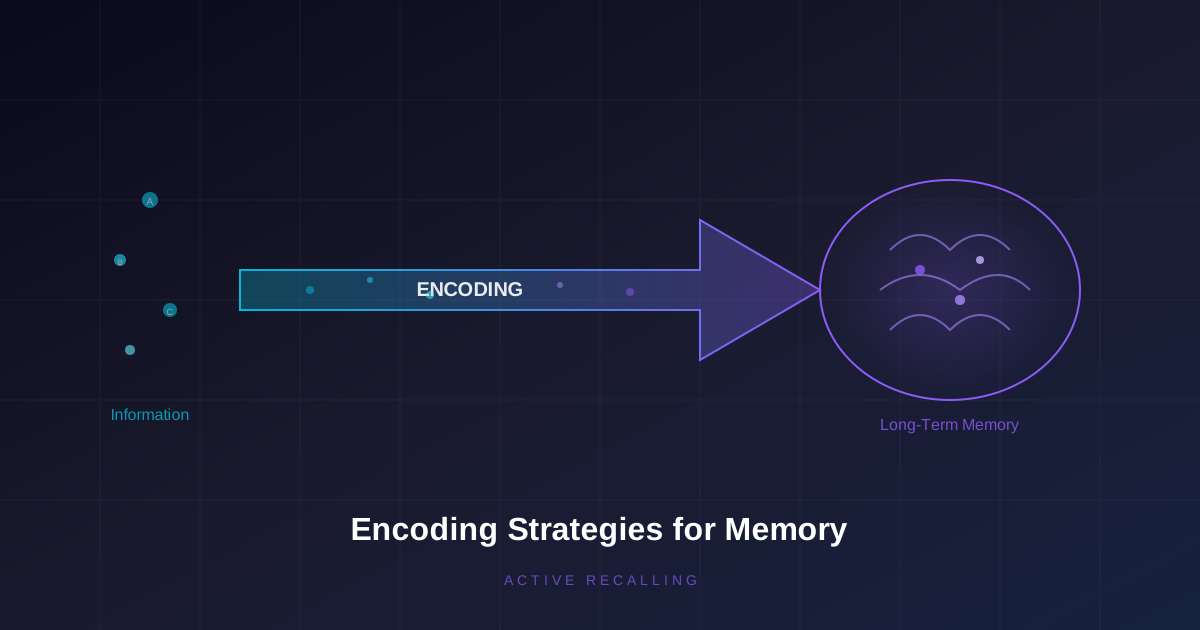
Every student has had the experience of reading a textbook chapter from beginning to end, only to realize at the bottom of the page that nothing has actually stuck. The words passed through your eyes, but they never made it into your long-term memory. This is not a failure of intelligence or effort. It is a failure of encoding, the critical first step in the memory process.
Encoding is the process by which your brain transforms sensory information into a form that can be stored and later retrieved. Think of it as the gateway to long-term memory. If information is not properly encoded, it does not matter how often you review it or how hard you try to remember it. The memory simply will not be there when you need it.
In this article, we will explore the science of encoding, from foundational theories to practical strategies you can apply immediately to improve how you learn and retain information.
What Is Encoding and Why Does It Matter?
When you encounter new information, whether through reading, listening, or observing, your brain must process that information and create a memory trace, also known as an engram. This memory trace is a pattern of neural connections that represents the information. The quality and durability of this trace depend entirely on how the information is encoded.
There are three main stages of memory: encoding, storage, and retrieval. Encoding is the first and arguably the most important, because without effective encoding, there is nothing to store or retrieve. Many students focus their efforts on the retrieval stage through last-minute cramming and review, but the real leverage lies in improving how information enters memory in the first place.
Levels of Processing: The Foundation
In 1972, psychologists Fergus Craik and Robert Lockhart proposed the levels of processing framework, which transformed how researchers and educators think about encoding. Their central insight was simple but profound: the depth at which information is processed determines how well it will be remembered.
Shallow Processing
Shallow processing involves paying attention only to the surface features of information. When you read a word and notice only its font or spelling, you are engaging in shallow processing. When you highlight a sentence without thinking about what it means, you are engaging in shallow processing. When you copy notes word for word from a lecture slide, you are engaging in shallow processing.
Shallow processing creates weak, fragile memory traces that decay rapidly. This is why techniques like rereading and highlighting are among the least effective study strategies, despite being among the most popular.
Deep Processing
Deep processing involves engaging with the meaning of information. When you read a concept and think about what it means, why it is true, how it connects to other ideas, and what its implications are, you are engaging in deep processing. This creates strong, durable memory traces that are resistant to forgetting.
The levels of processing framework tells us that it is not how much time you spend studying that matters most, but how deeply you engage with the material during that time. Twenty minutes of deep processing will produce better retention than two hours of shallow processing.
Elaborative Encoding: Building Rich Connections
Elaborative encoding is the process of connecting new information to existing knowledge by adding detail, context, and meaning. It is one of the most powerful encoding strategies available, and it works by creating multiple pathways to the same memory.
How Elaboration Works
When you learn a new fact in isolation, you create a single memory trace with limited connections to the rest of your knowledge. When you elaborate on that fact, asking questions about it, generating examples, connecting it to things you already know, you create a rich web of associations. Each of these associations serves as a potential retrieval cue, making the memory easier to access later.
Think of it like building roads to a destination. A single dirt road provides one route that is easy to lose. A network of highways provides many routes, ensuring you can always find your way.
Elaboration Techniques
Self-explanation is a technique where you pause while learning and explain to yourself what the material means and how it fits with what you already know. Research consistently shows that students who self-explain learn more than those who do not.
Elaborative interrogation involves asking "why" and "how" questions about the material you are studying. Instead of simply reading that the heart has four chambers, you ask yourself why four chambers are necessary and how this design relates to the circulatory system's function. This forces deeper processing and creates meaningful connections.
Analogies and metaphors connect new information to familiar concepts. Understanding electric current by comparing it to water flowing through pipes creates a bridge between new and existing knowledge. The more vivid and personal the analogy, the more effective it tends to be.
Semantic Encoding: The Power of Meaning
Semantic encoding involves processing information based on its meaning rather than its surface characteristics. Research consistently shows that semantically encoded information is remembered far better than information encoded based on appearance or sound.
The Classic Demonstration
In a famous series of experiments, researchers asked participants to process words in different ways. Some were asked about the physical appearance of words (Is the word written in capital letters?), some about the sound (Does the word rhyme with "train"?), and some about the meaning (Does the word fit in the sentence "The girl placed the ___ on the table"?). Recall was dramatically better for words processed for meaning.
Applying Semantic Encoding
To leverage semantic encoding in your studies, always focus on understanding the meaning of what you are learning rather than memorizing the exact wording. Paraphrase concepts in your own words. Summarize passages without looking at the original text. Create concept maps that show how ideas relate to one another.
When studying vocabulary, whether in a foreign language or a technical field, do not simply memorize definitions. Instead, understand the concept behind the word, use the word in sentences, and connect it to words you already know.
Visual and Dual Encoding
The dual coding theory, proposed by Allan Paivio, suggests that information processed both verbally and visually is better remembered than information processed through only one channel. This makes intuitive sense: two memory traces are better than one.
Creating Visual Representations
When studying verbal information, try to create a mental image or a physical diagram that represents the concept. If you are learning about the structure of a cell, do not just read about it; draw it. If you are studying historical events, create a timeline. If you are learning about a process, create a flowchart.
The Method of Loci
One of the oldest and most powerful memory techniques, the method of loci (also called the memory palace), exploits visual and spatial encoding. You imagine a familiar location, such as your home, and mentally place the items you want to remember in specific locations along a path through that space. To recall the items, you mentally walk through the space and "see" each item where you placed it.
This technique works because it transforms abstract information into vivid spatial and visual memories, which the brain is naturally excellent at retaining.
Organizational Encoding: Structure Matters
The way information is organized during encoding has a profound impact on how well it is remembered. Organizational encoding involves imposing structure on the material you are learning.
Chunking
Chunking is the process of grouping individual pieces of information into larger, meaningful units. The classic example is phone numbers: 5551234567 is hard to remember as ten individual digits, but 555-123-4567 is much easier because it is organized into three chunks.
Chunking works because it reduces the load on working memory, allowing you to process more information at once. When studying, look for natural groupings and categories within the material.
Hierarchical Organization
Organizing information into hierarchies, with main categories, subcategories, and specific details, creates a structured framework that supports both encoding and retrieval. Creating an outline before or after studying a chapter imposes this kind of structure and significantly improves retention.
Concept Mapping
Concept maps are visual tools that show relationships between ideas. Unlike simple outlines, concept maps capture cross-connections between different branches of knowledge. Creating a concept map requires you to identify the key concepts, determine how they relate to one another, and organize them spatially, all of which promote deep encoding.
Generation and the Production Effect
The generation effect is the finding that information you generate yourself is better remembered than information you passively receive. Writing your own summary is more effective than reading someone else's. Creating your own practice questions is more effective than using pre-made ones. Solving a problem yourself is more effective than watching someone else solve it.
Related to this is the production effect: information that is spoken aloud is better remembered than information that is read silently. This is likely because speaking involves additional encoding processes, including motor planning and auditory feedback, that create additional memory traces.
Practical Applications
Take notes in your own words rather than copying from slides. When reviewing, close your notes and write down everything you can remember before checking. Create your own flashcards with questions that require you to generate answers rather than simply recognize them. Explain concepts out loud, even if you are alone.
Encoding Specificity and Context
The encoding specificity principle, proposed by Endel Tulving, states that memory is best when the conditions at retrieval match the conditions at encoding. This means that the context in which you learn, including the physical environment, your emotional state, and even the way the information is presented, becomes part of the memory itself.
Study Implications
While it is not always practical to study in the exact environment where you will be tested, you can use this principle to your advantage. Study in conditions that are similar to your testing conditions. If your exam will be in a quiet room, study in a quiet room. If you will need to write essays, practice writing essays during your study sessions.
Alternatively, research suggests that studying in multiple different environments can make memories more flexible and easier to retrieve in novel situations, because the information becomes less tied to any single context.
Practical Tips for Better Encoding
Bringing all of these principles together, here are actionable strategies you can implement immediately.
Engage actively with material rather than reading passively. Ask questions, make predictions, and test yourself frequently. Every time you actively retrieve or manipulate information, you strengthen the encoding.
Space your encoding sessions across multiple days rather than cramming everything into one sitting. Each session provides a fresh opportunity to encode the information more deeply.
Minimize distractions during encoding. Divided attention dramatically reduces encoding quality. Put away your phone, close unnecessary tabs, and give the material your full attention.
Connect new learning to prior knowledge at every opportunity. The more connections you create, the more retrieval pathways you build.
Use multiple encoding channels by combining reading, writing, speaking, listening, and visualizing. Each channel creates additional memory traces.
Teach what you learn to someone else, or pretend to. The act of teaching forces you to organize, elaborate, and generate, all of which enhance encoding.
Conclusion
Encoding is where learning begins. No amount of review, repetition, or clever retrieval strategies can compensate for weak initial encoding. The good news is that effective encoding is a skill, not a talent. By understanding the principles of deep processing, elaborative encoding, semantic encoding, and organizational strategies, you can dramatically improve how well new information enters your long-term memory.
The key insight is that encoding is an active process. Passive exposure to information, no matter how prolonged, produces poor results. Active engagement with meaning produces strong, durable memories that are easy to retrieve when you need them. The strategies in this article are not shortcuts; they are the evidence-based foundation of effective learning.