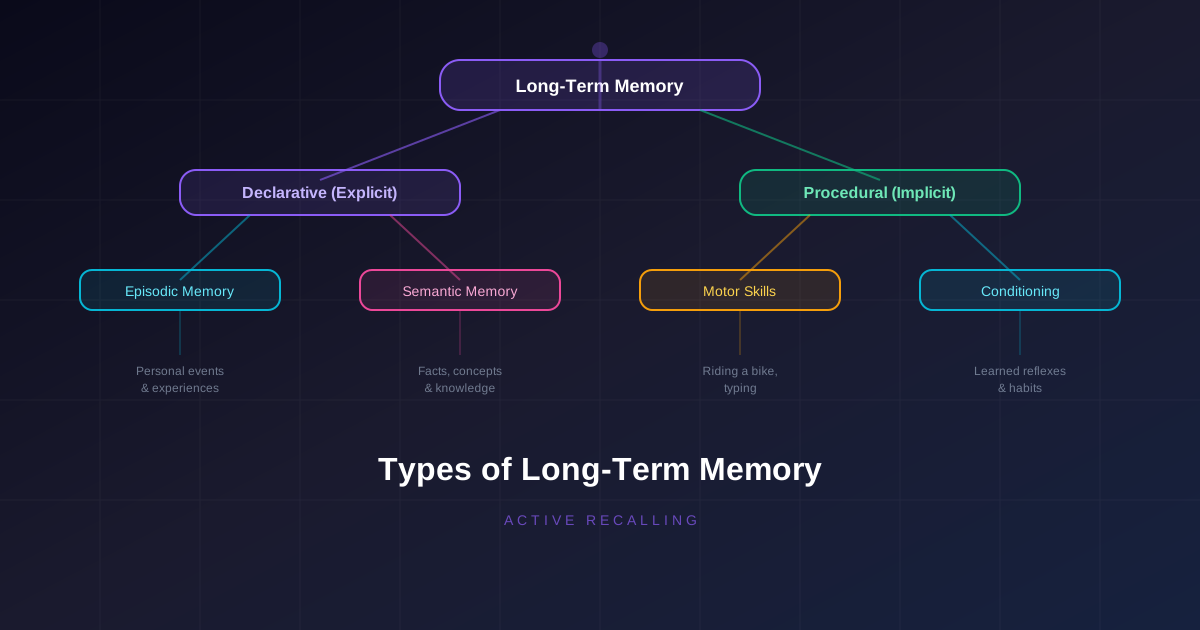
When people talk about memory, they often speak as though it were a single, unified system, like a filing cabinet where all information is stored in the same way. In reality, memory is far more complex and fascinating. Your brain has multiple distinct memory systems, each with its own characteristics, brain regions, and rules for how information is stored and retrieved.
Understanding these different types of long-term memory is not just an academic exercise. It has profound practical implications for how you study, what techniques you use, and why some things are easy to remember while others seem impossible. In this article, we will explore the major categories of long-term memory, how they work, and what they mean for your learning.
The Big Picture: A Taxonomy of Memory
Long-term memory is broadly divided into two major categories: explicit memory (also called declarative memory) and implicit memory (also called non-declarative memory). The key distinction is consciousness. Explicit memories are those you can consciously recall and describe. Implicit memories influence your behavior without conscious awareness.
This division was first clearly established through the study of patients with brain damage, particularly the famous patient known as H.M. (Henry Molaison). After surgical removal of his hippocampus and surrounding structures to treat severe epilepsy, H.M. lost the ability to form new explicit memories. Yet he could still learn new motor skills, demonstrating that different types of memory depend on different brain systems.
Explicit (Declarative) Memory
Explicit memory refers to memories that can be consciously recalled and verbally described. These are the memories you typically think of when someone asks you to "remember" something. Explicit memory is further divided into two subtypes: episodic memory and semantic memory.
Episodic Memory
Episodic memory is your memory for personal experiences and specific events. It is autobiographical, tied to a particular time and place, and experienced with a sense of reliving the event. When you remember your first day at university, a conversation you had yesterday, or what you ate for breakfast, you are accessing episodic memory.
Episodic memories have several distinctive features. They are rich in contextual detail, including the sights, sounds, emotions, and physical sensations associated with the event. They have a temporal dimension, meaning they are organized in time and you can often remember the sequence of events. And they are experienced from a first-person perspective, as though you are re-experiencing the event.
The brain region most critical for episodic memory is the hippocampus, along with surrounding structures in the medial temporal lobe. Damage to these areas severely impairs the ability to form new episodic memories while often leaving older memories relatively intact, suggesting that the hippocampus is especially important for encoding and early consolidation.
Semantic Memory
Semantic memory is your memory for facts, concepts, and general knowledge about the world. It is not tied to any particular personal experience. You know that Paris is the capital of France, that water is composed of hydrogen and oxygen, and that dogs are mammals, but you probably do not remember the specific moment when you learned each of these facts.
Semantic memory is the backbone of education. Almost everything you learn in school, from vocabulary and grammar rules to scientific principles and historical dates, is stored in semantic memory. Unlike episodic memory, semantic memory is decontextualized, meaning it is abstracted away from the specific experiences through which it was acquired.
The brain regions supporting semantic memory are more distributed than those supporting episodic memory. While the hippocampus plays a role in initially acquiring semantic memories, over time these memories become increasingly dependent on the neocortex, particularly the temporal and frontal lobes. This process of gradual transfer from hippocampus to neocortex is called systems consolidation.
The Relationship Between Episodic and Semantic Memory
Episodic and semantic memory are not entirely separate systems. They interact in important ways. Many semantic memories begin as episodic memories. You might first learn a historical fact in the context of a specific class on a specific day (episodic), but over time the contextual details fade and you are left with just the fact itself (semantic).
This has an important implication for studying. Creating vivid, episodic experiences during learning can serve as a bridge to semantic memory. When you learn a concept in a rich, engaging context, the episodic trace provides an initial scaffold that supports later semantic consolidation.
Implicit (Non-Declarative) Memory
Implicit memory encompasses a diverse collection of memory systems that operate below the level of conscious awareness. You cannot verbally describe these memories, but they powerfully influence your behavior, skills, and perceptions.
Procedural Memory
Procedural memory is your memory for how to do things: skills and habits that have been learned through practice. Riding a bicycle, typing on a keyboard, playing a musical instrument, and tying your shoelaces are all examples of procedural memory in action.
Procedural memories have several distinctive characteristics. They are acquired gradually through repeated practice, unlike episodic memories that can be formed in a single experience. They are difficult or impossible to verbalize: try explaining exactly how you balance on a bicycle, and you will find that words fail to capture the knowledge your body possesses. And they are remarkably durable: you can ride a bicycle after years away from one because procedural memory is highly resistant to forgetting.
The brain structures most critical for procedural memory include the basal ganglia and the cerebellum, which are distinct from the hippocampal system that supports explicit memory. This is why patients like H.M. could learn new motor skills despite being unable to form new episodic or semantic memories.
Priming
Priming is a form of implicit memory in which exposure to one stimulus influences the response to a subsequent stimulus. If you recently saw the word "yellow" and are then asked to name a fruit, you are more likely to say "banana" than someone who had not seen the word "yellow." This happens automatically, without conscious intent.
Priming demonstrates that memory influences cognition in ways we are often unaware of. Prior exposure to information can shape our perceptions, judgments, and decisions even when we have no conscious memory of the prior exposure.
Classical Conditioning
Classical conditioning, famously demonstrated by Pavlov's experiments with dogs, is another form of implicit memory. When two stimuli are repeatedly paired together, the brain learns an association between them. The resulting memory is expressed through automatic physiological or behavioral responses rather than conscious recall.
In everyday life, classical conditioning explains many of our emotional reactions to places, sounds, and smells. The anxiety you feel walking into an exam room, or the comfort you feel smelling a meal your grandmother used to make, are examples of classically conditioned memories.
Emotional Memory
While emotions influence all types of memory, there is evidence for a distinct emotional memory system centered on the amygdala. This system stores the emotional significance of experiences and generates emotional responses when you encounter similar situations.
The amygdala works in concert with the hippocampus during memory formation. Emotionally significant events activate the amygdala, which in turn enhances hippocampal encoding, leading to stronger and more vivid memories. This is why emotionally charged experiences, both positive and negative, are remembered better than neutral ones.
How Memory Types Interact During Learning
Understanding the different types of memory helps explain why different study strategies work for different types of material.
Learning Facts vs. Learning Skills
When you are studying factual information for an exam, you are primarily building semantic memories. The most effective strategies for this include active recall, spaced repetition, elaborative encoding, and making meaningful connections between concepts.
When you are learning a skill, such as solving mathematical proofs, writing essays, or performing laboratory procedures, you are building procedural memories. The most effective strategy for this is deliberate practice: repeated, focused practice with feedback, gradually increasing in difficulty.
Many real-world learning tasks involve both types of memory. A medical student needs semantic memory for anatomical facts and procedural memory for clinical skills. A programmer needs semantic memory for programming concepts and procedural memory for the act of writing and debugging code. The most effective study plans address both types.
The Power of Episodic Context
Research on context-dependent memory shows that episodic context can serve as a powerful retrieval cue for semantic information. This is why studying with rich, varied, and personally meaningful contexts can improve recall. Creating vivid mental images, studying in different locations, and connecting facts to personal experiences all leverage the episodic memory system to support semantic learning.
From Explicit to Implicit
Many skills begin as explicit knowledge and gradually become implicit through practice. When you first learn to drive, every action requires conscious thought and deliberate attention. With practice, these actions become automatic, freeing your conscious mind for conversation or navigation. This transition from explicit to implicit memory is called automatization, and it is a key goal of practice.
Implications for Studying
Understanding memory types leads to several practical recommendations.
Match your study strategy to the type of memory you are building. For factual knowledge, use active recall and spaced repetition. For skills, use deliberate practice with feedback. For conceptual understanding, use elaboration and self-explanation.
Create rich episodic contexts during learning. Do not study in a sterile, monotonous environment. Vary your study locations, use vivid examples, and connect material to personal experiences. These episodic cues will help you retrieve the information later.
Practice until skills become automatic. Foundational skills like reading, basic math, and typing should be practiced until they require minimal conscious effort. This frees working memory for higher-level thinking.
Use emotion strategically. While you cannot manufacture genuine emotional experiences for every topic, you can increase engagement by connecting material to your goals, values, and interests. Curious, motivated learners create stronger memory traces than passive, disengaged ones.
Leverage multiple memory systems. When possible, engage both declarative and procedural memory systems. Do not just read about how to solve a problem; actually solve problems. Do not just memorize vocabulary; use the words in sentences and conversations.
Be patient with skill learning. Procedural memories take time to develop. Unlike semantic memories, which can sometimes be formed in a single exposure, procedural memories require repeated practice. Progress may feel slow at first, but the resulting skills are remarkably durable.
The Reconstructive Nature of Memory
One important caveat about all types of explicit memory is that they are reconstructive rather than reproductive. When you recall a memory, you do not play back a perfect recording. Instead, your brain reconstructs the memory from stored fragments, filling in gaps with expectations, knowledge, and sometimes imagination.
This means that memories can be distorted, incomplete, or even entirely false, while feeling completely genuine. This has important implications for studying: do not assume that because you remember studying something, you remember it accurately. Regular testing and verification are essential.
Conclusion
Long-term memory is not a single system but a collection of distinct systems, each with its own characteristics, brain regions, and rules. Explicit memory, encompassing both episodic and semantic subtypes, stores the facts and experiences you can consciously recall. Implicit memory, including procedural memory, priming, and conditioning, shapes your behavior and skills below the level of conscious awareness.
Effective learning requires understanding and leveraging all of these systems. By matching your study strategies to the type of memory you are building, creating rich learning contexts, practicing skills to automaticity, and engaging multiple memory systems simultaneously, you can learn more efficiently and retain more of what you learn. Memory is not a monolith. It is a toolbox, and the more tools you understand, the more effectively you can learn.