TL;DR: Interleaving is the practice of mixing different topics or problem types within one study session instead of studying them in blocks. Rohrer and Taylor (2007) found interleaved math practice produced 43 percent higher scores one week later; Rohrer, Dedrick, and Stencil (2015) found a 72 vs. 38 percent gap in real classrooms. It feels harder — that is why it works.
Imagine you are learning to identify different species of trees. Would you learn better by studying all the oaks first, then all the maples, then all the elms? Or would you learn better by looking at oaks, maples, and elms mixed together in random order? Most people instinctively choose the first approach, studying one category at a time until it feels mastered before moving on. But decades of research reveal that this instinct is wrong. Interleaving, the practice of mixing different topics or problem types during study sessions, consistently produces superior learning outcomes.
What Is Interleaving?
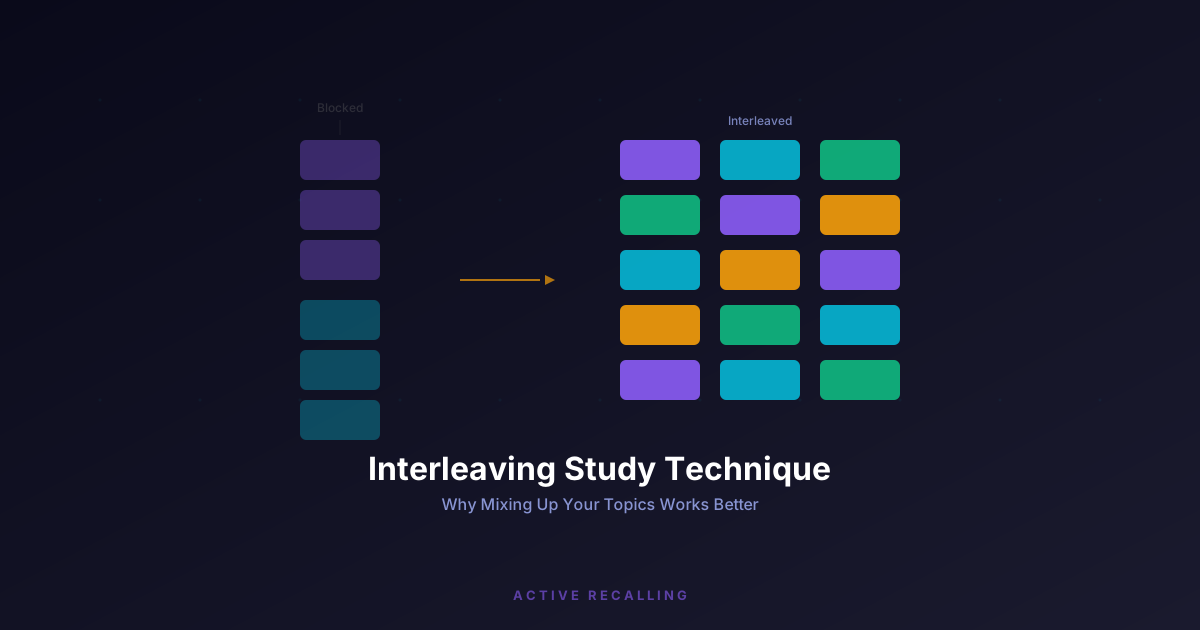
Interleaving is a study strategy where you alternate between different topics, concepts, or types of problems within a single study session rather than focusing on one topic at a time. The opposite approach, called blocked practice, involves studying one category or topic exhaustively before moving to the next.
Here is a simple illustration. Suppose you need to learn three mathematical concepts: A, B, and C. With blocked practice, your study session would look like this: AAAA-BBBB-CCCC. You practice all problems of type A, then all of type B, then all of type C. With interleaving, the same session would look like this: ABCBACBAC. The problems are mixed together so that you never practice the same type twice in a row.
At first glance, interleaving seems inefficient and even counterproductive. Blocked practice feels smoother and more productive. You get into a rhythm, performance improves rapidly within each block, and you feel like you are mastering the material. Interleaving, by contrast, feels choppy and frustrating. Performance during the study session is typically worse. But here is the critical insight: performance during practice is not the same as learning. What matters is how well you can use the information later, and that is where interleaving shines.
The Research: Doug Rohrer and Beyond
The modern understanding of interleaving owes much to the work of Doug Rohrer and his colleagues at the University of South Florida. In a series of influential studies, Rohrer demonstrated that interleaving dramatically improves learning across a wide range of domains.
In one landmark study, Rohrer and Taylor (2007) had students practice calculating the volumes of different geometric solids, including wedges, spheroids, spherical cones, and half cones. One group practiced in blocked fashion, completing all problems of one type before moving to the next. The other group practiced the same problems in interleaved order. On a test given one week later, the interleaving group scored 43 percent higher than the blocked group. This was not a small effect. It was a dramatic improvement that came simply from changing the order in which problems were practiced.
Kornell and Bjork (2008) extended these findings to a completely different domain: learning to identify the painting styles of different artists. Participants who studied paintings in interleaved order, seeing works by different artists mixed together, were significantly better at identifying new paintings by those artists compared to participants who studied each artist's work in blocks. Critically, even though the interleaving group performed better on the test, the majority of participants in both conditions believed that blocked practice had been more effective. This demonstrates a troubling disconnect between how effective a strategy feels and how effective it actually is.
Rohrer, Dedrick, and Stencil (2015) brought interleaving into real classrooms. Seventh-grade math students who completed interleaved homework assignments scored 72 percent on a surprise test given a month later, compared to just 38 percent for students who completed blocked assignments. This near-doubling of test scores in an authentic educational setting is one of the most compelling demonstrations of interleaving's power.
More recent research by Brunmair and Richter (2019) conducted a comprehensive meta-analysis of interleaving studies and confirmed a reliable moderate-to-large benefit of interleaving across diverse learning tasks, materials, and populations.
Interleaving vs. Blocked Practice: A Detailed Comparison
To understand why interleaving works, it helps to examine in detail how it differs from blocked practice.
Learning Feels Different
During blocked practice, performance improves rapidly because you develop a rhythm for the current problem type. You are essentially repeating the same mental operation over and over, which feels productive and satisfying. However, this improvement is largely an illusion. Much of the apparent progress reflects short-term performance gains that do not translate into durable learning.
During interleaving, performance is noticeably worse during the practice session. Switching between topics feels effortful and disorienting. You may feel like you are not making progress. But this difficulty is precisely what drives deeper learning. Cognitive scientists call this a desirable difficulty, a challenge that slows performance during practice but enhances long-term retention and transfer.
Different Cognitive Demands
Blocked practice primarily requires you to execute a known procedure repeatedly. Once you identify the problem type, you apply the same strategy over and over. Interleaving, however, requires you to do something fundamentally more challenging. You must first discriminate between different problem types, identifying what kind of problem you are facing, and then select the appropriate strategy. This discrimination and selection process is exactly what you need to do on real tests and in real-world situations, where problems do not come pre-sorted by type.
Memory Encoding Differences
When you study topics in blocks, each item in the block is processed in the context of highly similar items. This makes it easy to notice the features they share but difficult to notice what makes them distinct. When you interleave, each item is processed in the context of different items, which forces you to notice the distinctive features of each category. This deeper, more discriminating encoding leads to better memory and understanding.
Why Interleaving Works: The Mechanisms
Several cognitive mechanisms explain the interleaving benefit.
The Discrimination Hypothesis
The most widely supported explanation is the discrimination hypothesis. Interleaving forces you to compare and contrast different categories, concepts, or problem types. This comparison highlights the features that distinguish one category from another, leading to richer and more differentiated mental representations. When categories are studied in blocks, you never need to distinguish between them, so you never develop the ability to tell them apart.
The Retrieval Practice Component
Interleaving incorporates an element of retrieval practice. When you return to a topic after working on something different, you must retrieve the relevant knowledge from memory rather than simply continuing to apply it from working memory. This retrieval strengthens the memory and makes it more durable.
Contextual Interference
Interleaving creates what motor learning researchers call contextual interference, the disruption caused by switching between tasks. While this interference hinders performance during practice, it forces deeper cognitive processing that benefits long-term learning. The brain must work harder to maintain and distinguish between multiple cognitive schemas, which ultimately makes each schema more robust.
Spacing Within Interleaving
Interleaving naturally introduces spacing between instances of the same topic. When you practice A, then B, then C, then return to A, there is a time gap between your first and second encounter with A. This built-in spacing effect contributes to the interleaving benefit, though research suggests that interleaving provides benefits above and beyond what spacing alone can explain.
How to Implement Interleaving
Here are practical strategies for incorporating interleaving into your study routine.
Mix Problem Types in Practice Sets
When working through practice problems, resist the temptation to complete all problems of one type before moving on. Instead, shuffle your practice problems so that you encounter different types in random or semi-random order. Many textbooks organize problems by type at the end of each section, which encourages blocked practice. Actively counteract this by mixing problems from different sections.
Alternate Between Subjects
During a study session, switch between different subjects or topics every 20 to 30 minutes rather than spending the entire session on a single subject. This might mean alternating between biology and chemistry, or between different chapters within the same course. The transitions will feel less efficient, but the long-term learning benefits are substantial.
Use Cumulative Review
When studying for exams, do not just review the most recent material. Include problems and questions from earlier topics in every study session. This creates natural interleaving between old and new material, which strengthens your ability to distinguish between different concepts and prevents the forgetting of earlier material.
Create Mixed Flashcard Decks
If you use flashcards, avoid organizing them by topic in separate decks. Instead, combine cards from multiple topics into a single deck and shuffle them regularly. This forces you to identify the relevant category or concept before you can answer, which mirrors the demands of real assessments.
Interleave Within a Single Topic
Even within a single topic, you can interleave. For example, when studying a historical period, alternate between political events, cultural developments, economic factors, and key figures rather than studying each dimension separately. This helps you build a more integrated and nuanced understanding.
When to Use Blocked Practice
While interleaving is generally superior for learning, there are situations where blocked practice is appropriate. When you are encountering a completely new topic for the first time, some initial blocked practice can help you develop a basic understanding before you begin interleaving. Think of blocked practice as a way to build the initial foundation, and interleaving as a way to deepen and consolidate that foundation.
Additionally, if you are struggling with a specific concept and need focused remediation, spending concentrated time on that concept before returning to interleaved practice can be beneficial. The key is to use blocked practice strategically and temporarily, not as your default study approach.
Overcoming the Illusion of Ineffectiveness
The biggest barrier to adopting interleaving is the illusion of ineffectiveness. Because interleaving feels harder and performance during practice is lower, most learners believe it is not working. This is compounded by the fact that blocked practice feels smooth and productive, creating a false sense of mastery.
To overcome this illusion, trust the research rather than your feelings during practice. Remind yourself that the difficulty you experience during interleaving is a sign of deeper cognitive processing, not a sign of failure. Track your performance on actual tests and assessments over time, and you will see the evidence of interleaving's effectiveness in your results.
Frequently Asked Questions
What is interleaving in studying?
Interleaving is a study technique where you mix different topics, problem types, or skills within one session rather than studying one category at a time (called "blocked practice"). Instead of AAAA-BBBB-CCCC, you study ABCBACBAC.
Does interleaving really work?
Yes, strongly. Rohrer and Taylor (2007) found interleaved math practice produced 43 percent higher test scores one week later than blocked practice. A 2019 meta-analysis by Brunmair and Richter confirmed moderate-to-large interleaving benefits across diverse learning tasks.
Why does interleaving feel worse than blocking?
Interleaving produces lower performance during the study session because switching between topics is cognitively effortful. This feels unproductive, but the productive difficulty is exactly what builds durable learning. Bjork calls this the "desirable difficulty" principle.
When should I use blocked practice instead?
When first encountering a completely new topic, some blocked practice helps build initial understanding. Once you have basic competence, switch to interleaving. Think of blocked as the scaffold and interleaving as the consolidation.
How do I start interleaving in my studies?
Three concrete steps: (1) mix problem types in practice sets rather than grouping by section, (2) alternate between subjects every 20-30 minutes in a study session, and (3) shuffle flashcard decks so related cards do not cluster together.
Does interleaving work for all subjects?
Yes, though the effect size varies. It is especially strong for math, science, language learning, and any subject where you need to discriminate between similar but distinct concepts. It is less critical for isolated factual recall where there are no similar competitors.
Conclusion
Interleaving is a powerful and well-supported study strategy that challenges our intuitions about how learning works. By mixing different topics and problem types during study sessions, you force your brain to engage in the kind of discrimination, retrieval, and deep processing that builds durable and flexible knowledge. The research from Rohrer, Kornell, Bjork, and many others consistently demonstrates that interleaving produces substantially better learning outcomes than blocked practice, even though it feels less effective in the moment. Start mixing up your study topics today, embrace the productive struggle, and watch your learning outcomes improve.