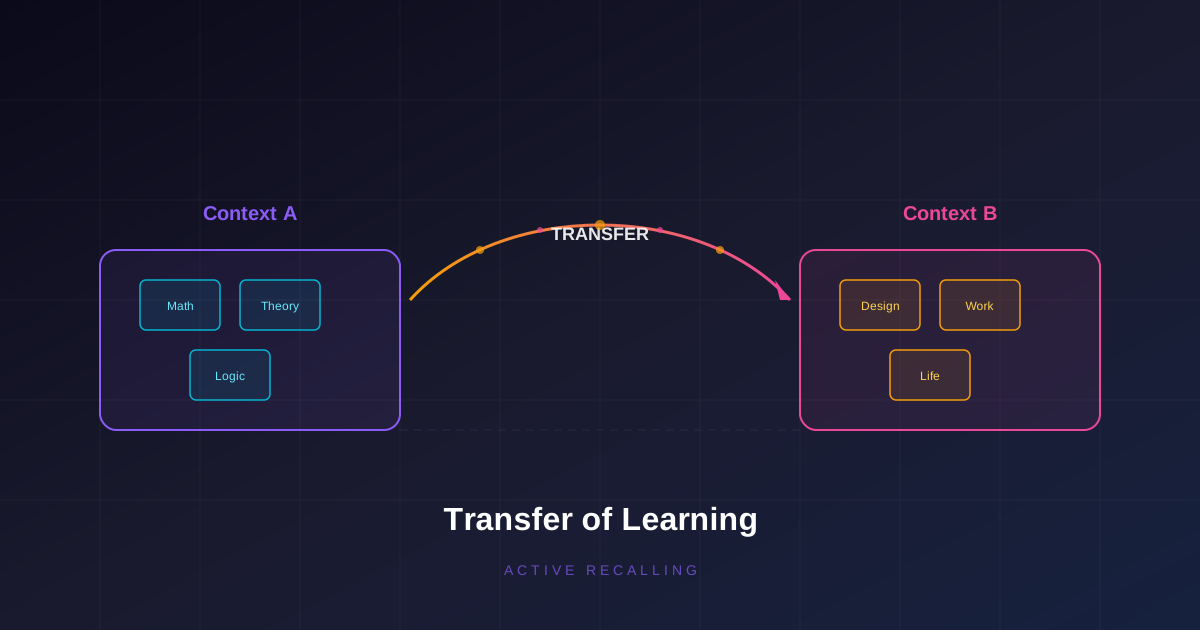
There is a common frustration among students that goes something like this: "I understood everything in class, but when I saw the exam questions, I had no idea how to apply what I had learned." This disconnect between learning and application is one of the most important challenges in education, and it relates directly to a concept called transfer of learning.
Transfer of learning refers to the ability to take knowledge or skills learned in one context and apply them to a different context. It is, in many ways, the ultimate goal of education. After all, the value of learning does not lie in being able to repeat information in the exact same setting where you learned it. It lies in being able to use that knowledge flexibly, in new situations, to solve new problems.
Yet transfer is notoriously difficult to achieve. Research has repeatedly shown that people often fail to apply knowledge they demonstrably possess when the situation changes even slightly. Understanding why this happens, and what you can do about it, is essential for anyone who wants their learning to have lasting, real-world impact.
What Is Transfer of Learning?
Transfer of learning occurs when something learned in one situation influences performance in another situation. This can be positive, where prior learning helps with a new task, or negative, where prior learning interferes with a new task.
A classic example of positive transfer is a student who learns algebra and then finds it easier to learn physics, because algebraic reasoning transfers to solving physics equations. An example of negative transfer is a tennis player who takes up badminton and initially uses the wrong wrist movements, because tennis habits interfere with badminton technique.
Transfer can also occur at different levels. You might transfer a specific skill, like the ability to factor quadratic equations, or you might transfer a general strategy, like the habit of breaking complex problems into smaller parts. The breadth and depth of transfer determine its practical value.
Near Transfer vs. Far Transfer
Researchers distinguish between two types of transfer based on how similar the learning and application contexts are.
Near Transfer
Near transfer occurs when the new situation closely resembles the original learning situation. If you learn to solve a particular type of math problem in class and then encounter a similar problem on an exam with different numbers, successfully solving it represents near transfer. The surface features have changed, but the underlying structure is the same.
Near transfer is relatively common and relatively easy to achieve. Most of what happens in traditional education, where students practice problems similar to those they will encounter on tests, relies on near transfer.
Far Transfer
Far transfer occurs when knowledge is applied to situations that are substantially different from the original learning context. Using principles of statistical reasoning learned in a math class to evaluate a medical study, or applying project management skills from your job to organizing a community event, would be examples of far transfer.
Far transfer is much more difficult to achieve and is the subject of significant debate among researchers. Some studies suggest that far transfer is rare and unreliable, while others demonstrate that it can be achieved under the right conditions. The consensus is that far transfer does not happen automatically but requires deliberate effort and specific learning strategies.
Why Transfer Is So Difficult
Several factors explain why transfer fails to occur even when learners possess the relevant knowledge.
Context Dependence
Memories are strongly tied to the context in which they were formed. This includes the physical environment, the way information was presented, and even the learner's emotional state. When the context changes, the relevant knowledge may fail to activate. A student who has always practiced chemistry problems in a textbook format may not recognize that the same chemistry principles apply when confronted with a real-world scenario described in paragraph form.
Surface Features vs. Deep Structure
People naturally tend to focus on the surface features of problems rather than their deep structure. Two problems may look completely different on the surface but have identical underlying structures. Without training, learners often fail to see past the surface to recognize the structural similarities that would enable transfer.
In a classic study by Gick and Holyoak, participants read a story about a military general who divided his army into small groups to converge on a fortress from multiple directions. They then attempted to solve a medical problem about destroying a tumor with radiation without damaging surrounding tissue. Very few spontaneously transferred the convergence strategy from the military story to the medical problem, even though the underlying structure was identical. Only when explicitly prompted to think about the connection did transfer occur.
Inert Knowledge
Inert knowledge is knowledge that a person possesses but fails to use when it would be relevant. This is one of the most common and frustrating failures of transfer. Students may know a relevant principle but never think to apply it because the knowledge is stored in a way that is not activated by the new situation.
Inert knowledge often results from learning that is too passive, too context-specific, or too focused on memorization rather than understanding. When knowledge is acquired without deep processing, it tends to sit dormant rather than being flexibly deployed.
Analogical Reasoning: The Engine of Transfer
Analogical reasoning, the ability to recognize and use structural similarities between different situations, is one of the primary cognitive mechanisms underlying transfer. When you successfully transfer knowledge from one domain to another, you are typically drawing an analogy between the familiar situation and the new one.
How Analogies Work
An analogy involves mapping the structure of a known situation (the source or base) onto a new situation (the target). For the analogy to work, the learner must recognize the relevant structural correspondences while ignoring irrelevant surface differences.
Effective analogical reasoning requires several cognitive steps. First, you must retrieve a relevant source analog from memory. Then, you must map the structural elements from the source to the target. Finally, you must adapt the mapped knowledge to fit the specifics of the new situation.
Building Analogical Skills
The ability to reason by analogy can be strengthened through practice. Comparing multiple examples of the same principle, identifying the common deep structure across different problems, and explicitly practicing the mapping of knowledge from one context to another all build analogical reasoning skills.
Strategies to Promote Transfer
Research has identified several strategies that significantly improve the likelihood of transfer.
Learn with Understanding, Not Just Memorization
Transfer is far more likely when knowledge is understood deeply rather than memorized superficially. When you understand the why behind a principle, not just the what, you are better equipped to recognize situations where that principle applies, even when the surface features are different.
Instead of memorizing formulas, understand what each variable represents and why the formula works. Instead of memorizing historical dates, understand the causal relationships between events. Deep understanding creates flexible knowledge that transfers more readily.
Study Multiple Examples and Contexts
One of the most effective strategies for promoting transfer is to study the same concept across multiple examples drawn from different contexts. When you see the same principle illustrated in three different ways, you begin to abstract the underlying structure from the surface features. This abstraction is exactly what enables transfer.
For instance, if you are learning about supply and demand, study examples from different markets: housing, labor, commodities, and digital goods. The variety helps you see the common structure and recognize it in new contexts.
Practice Comparing and Contrasting
Actively comparing and contrasting different problems and examples forces you to identify structural similarities and differences. This comparative process highlights the deep features that are relevant for transfer while making surface features less prominent.
When studying worked examples, compare two problems with different surface features but the same solution structure. When reviewing concepts, compare them with related but distinct concepts to sharpen your understanding of each.
Vary Your Practice Conditions
Practicing in varied conditions promotes transfer by preventing knowledge from becoming too tightly bound to a single context. Study in different locations. Practice problems in different formats. Apply concepts to different types of situations.
This principle extends to how problems are sequenced. Interleaved practice, where you mix different types of problems within a single study session, promotes better transfer than blocked practice, where you complete all problems of one type before moving to the next.
Make Connections Explicit
Do not wait for transfer to happen spontaneously. Actively and explicitly make connections between what you are learning and other domains. Ask yourself: "Where else does this principle apply? What does this remind me of? How is this similar to something I already know?"
Keep a running list of connections between different subjects you are studying. When you learn a new concept in biology, think about whether it has parallels in other fields. This habit of deliberate connection-making builds the retrieval pathways that enable transfer.
Use Abstract Representations
Representing knowledge in abstract, schema-like forms promotes transfer by stripping away context-specific details and highlighting the transferable structure. Concept maps, flowcharts, and principle-based summaries all serve this purpose.
When you distill a complex topic into its core principles and relationships, you create a representation that is more portable than a context-specific memory. This abstract representation can be mapped onto new situations more easily.
Teach and Explain
Teaching a concept to someone else, or even explaining it to yourself, forces you to organize knowledge in a way that makes the underlying structure clear. This process of articulation and organization promotes the kind of deep, flexible understanding that supports transfer.
When you can explain not just what a principle is but also why it works and when it applies, you have achieved the level of understanding needed for transfer.
Transfer in the Real World
Transfer is not just an academic concern. It is at the heart of what makes education valuable in everyday life and professional settings.
Professional Expertise
Experts in any field are distinguished not by the sheer volume of facts they know but by their ability to transfer knowledge flexibly to novel problems. An experienced doctor does not diagnose by matching symptoms to a memorized list; they recognize patterns, draw on diverse cases from their experience, and apply general medical principles to unique patient presentations.
Lifelong Learning
In a rapidly changing world, the specific facts you learn today may become outdated, but the ability to transfer principles and strategies to new situations remains valuable indefinitely. Learning how to learn, and particularly learning how to transfer, is among the most important skills you can develop.
Creativity and Innovation
Many creative breakthroughs involve transferring ideas from one domain to another. Velcro was inspired by the way burrs attached to clothing. The assembly line was inspired by meatpacking plants. The ability to see structural connections across different domains is a hallmark of creative thinking and a direct application of transfer.
Common Barriers and How to Overcome Them
Several common study habits actually work against transfer. Rote memorization produces context-bound knowledge that does not transfer. Studying in a single format prevents the abstraction of deep structure. Avoiding difficult problems deprives you of opportunities to practice flexible application.
To overcome these barriers, embrace difficulty. Seek out problems that require you to apply knowledge in new ways. When you encounter a challenging transfer problem and struggle with it, the effort itself strengthens your ability to transfer in the future. This is an example of desirable difficulty, a concept in learning science where short-term challenge leads to long-term benefit.
Conclusion
Transfer of learning is what separates meaningful education from mere memorization. It is the ability to take what you have learned and use it in the world, in situations you have never encountered before, to solve problems you have never seen before.
While transfer does not happen automatically, it is not a matter of luck or innate talent either. By learning for understanding rather than memorization, studying across multiple contexts, practicing comparison and abstraction, and deliberately making connections between different domains, you can dramatically increase the likelihood that your learning will transfer to new and meaningful situations. The goal is not just to know things, but to be able to use what you know. That is the promise of transfer, and with the right strategies, it is a promise you can fulfill.