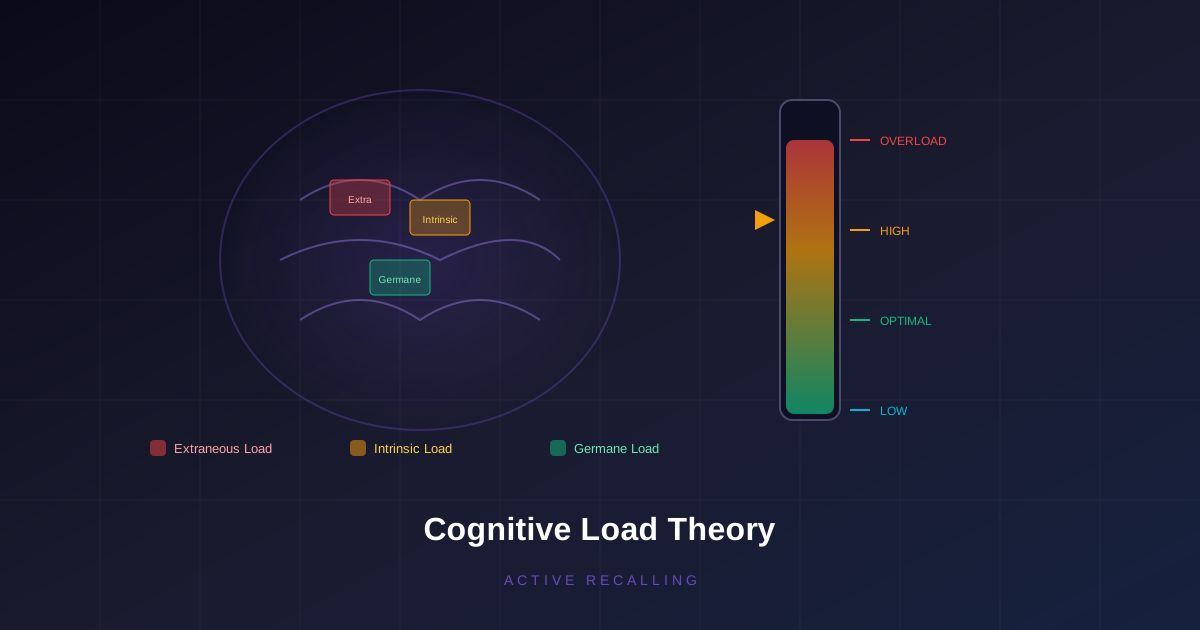
Have you ever sat down to study a complex topic, read through pages of material, and ended up feeling more confused than when you started? Or have you watched a video tutorial that jumped between so many ideas, diagrams, and annotations that you could barely follow along? If so, you have experienced the effects of cognitive overload, and the science behind this experience is one of the most important theories in education.
Cognitive load theory, developed by educational psychologist John Sweller in the late 1980s, explains why certain learning experiences are effective while others are overwhelming. At its core, the theory is based on a simple but powerful observation: your working memory has a limited capacity, and how that capacity is used during learning determines whether you actually learn.
In this article, we will explore the three types of cognitive load, understand why overload happens, and discover practical strategies for managing your mental resources to study more effectively.
The Foundation: Working Memory Is Limited
Cognitive load theory is built on the well-established finding that working memory, the cognitive system responsible for temporarily holding and processing information, has a severely limited capacity. Most estimates suggest that working memory can handle approximately three to five new items of information at any given time.
This limitation is critical because all new learning must pass through working memory before it can be stored in long-term memory. If working memory is overwhelmed, learning breaks down. Information that cannot be processed in working memory simply does not make it into long-term storage.
However, there is an important exception. Information that has already been stored in long-term memory and organized into well-structured schemas can be retrieved and used with minimal demands on working memory. This is why experts can handle complex information in their field that would overwhelm a novice: their long-term memory does much of the heavy lifting that a novice's working memory cannot.
The Three Types of Cognitive Load
Sweller and his colleagues identified three distinct types of cognitive load, each with different characteristics and implications for learning.
Intrinsic Cognitive Load
Intrinsic cognitive load is the mental effort inherent in the material itself. It is determined by the complexity of what you are trying to learn and, importantly, by the number of interacting elements that must be processed simultaneously in working memory.
Some topics are inherently more complex than others. Learning vocabulary in a new language has relatively low intrinsic load because each word can be learned independently. Learning to construct grammatically correct sentences in that language has higher intrinsic load because you must simultaneously consider vocabulary, grammar rules, word order, and meaning.
Intrinsic load cannot be changed by the way material is presented, but it can be managed. A common strategy is to sequence learning so that simpler elements are mastered before more complex ones are introduced. This reduces the number of new interacting elements that must be held in working memory at any one time.
Another way intrinsic load is reduced is through prior knowledge. As you learn the individual components of a complex topic and store them in long-term memory, those components can be retrieved as single chunks, freeing working memory capacity for processing the relationships between them.
Extraneous Cognitive Load
Extraneous cognitive load is the mental effort imposed by poor instructional design or inefficient study practices. It does not contribute to learning and wastes precious working memory resources on activities that are irrelevant to the learning goal.
Examples of extraneous load are everywhere. A textbook that places diagrams on a different page from the text that explains them creates extraneous load because you must mentally integrate the two while flipping back and forth. A lecture that includes amusing but irrelevant anecdotes creates extraneous load because your working memory processes the anecdotes at the expense of the core material. A study guide with an overly complex layout, decorative fonts, and inconsistent formatting creates extraneous load because your brain must work to navigate the format rather than focusing on the content.
Extraneous load is the most important target for optimization because it can be eliminated without reducing the richness or quality of learning. Every unit of working memory capacity freed from extraneous load becomes available for actual learning.
Germane Cognitive Load
Germane cognitive load is the mental effort devoted to processing, constructing, and automating schemas. It is the productive cognitive work of learning itself, the effort of making sense of new information, connecting it to existing knowledge, and organizing it into meaningful structures.
Unlike extraneous load, germane load is desirable and should be maximized. When a student struggles to understand how a new concept relates to what they already know, that is germane load at work. When a student reorganizes their notes into a concept map, the mental effort involved is germane load. When a student practices retrieving information from memory during self-testing, that effort is germane load.
The goal of effective studying is to minimize extraneous load and maximize germane load, all while keeping the total cognitive load within the limits of working memory capacity.
Key Principles and Effects
Cognitive load theory has generated a wealth of specific instructional principles, many of which have direct applications for self-directed learners.
The Split-Attention Effect
The split-attention effect occurs when learners must mentally integrate multiple sources of information that are physically or temporally separated. For example, a geometry diagram with labels that are explained in a separate paragraph requires you to split your attention between the diagram and the text, increasing extraneous load.
The solution is to integrate related information physically. Place explanations directly on or adjacent to the diagrams they refer to. When studying, annotate your diagrams rather than writing explanations separately. When taking notes during a lecture, write your notes directly alongside the relevant slide content.
The Redundancy Effect
The redundancy effect occurs when the same information is presented in multiple unnecessary formats. If a diagram is self-explanatory, adding a detailed text explanation of what the diagram already shows is redundant. The learner's working memory now has to process both the diagram and the text, and reconcile them, without any additional learning benefit.
When studying, be wary of materials that present the same information in multiple overlapping ways. Choose the format that works best for you and ignore redundant presentations. When creating study materials, avoid duplicating information unnecessarily.
The Worked Example Effect
The worked example effect demonstrates that novice learners benefit more from studying solved examples than from attempting to solve problems independently. This is because problem-solving imposes a high cognitive load on novices, who must simultaneously manage the problem state, search for relevant procedures, and evaluate potential solutions.
Worked examples reduce this load by showing the solution path, allowing learners to focus their cognitive resources on understanding why each step was taken. As expertise increases, however, worked examples become less beneficial and can even become detrimental, a phenomenon known as the expertise reversal effect. At that point, independent problem-solving becomes more effective.
The Expertise Reversal Effect
The expertise reversal effect is a critical insight of cognitive load theory. Instructional techniques that are effective for novices can become ineffective or even counterproductive for more advanced learners, and vice versa.
This happens because experts have well-developed schemas in long-term memory that handle much of the processing automatically. What helps a novice manage complexity (like worked examples or integrated formats) becomes redundant for an expert, adding unnecessary extraneous load. Conversely, what overwhelms a novice (like open-ended problem-solving) provides productive germane load for an expert.
The practical implication is that you should adjust your study strategies as your expertise develops. Start with worked examples, guided practice, and well-structured materials. As you gain proficiency, transition to independent problem-solving, less scaffolded materials, and more challenging applications.
Reducing Cognitive Overload: Practical Strategies
Understanding cognitive load theory leads to several actionable strategies for more effective studying.
Simplify Before Complexifying
When tackling a complex topic, start with the simplest version and gradually add complexity. Learn the basic concept before exploring exceptions. Master the standard procedure before attempting variations. Build your schema step by step rather than trying to absorb everything at once.
This approach, sometimes called progressive disclosure, respects the limitations of working memory by ensuring that each step is manageable and that each new element builds on a solid foundation of prior knowledge.
Eliminate Distractions Ruthlessly
Every distraction in your study environment consumes working memory resources that could be devoted to learning. Silence your phone. Close unnecessary browser tabs. Study in a quiet environment. Use a clean, uncluttered desk.
But distractions are not just external. Mental distractions, like worrying about an upcoming deadline or rehearsing a conversation, also consume working memory. Before studying, take a few minutes to write down any lingering concerns. Getting them out of your head and onto paper frees working memory for learning.
Use Clear, Well-Organized Study Materials
Invest time in organizing your study materials so they are easy to navigate. Use clear headings, consistent formatting, and logical structure. When creating notes, place related information together. When using textbooks, annotate them so key information is easy to find.
Avoid study materials that are visually cluttered, poorly organized, or excessively decorated. Aesthetic appeal should never come at the cost of clarity.
Segment Complex Material
Break complex information into manageable segments and master each segment before moving to the next. Do not try to read an entire chapter in one pass if the material is dense. Instead, read one section, pause to process and consolidate, and then move to the next.
This segmentation strategy keeps the total cognitive load within working memory's capacity at each step. It also provides natural checkpoints where you can assess your understanding before proceeding.
Leverage Prior Knowledge
Before studying new material, take a few minutes to activate relevant prior knowledge. Review what you already know about the topic. Look at the headings and subheadings to form a mental framework. Read the summary or conclusion first to get an overview.
This priming activates existing schemas in long-term memory, providing a structure into which new information can be integrated. The result is lower intrinsic load and more efficient encoding.
Use Dual Coding Wisely
Combining verbal and visual information can be powerful, but only when the two formats complement rather than duplicate each other. A diagram that shows spatial relationships combined with text that explains the process depicted in the diagram is an effective use of dual coding. Text that simply describes what is already obvious from the diagram adds extraneous load.
When creating study materials, ask yourself whether each element adds unique information. If a visual and a verbal representation say the same thing, keep the one that communicates most effectively and remove the other.
Practice Retrieval, Not Just Review
Retrieval practice is one of the most effective ways to build strong schemas while maintaining a manageable cognitive load. When you test yourself on material, you force your brain to reconstruct the information from memory, which strengthens the schema and makes it more resistant to forgetting.
Unlike rereading, which often creates an illusion of familiarity without genuine learning, retrieval practice provides honest feedback about what you actually know and what you need to review further.
Cognitive Load in the Digital Age
Modern students face unique cognitive load challenges that previous generations did not encounter. Digital devices present a constant stream of notifications, hyperlinks, and multimedia that can fragment attention and increase extraneous load.
Multitasking, in particular, is devastating for learning. When you switch between studying and checking social media, each switch imposes a cognitive cost. Your working memory must disengage from the study material, engage with the new task, and then re-engage with the study material, losing information and momentum at each transition.
The most effective digital study environments are those that minimize these interruptions. Use website blockers during study sessions. Turn off notifications. If you are watching an educational video, resist the urge to click on related links until you have finished and processed the current material.
Cognitive Load and Different Types of Learners
Cognitive load theory applies to all learners, but the specific implications vary based on expertise level, working memory capacity, and the nature of the material.
Novice learners benefit most from structured, well-scaffolded materials with low extraneous load. Worked examples, clear explanations, and guided practice are most effective at this stage.
Intermediate learners can handle more independence and begin to benefit from problem-solving and application tasks. Gradually reducing scaffolding as competence grows maintains an optimal level of germane load.
Advanced learners thrive with open-ended challenges, complex problems, and minimal guidance. At this stage, too much structure can actually impede learning by preventing the kind of effortful processing that builds expertise.
Conclusion
Cognitive load theory provides a scientific framework for understanding why some study sessions are productive and others feel like wasted time. The core message is that your working memory is a precious and limited resource, and how you manage that resource determines how effectively you learn.
By minimizing extraneous load through clear materials, organized environments, and focused attention, and by maximizing germane load through deep processing, schema building, and retrieval practice, you can make every study session more effective. The paradox at the heart of cognitive load theory is that less can truly be more: less clutter, less multitasking, and less complexity at each step leads to more learning, more understanding, and more lasting knowledge.