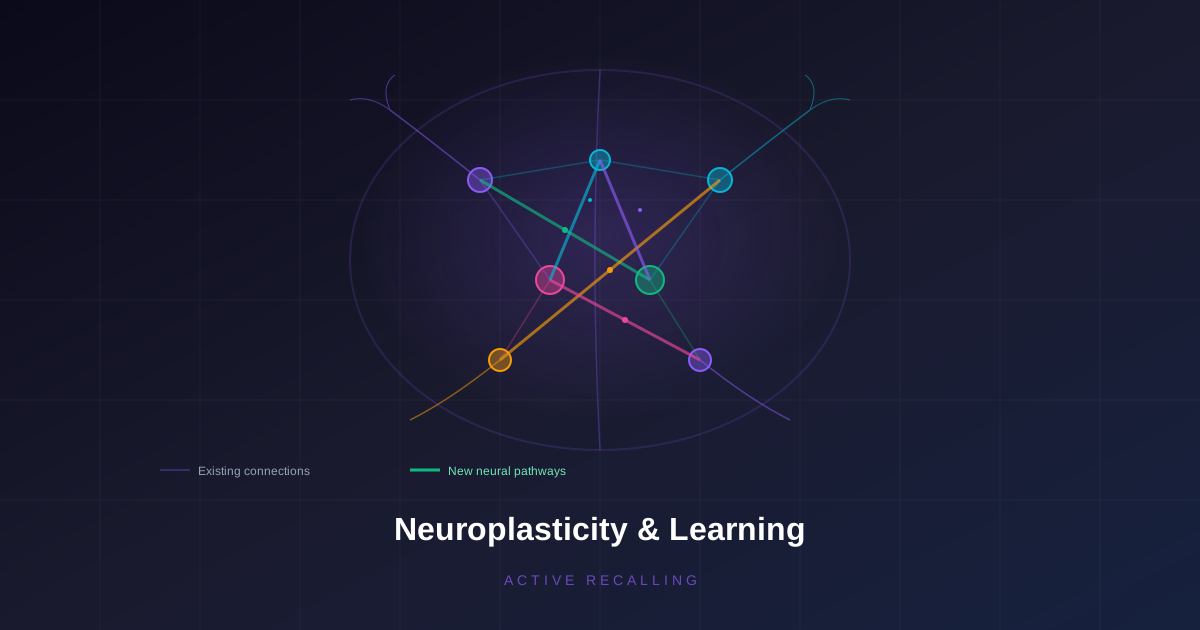
For most of the twentieth century, scientists believed that the adult brain was essentially fixed, a static organ that could lose neurons but never grow new ones, and whose basic wiring was set by the end of childhood. This view has been completely overturned. We now know that the brain is remarkably plastic, continuously reshaping itself in response to experience, learning, and even thought itself.
This capacity for change is called neuroplasticity, and it is one of the most important discoveries in modern neuroscience. For learners, neuroplasticity carries a profound message: your brain is not a fixed container with a predetermined capacity for knowledge. It is a living, dynamic organ that physically transforms as you learn. Understanding how this transformation works can change not only how you study but how you think about your own potential.
What Is Neuroplasticity?
Neuroplasticity (also called brain plasticity or neural plasticity) refers to the brain's ability to change its structure and function in response to experience. This includes changes at multiple levels, from the molecular and cellular to the level of large-scale brain networks.
Neuroplasticity is not a single process but an umbrella term for a wide range of mechanisms by which the brain adapts. These include the strengthening and weakening of existing connections between neurons, the formation of entirely new connections, the pruning of unused connections, changes in the production of neurotransmitters, and even the growth of new neurons in certain brain regions.
The term "plasticity" comes from the Greek word "plastos," meaning "molded." Just as clay can be shaped by a sculptor's hands, the brain is shaped by experience. But unlike clay, the brain is never finished. It continues to be shaped throughout your entire life.
Synaptic Plasticity: The Foundation of Learning
At the most fundamental level, learning involves changes in the connections between neurons. These connections are called synapses, and the modification of synaptic strength is known as synaptic plasticity.
How Neurons Communicate
Your brain contains approximately 86 billion neurons, and each neuron can form thousands of synaptic connections with other neurons, creating a network of staggering complexity. Neurons communicate by sending electrical signals down their long extensions called axons. When the signal reaches the end of an axon, it triggers the release of chemical messengers called neurotransmitters across the tiny gap (the synapse) to the next neuron. If enough neurotransmitter reaches the receiving neuron, it fires its own electrical signal, continuing the chain of communication.
The strength of a synaptic connection, meaning how effectively one neuron can activate another, is not fixed. It can be increased or decreased based on activity patterns. This modifiability is the physical basis of learning and memory.
Long-Term Potentiation (LTP)
The most studied form of synaptic plasticity is long-term potentiation (LTP), a process by which repeated stimulation of a synapse leads to a long-lasting increase in the strength of that connection. LTP was first described in 1973 by Terje Lomo and Timothy Bliss, who demonstrated that high-frequency stimulation of neural pathways in the hippocampus produced a lasting enhancement of synaptic transmission.
LTP is widely regarded as one of the primary cellular mechanisms underlying learning and memory. When you study a concept and successfully encode it, the synaptic connections representing that concept are strengthened through LTP. Each subsequent review further strengthens these connections, making the memory more durable and accessible.
Long-Term Depression (LTD)
The counterpart to LTP is long-term depression (LTD), a process by which synaptic connections are weakened. LTD is not a failure of the brain; it is an essential part of the learning process. By weakening irrelevant or incorrect connections, LTD helps refine neural circuits and allows the brain to focus its resources on the most important pathways.
Together, LTP and LTD provide a mechanism for the brain to selectively strengthen important connections and weaken unimportant ones, sculpting neural circuits based on experience.
Hebb's Rule: Neurons That Fire Together Wire Together
One of the most influential ideas in neuroscience was proposed by Canadian psychologist Donald Hebb in 1949. Hebb's rule, often summarized as "neurons that fire together wire together," states that when two neurons are activated at the same time, the connection between them is strengthened.
This principle has profound implications for learning. When you repeatedly associate two pieces of information, the neurons representing each piece become more strongly connected. Over time, activating one automatically activates the other. This is the neural basis of association, one of the most fundamental forms of learning.
Hebb's rule also explains why practice and repetition are so important. Each time you activate a particular neural pathway, whether by recalling a fact, practicing a skill, or thinking through a problem, the connections along that pathway are strengthened. The more you use a particular pattern of neural activity, the stronger and more efficient it becomes.
The Flip Side: Use It or Lose It
The corollary of Hebb's rule is equally important: connections that are not regularly activated tend to weaken and may eventually be pruned away. This is the neural basis of forgetting. When you stop reviewing information or practicing a skill, the corresponding neural connections gradually weaken, making the memory harder to access.
This "use it or lose it" principle underscores the importance of regular review and practice. It also explains why spaced repetition is so effective: by reactivating neural pathways at strategic intervals, you maintain and strengthen connections that would otherwise decay.
Structural Plasticity: Rewiring the Brain
Beyond changes in synaptic strength, the brain can undergo more dramatic structural changes in response to learning and experience.
Dendritic Growth and Remodeling
Dendrites are the branching extensions of neurons that receive input from other neurons. Learning can trigger the growth of new dendritic branches and the formation of new dendritic spines, the small protrusions where synapses form. This means that learning literally grows new physical structures in your brain.
Research has shown that enriched environments and complex learning tasks produce measurable increases in dendritic branching. Conversely, impoverished environments and lack of stimulation lead to dendritic shrinkage. The physical structure of your neurons reflects the richness of your learning experiences.
Myelination
Myelin is a fatty substance that wraps around the axons of neurons, acting as insulation that dramatically increases the speed of electrical signal transmission. When you practice a skill repeatedly, the relevant neural pathways become more heavily myelinated, allowing signals to travel faster and more efficiently.
This process of myelination is one reason why practiced skills feel so effortless compared to new ones. The neural circuits underlying well-practiced skills transmit signals with greater speed and precision, enabling the smooth, automatic performance that characterizes expertise.
Neurogenesis: Growing New Neurons
Perhaps the most dramatic form of structural plasticity is neurogenesis, the birth of entirely new neurons. For decades, it was dogma that the adult brain could not produce new neurons. This belief was overturned in the 1990s when researchers discovered that new neurons are indeed generated in certain regions of the adult brain, particularly the hippocampus, a structure critical for learning and memory.
Adult hippocampal neurogenesis has been linked to learning, memory, mood regulation, and stress response. Research in animals has shown that learning tasks, particularly those that are challenging and engaging, can increase the rate of neurogenesis. Physical exercise, a rich social environment, and adequate sleep also promote the production of new neurons.
While the extent and functional significance of adult neurogenesis in humans is still being studied, the discovery has fundamentally changed our understanding of the brain's capacity for change and growth.
Adult Neuroplasticity: It Is Never Too Late
One of the most empowering findings in neuroplasticity research is that the brain retains significant plasticity throughout adulthood. While it is true that the brain is most plastic during certain critical periods in childhood and adolescence, adult brains continue to change in response to learning and experience.
Evidence from Adult Learners
Studies of adult learners provide compelling evidence for ongoing neuroplasticity. Research on London taxi drivers, who must memorize the complex layout of London's streets to pass a rigorous licensing exam, found that their hippocampi were significantly larger than those of control subjects, and that the size increase correlated with the number of years spent driving.
Studies of musicians who began training in adulthood show measurable changes in brain structure and function, including enlarged motor cortex areas corresponding to the fingers used in their instrument. Research on people who learn to juggle shows increases in gray matter in visual and motor areas after just a few weeks of practice.
These studies demonstrate that the adult brain is far from fixed. It continues to respond to experience with structural and functional changes, though the rate and extent of change may be somewhat less than in childhood.
Implications for Lifelong Learning
The persistence of adult neuroplasticity means that it is never too late to learn. Whether you are learning a new language at forty, picking up a musical instrument at sixty, or returning to school at any age, your brain has the capacity to change and grow in response to the challenge.
However, adult neuroplasticity does not happen passively. It requires active engagement, challenge, and sustained effort. Simply going through the motions of a familiar routine does not drive significant neural change. It is the struggle with new and difficult material that triggers the plasticity mechanisms that reshape the brain.
What Drives Neuroplasticity?
Not all experiences are equally effective at triggering neuroplastic changes. Research has identified several factors that promote neuroplasticity.
Attention and Engagement
Neuroplasticity requires focused attention. Passively listening to a lecture while your mind wanders does not produce the same neural changes as actively engaging with the material. Research by Michael Merzenich and others has shown that attention is a gating mechanism for plasticity: the same stimulus can produce significant brain changes when attended to and virtually no change when ignored.
This finding reinforces the importance of active learning strategies. Reading passively is less effective than actively questioning, summarizing, and testing yourself, not just psychologically but neurologically.
Challenge and Difficulty
The brain changes most in response to tasks that are challenging but achievable. Activities that are too easy do not push the brain beyond its current capabilities and therefore do not drive significant plasticity. Activities that are too difficult produce frustration and disengagement. The optimal zone for neuroplastic change corresponds to what psychologists call the zone of proximal development, the range just beyond your current level of competence.
Repetition and Practice
While a single exposure can initiate neuroplastic changes, sustained practice is necessary to consolidate and maintain them. Each repetition strengthens the relevant neural pathways, and over time, these strengthened pathways become the brain's default mode of processing.
However, the quality of practice matters as much as the quantity. Deliberate practice, which involves focused effort, feedback, and progressive challenge, drives far more neuroplastic change than mindless repetition.
Sleep and Recovery
Sleep is essential for consolidating the neural changes initiated during learning. During sleep, the brain replays and strengthens newly formed neural patterns, a process that is critical for transferring information from short-term to long-term storage.
Research has shown that sleep deprivation impairs neuroplasticity and learning. Getting adequate sleep, particularly after a study session, is not a luxury; it is a biological necessity for effective learning.
Physical Exercise
Regular physical exercise is one of the most powerful known promoters of neuroplasticity. Exercise increases blood flow to the brain, promotes the release of growth factors like brain-derived neurotrophic factor (BDNF) that support neuronal growth and survival, and enhances hippocampal neurogenesis.
Students who exercise regularly tend to learn more effectively, and research suggests that this is not just because exercise improves mood and energy. Exercise directly enhances the biological mechanisms of learning.
Neuroplasticity and Learning Strategies
Understanding neuroplasticity provides a neurological rationale for many evidence-based learning strategies.
Active recall works because retrieving information from memory reactivates and strengthens the neural pathways encoding that information, a direct application of Hebb's rule.
Spaced repetition works because reactivating neural pathways at intervals prevents synaptic weakening and promotes long-term consolidation.
Interleaving works because switching between different types of material forces the brain to build more distinct and flexible neural representations.
Elaboration works because connecting new information to existing knowledge creates additional synaptic connections, building a richer and more interconnected neural network.
Sleep works because it provides the consolidation period necessary for newly formed synaptic changes to become permanent.
Mindset and Neuroplasticity
Psychologist Carol Dweck's research on growth mindset takes on added significance in light of neuroplasticity. Dweck found that students who believe intelligence is malleable (growth mindset) outperform those who believe intelligence is fixed (fixed mindset). Neuroplasticity provides the biological foundation for the growth mindset: intelligence and ability genuinely are malleable because the brain genuinely does change in response to learning.
Believing that you can improve is not just motivational thinking. It is a scientifically accurate understanding of how your brain works. When you struggle with difficult material, you are not bumping up against the limits of a fixed brain. You are actively reshaping a dynamic one.
Conclusion
Neuroplasticity is the biological foundation of learning. Every time you study, practice, or engage with challenging material, your brain physically changes, strengthening synapses, growing new dendritic branches, increasing myelination, and potentially even generating new neurons.
This knowledge carries both responsibility and hope. The responsibility is that effective learning requires active engagement, sustained effort, adequate sleep, and physical health, because these are the conditions that drive neuroplastic change. The hope is that your potential for learning is not fixed at birth or limited by age. Your brain is a living organ with a remarkable capacity for growth and change, and every study session is an opportunity to reshape it.
The science of neuroplasticity tells us that learning is not just about acquiring information. It is about physically building a better brain. And that is something every student can do.