If you have ever felt like you understood a topic while reading your notes but then struggled to answer exam questions that required you to apply or analyze the material, you have experienced one of the most common pitfalls in studying. The problem is not that you did not study enough. The problem is that you studied at the wrong level of cognitive depth.
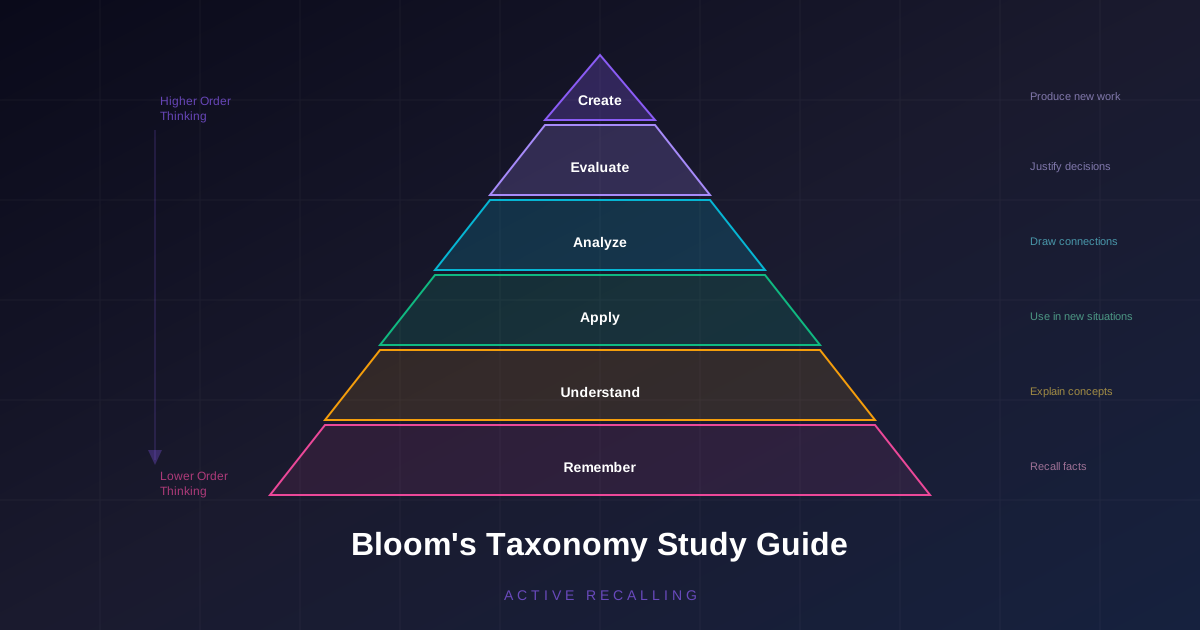
Bloom's Taxonomy is a framework that describes six levels of cognitive complexity, from simple recall of facts to sophisticated evaluation and creation. Originally developed in the 1950s by educational psychologist Benjamin Bloom and his colleagues, and later revised in 2001 by Lorin Anderson and David Krathwohl, this taxonomy has become one of the most widely used tools in education for understanding what it truly means to "learn" something.
For students, Bloom's Taxonomy is more than an abstract theory. It is a practical guide for studying at the right depth, preparing effectively for exams, and developing genuine understanding rather than superficial familiarity. In this article, we will walk through each level, explore study strategies tailored to each, and show you how to use the taxonomy to assess and deepen your own learning.
The Six Levels of Bloom's Taxonomy
The revised taxonomy describes six levels of cognitive processes, arranged from the simplest to the most complex. Each level builds on the ones below it, meaning you generally need to master lower levels before you can perform effectively at higher ones.
Level 1: Remember
The foundation of all learning is the ability to remember, to recognize and recall relevant information from long-term memory. This includes memorizing definitions, recalling facts, listing items, and identifying key terms.
At this level, you are answering questions like: What is the definition of photosynthesis? Who wrote Hamlet? What are the three branches of government?
Remembering is necessary but not sufficient for deep learning. Many students make the mistake of stopping here, assuming that being able to recall a definition means they understand the concept. In reality, remembering is only the first step.
Study strategies for this level:
Use flashcards to drill key terms, definitions, and facts. Employ spaced repetition to review material at increasing intervals, ensuring that information stays in long-term memory. Create mnemonics for lists and sequences that need to be memorized. Practice free recall by closing your notes and writing down everything you can remember about a topic.
Level 2: Understand
Understanding goes beyond memorization to grasp the meaning of information. At this level, you can explain concepts in your own words, summarize main ideas, give examples, compare and contrast related ideas, and interpret information.
Questions at this level look like: Explain how photosynthesis works in your own words. What is the main idea of this passage? How are mitosis and meiosis different?
Understanding is where genuine comprehension begins. If you can explain a concept clearly to someone else without looking at your notes, you have achieved understanding.
Study strategies for this level:
Practice paraphrasing by rewriting key concepts in your own words. Use the Feynman Technique: choose a concept, explain it as if teaching a twelve-year-old, identify gaps in your explanation, and go back to the source material to fill those gaps. Create summaries of each section or chapter without referring to the original text. Draw diagrams or concept maps that show how ideas relate to each other. Discuss concepts with study partners and explain ideas to one another.
Level 3: Apply
Application involves using knowledge in new and concrete situations. At this level, you can take a principle, method, or concept you have learned and use it to solve a problem, complete a task, or address a scenario you have not seen before.
Questions at this level look like: Use the formula for kinetic energy to calculate the energy of a moving object. Apply the principles of supply and demand to explain a real-world market situation. Demonstrate the correct procedure for titration.
Application is where knowledge becomes practical. It is the bridge between understanding a concept and being able to do something with it.
Study strategies for this level:
Work through practice problems that require you to apply formulas, principles, and procedures. Seek out novel problems that differ from the examples in your textbook, forcing you to adapt your knowledge rather than simply repeating a memorized procedure. Create real-world scenarios and practice applying concepts to them. After learning a principle, ask yourself: "Where could I use this? What kinds of problems does this solve?"
Use worked examples when you are first learning to apply a concept, studying the solution process carefully to understand not just what was done but why. Then transition to solving problems independently as your competence grows.
Level 4: Analyze
Analysis involves breaking information into its component parts, examining relationships between parts, and distinguishing relevant from irrelevant information. At this level, you can identify patterns, recognize underlying structures, detect assumptions, and evaluate the logic of arguments.
Questions at this level look like: What are the key factors that led to the economic crisis? How does the structure of this argument support or undermine its conclusion? Compare the methodologies of these two research studies.
Analysis is where critical thinking truly begins. It requires you to look beneath the surface and understand not just what something is, but how and why it works the way it does.
Study strategies for this level:
Practice breaking down complex information into its components. When reading an argument, identify the premises, the conclusion, and the logical connections between them. When studying a process, map out the individual steps and their relationships. Create comparison tables that highlight similarities and differences between related concepts, theories, or methods.
Ask analytical questions while studying: What are the parts of this system? How do they interact? What would happen if one part changed? What assumptions underlie this theory? What evidence supports each claim?
Practice categorization by sorting examples into groups based on their underlying features rather than surface characteristics. This builds the ability to see deep structure, which is essential for both analysis and transfer.
Level 5: Evaluate
Evaluation involves making judgments based on criteria and standards. At this level, you can assess the quality of arguments, the validity of evidence, the appropriateness of methods, and the merits of different positions.
Questions at this level look like: Which of these two theories better explains the observed data, and why? Is the methodology of this study appropriate for the research question? What are the strengths and weaknesses of this policy proposal?
Evaluation requires you to synthesize your knowledge and apply criteria to make reasoned judgments. It is a higher-order skill that builds on all the previous levels.
Study strategies for this level:
Practice critiquing arguments, research studies, and proposed solutions. Develop a set of criteria for evaluation (such as logical consistency, empirical support, and practical feasibility) and systematically apply them. Engage in debates with study partners, defending a position and then arguing the opposite side. Write evaluative essays that weigh the strengths and weaknesses of different approaches.
After studying a topic, ask yourself: What is the strongest evidence for this claim? What is the strongest evidence against it? What are the limitations of this approach? Under what conditions would this principle fail?
Read multiple sources on the same topic and compare how different authors present the evidence, structure their arguments, and reach their conclusions. This develops the ability to evaluate quality and reliability.
Level 6: Create
Creation is the highest level of Bloom's Taxonomy. It involves combining elements to form a coherent, novel whole. At this level, you can design experiments, formulate hypotheses, write original arguments, develop plans, and produce creative works.
Questions at this level look like: Design an experiment to test this hypothesis. Write a proposal for addressing this public health challenge. Develop a new theoretical framework that integrates these findings.
Creation does not mean producing something out of nothing. It means synthesizing existing knowledge in novel ways to produce something that did not exist before. It is the pinnacle of cognitive achievement and the ultimate goal of education.
Study strategies for this level:
Practice designing solutions to open-ended problems. Write original essays that synthesize ideas from multiple sources into a coherent argument. Create your own practice exam questions, especially questions that require analysis and evaluation, not just recall. Develop study guides or teaching materials for your peers, which requires you to organize, synthesize, and present knowledge in a clear and effective way.
Engage in project-based learning where you must apply and combine knowledge from multiple areas to produce a tangible result. Brainstorm what-if scenarios: What if this variable were different? What if we combined this theory with that approach? What new questions arise from what we have learned?
Using Bloom's Taxonomy for Self-Assessment
One of the most valuable applications of Bloom's Taxonomy is as a tool for self-assessment. By checking your understanding against each level, you can identify exactly where your knowledge is strong and where it needs development.
The Self-Assessment Process
After studying a topic, work through the levels systematically.
Can I remember the key terms, definitions, and facts? If not, you need more basic review.
Can I understand the concepts well enough to explain them in my own words? If not, you need to work on comprehension before moving higher.
Can I apply the concepts to solve new problems? If not, you need more practice with application.
Can I analyze the material by identifying components, relationships, and underlying structures? If not, you need to practice breaking down complex information.
Can I evaluate different claims, arguments, or approaches using appropriate criteria? If not, you need more practice with critical assessment.
Can I create something new by synthesizing and combining what I have learned? If not, you need more practice with open-ended, creative tasks.
This self-assessment process often reveals that students are stronger at lower levels and weaker at higher levels. This is normal and expected. The key is to identify the gaps and deliberately practice at the levels where you are weakest.
Matching Study Strategies to Exam Demands
Bloom's Taxonomy is also invaluable for exam preparation. By analyzing the types of questions your exam is likely to contain, you can match your study strategies to the required cognitive levels.
Multiple-choice exams that test definitions and facts primarily target the Remember and Understand levels. Problem-solving exams target Apply and sometimes Analyze. Essay exams often target Analyze, Evaluate, and Create. Case study exams typically span from Apply through Evaluate.
If your exam will require analysis and evaluation, studying only at the Remember level will leave you unprepared. Match the depth of your studying to the depth of the assessment.
Common Mistakes Students Make
Several common study habits reflect a failure to move beyond the lower levels of Bloom's Taxonomy.
Rereading notes primarily engages the Remember level. You may feel familiar with the material, but familiarity is not understanding, and understanding is not the ability to apply, analyze, or evaluate.
Highlighting text is another low-level activity. It requires only that you identify information as important, not that you understand, apply, or evaluate it.
Copying notes is primarily a Remember-level activity unless you are actively reorganizing and rephrasing the information.
Watching video lectures passively engages primarily the Remember and Understand levels. To benefit more, pause the video, summarize what was said, and try to answer questions about the material before continuing.
The antidote to these low-level study habits is to deliberately incorporate higher-level activities into your study routine. After rereading, explain. After highlighting, analyze. After copying, create.
Bloom's Taxonomy and Active Learning
Bloom's Taxonomy provides a theoretical foundation for the effectiveness of active learning strategies. Active recall, self-testing, teaching others, solving problems, and writing essays all engage higher levels of the taxonomy compared to passive strategies like rereading and highlighting.
This is why active learning produces better outcomes. It is not just that active learning is more effortful. It is that active learning engages the cognitive processes, application, analysis, evaluation, and creation, that produce deep, flexible, and durable understanding.
Conclusion
Bloom's Taxonomy is a map of cognitive depth. It shows you where you are, where you need to go, and what kinds of activities will get you there. By understanding the six levels, from remembering to creating, you can design study sessions that go beyond surface-level familiarity and build genuine, lasting understanding.
The most effective learners do not just study harder; they study at the right level. They recognize that memorizing definitions is only the beginning, and they deliberately practice explaining, applying, analyzing, evaluating, and creating. Bloom's Taxonomy gives you the vocabulary and the framework to do the same.
Next time you sit down to study, ask yourself: what level am I working at? And if the answer is only Remember or Understand, challenge yourself to go deeper. That is where real learning happens.