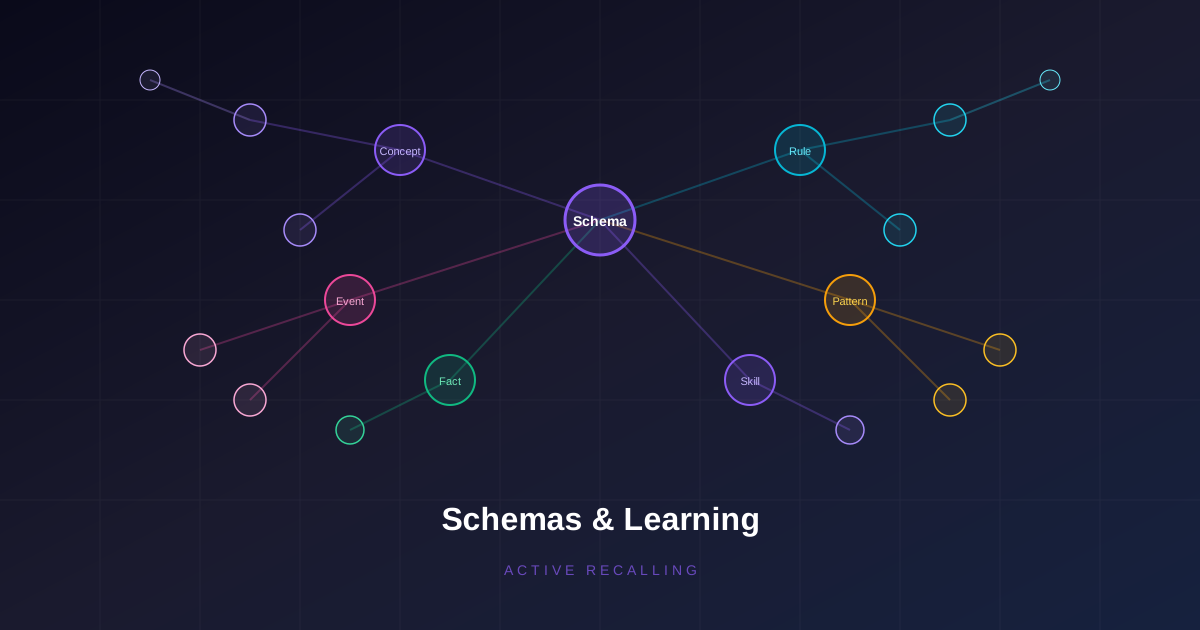
Think about what happens in your mind when you hear the word "restaurant." Without any conscious effort, a rich network of associated knowledge activates: menus, waiters, tables, ordering food, paying a bill, tipping. You know the general sequence of events, the roles different people play, and the social norms that apply. This organized body of knowledge is called a schema, and schemas are among the most important structures in your cognitive architecture.
Schemas are not just passive repositories of information. They actively shape how you perceive the world, how you interpret new experiences, and how effectively you learn and remember new information. Understanding how schemas work can fundamentally change your approach to studying and knowledge building.
What Are Schemas?
A schema (plural: schemas or schemata) is an organized mental framework that represents your knowledge about a concept, event, or category. Schemas are built from experience and prior learning, and they serve as templates that help you interpret and organize new information.
The concept of schemas was first introduced by the British psychologist Sir Frederic Bartlett in the 1930s. Through his famous studies on memory for stories, Bartlett demonstrated that people do not simply record experiences verbatim. Instead, they interpret and reconstruct memories based on their existing schemas. When participants recalled a Native American folk tale called "The War of the Ghosts," they systematically distorted the story to fit their own cultural schemas, omitting unfamiliar details and adding details that made the story more consistent with their expectations.
Swiss developmental psychologist Jean Piaget further developed schema theory as part of his influential work on cognitive development. Piaget described schemas as the basic building blocks of intelligence, structures that are continuously modified through experience.
Characteristics of Schemas
Schemas have several important characteristics that influence learning.
Schemas are hierarchical. They are organized in layers, with general schemas containing more specific sub-schemas. Your schema for "animal" contains sub-schemas for "mammal," "bird," "reptile," and so on, each of which contains even more specific schemas for individual species.
Schemas are interconnected. They do not exist in isolation but are linked to other schemas through associations, creating a vast network of knowledge. Your schema for "doctor" is connected to schemas for "hospital," "illness," "medicine," "health insurance," and many other concepts.
Schemas are dynamic. They change and develop as you gain new experiences and information. The schema a child has for "dog" is quite different from the schema a veterinarian has for "dog," reflecting vastly different levels of experience and knowledge.
Schemas are activated automatically. When you encounter a relevant stimulus, the corresponding schema activates without conscious effort, providing a framework for interpretation and action.
How Schemas Affect Learning
Schemas influence every stage of the learning process, from how you perceive new information to how you store and retrieve it.
Schemas Guide Attention
Your existing schemas determine what you notice and what you overlook. When reading a scientific article, an expert's schemas direct their attention to the key findings, methodological details, and theoretical implications, while a novice might focus on surface-level descriptions and miss the deeper significance.
This selective attention is generally helpful, but it can also lead to confirmation bias, where you preferentially attend to information that confirms your existing schemas while overlooking information that contradicts them. Being aware of this tendency is the first step to counteracting it.
Schemas Facilitate Encoding
New information that fits within an existing schema is encoded more easily and remembered better than information that does not. When you already have a schema for "how elections work," learning about the electoral process of a new country is much easier because you have an existing framework to integrate the new details into.
This is why prior knowledge is one of the strongest predictors of learning. The more you already know about a topic, the more schemas you have available, and the easier it is to learn more. Knowledge begets knowledge.
Schemas Support Retrieval
Schemas provide retrieval cues that help you access stored information. When you try to remember details about a topic, your schema for that topic activates and provides pathways to the specific information you are looking for. This is why organized knowledge is more accessible than isolated facts.
Schemas Enable Inference
Schemas allow you to go beyond the information given by filling in gaps with schema-based expectations. If someone tells you they went to a restaurant, you can infer that they probably looked at a menu, ordered food, ate a meal, and paid a bill, even though none of these details were mentioned. This ability to make schema-based inferences is essential for reading comprehension, problem-solving, and everyday reasoning.
Schema Modification: Assimilation and Accommodation
Piaget described two fundamental processes by which schemas change in response to new experience.
Assimilation
Assimilation occurs when new information is incorporated into an existing schema without changing the schema itself. If you have a schema for "bird" that includes features like "has wings, can fly, has feathers," and you encounter a robin, you simply assimilate this new example into your existing bird schema.
Assimilation is the default mode of learning. It is efficient and requires relatively little cognitive effort because the new information fits neatly into an existing framework.
Accommodation
Accommodation occurs when new information does not fit an existing schema, requiring the schema to be modified or a new schema to be created. If you encounter a penguin and try to assimilate it into your "bird" schema, you face a problem: penguins cannot fly. To accommodate this exception, you must modify your bird schema to include the possibility of flightless birds, or create a sub-schema for flightless birds.
Accommodation is more cognitively demanding than assimilation and can involve a period of confusion or discomfort known as cognitive disequilibrium. However, it is through accommodation that schemas grow more accurate and sophisticated. Without accommodation, your knowledge would remain oversimplified and prone to errors.
The Role of Disequilibrium
Piaget believed that learning is driven by the tension between assimilation and accommodation. When you encounter information that cannot be assimilated, you experience a state of cognitive disequilibrium that motivates you to modify your schemas. This temporary discomfort is a sign that genuine learning is occurring.
Effective learners embrace this discomfort rather than avoiding it. When something does not make sense, when new information contradicts what you thought you knew, that is precisely the moment when the most valuable learning can happen.
Schema Activation: Priming the Learning Pump
Before new learning can benefit from existing schemas, those schemas must be activated, brought into working memory where they can be used to interpret and integrate new information.
How Activation Works
Schema activation can occur through various cues: a word, an image, a question, or even a familiar context. When a teacher begins a lesson by reviewing what was covered in the previous class, they are activating relevant schemas in students' minds, preparing the cognitive ground for new learning.
Activation is not all-or-nothing. Schemas can be activated to different degrees, and the degree of activation influences how much they contribute to learning. A schema that is highly activated will exert a strong influence on how new information is interpreted and encoded.
Pre-Learning Strategies
Several strategies can help activate relevant schemas before engaging with new material.
Previewing involves scanning the material before reading it in detail, looking at headings, subheadings, bold terms, and summaries. This activates relevant schemas and provides an organizational framework for the detailed learning that follows.
Advance organizers, a concept introduced by David Ausubel, are introductory materials that provide a general framework for the specific content that will follow. They work by activating and organizing existing schemas so that new information can be more easily assimilated.
Self-questioning before studying, asking yourself what you already know about the topic and what you expect to learn, activates existing schemas and creates a state of active readiness for new information.
KWL charts (Know, Want to know, Learned) are a structured way to activate prior knowledge before studying. By listing what you already know and what you want to learn, you prime the relevant schemas and set clear learning goals.
Building Better Schemas: Strategies for Learners
Since schemas are the foundation of effective learning, building strong, accurate, and well-organized schemas should be a primary goal of any study strategy.
Elaborate on New Information
Elaboration is the process of adding detail, context, and connections to new information. When you elaborate on what you are learning, you create richer and more interconnected schemas. Ask yourself why the information is true, how it relates to other concepts, and what examples illustrate the principle.
The more connections you create within and between schemas, the more robust and accessible those schemas become. A schema with many connections is like a city with many roads: there are many routes to reach any destination, making it easy to access the information from various starting points.
Use Analogies to Bridge Old and New
Analogies are powerful tools for schema building because they explicitly connect new information to existing schemas. When a teacher explains electricity by comparing it to water flowing through pipes, they are helping students leverage their existing schema for water flow to build a new schema for electrical current.
When studying, actively seek analogies between what you are learning and what you already know. The more vivid and personally meaningful the analogy, the more effective it will be at supporting schema construction.
Organize Information Hierarchically
Schemas are naturally hierarchical, and studying in a way that respects this structure promotes better schema construction. Create outlines that move from general categories to specific details. Use concept maps that show the relationships between ideas at different levels of abstraction.
When reviewing notes, reorganize them into hierarchical structures rather than leaving them in the chronological order in which you wrote them. This reorganization process itself is a powerful form of learning because it requires you to identify the relationships between different pieces of information.
Seek Out Diverse Examples
Exposure to multiple and varied examples of a concept builds a more robust and flexible schema than exposure to a single example. If you only encounter one example of a principle, your schema will be too narrow and tied to the specific features of that example. Multiple diverse examples help you abstract the essential features and distinguish them from incidental ones.
When studying, actively seek out examples that differ in their surface features but share the same underlying structure. This variety strengthens the core of the schema while making it more flexible and transferable.
Confront Misconceptions Directly
Misconceptions are schemas that contain inaccurate information. They are often resistant to change because new information that contradicts them is either ignored (due to schema-driven selective attention) or distorted to fit the existing schema (assimilation without accommodation).
Overcoming misconceptions requires deliberate accommodation. First, you must become aware of the misconception. Then, you must encounter compelling evidence that contradicts it. Finally, you must be provided with or construct an alternative schema that better accounts for the evidence.
When studying, actively seek out common misconceptions in the topic you are learning. Textbooks and educational resources often highlight these. By confronting misconceptions head-on, you can ensure that your schemas are accurate from the start.
Test and Revise Your Schemas
Regular self-testing serves as a quality check on your schemas. When you test yourself and find gaps or errors, you have identified areas where your schemas need revision. Without testing, inaccurate or incomplete schemas can persist unchallenged.
After testing, take the time to correct and strengthen the schemas that were found wanting. Review the material, seek additional explanations, and practice until the corrected information is firmly established.
Schemas and Expert Performance
One of the most striking findings in the study of expertise is the difference between expert and novice schemas. Experts have schemas that are larger, more detailed, more interconnected, and better organized than those of novices. These rich schemas allow experts to rapidly recognize patterns, make accurate predictions, and solve problems efficiently.
The development of expert-level schemas takes time and deliberate effort. There are no shortcuts. But understanding that schema development is the core mechanism of expertise can motivate you to invest in the deep, connected, elaborative learning that builds strong schemas, rather than the superficial memorization that produces only fragile and isolated facts.
The Connection Between Schemas and Other Learning Strategies
Many effective learning strategies can be understood in terms of their effect on schemas. Spaced repetition strengthens schemas by reactivating them at optimal intervals. Active recall tests and reinforces the accuracy of schemas. Interleaving helps build schemas that are flexible and discriminating. Elaborative encoding enriches schemas with additional connections and details.
Understanding schemas provides a unifying framework for understanding why different learning strategies work and how they complement each other.
Conclusion
Schemas are the invisible architecture of your mind, the organized frameworks that shape how you perceive, interpret, learn, and remember. They are built through experience and refined through the ongoing processes of assimilation and accommodation.
For learners, the practical message is clear: invest in building strong, accurate, well-connected schemas. Activate your prior knowledge before studying. Elaborate on new information to create rich connections. Seek out diverse examples to build flexible schemas. Test yourself regularly to identify and correct weaknesses. And embrace the temporary discomfort of accommodation, because that is where the deepest learning happens.
The quality of your schemas is the quality of your knowledge. By understanding how schemas work and deliberately cultivating them, you give yourself the strongest possible foundation for effective, lasting learning.