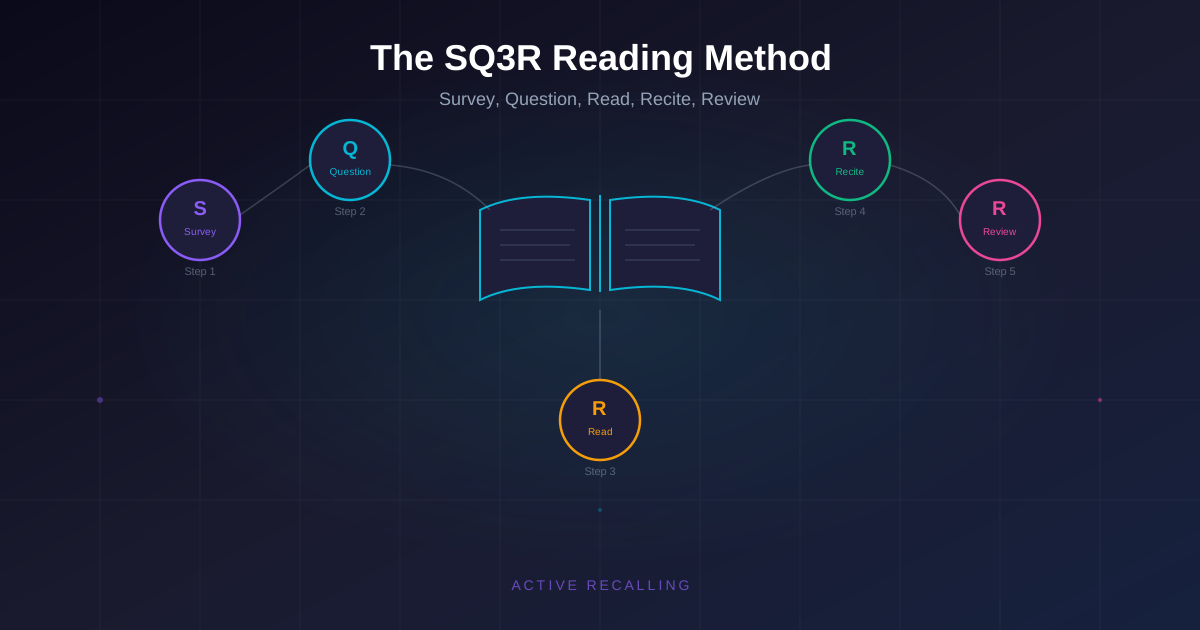
What Is the SQ3R Method?
SQ3R stands for Survey, Question, Read, Recite, and Review — a five-step active reading strategy developed by educational psychologist Francis P. Robinson in 1946. Originally designed to help military personnel study more effectively during World War II, it has since become one of the most widely taught and researched reading methods in education.
The fundamental insight behind SQ3R is that reading is not the same as learning. You can read an entire textbook chapter from start to finish and retain almost nothing. This is because passive reading — moving your eyes over words without actively processing their meaning — creates only superficial engagement with the material. Information enters short-term memory and dissipates within minutes.
SQ3R transforms reading from a passive activity into an active learning process. Each of its five steps adds a layer of cognitive engagement that deepens comprehension and strengthens retention. The method works because it aligns with established principles of cognitive science: it activates prior knowledge, creates purpose-driven reading, forces self-testing, and incorporates spaced review.
Despite being nearly 80 years old, SQ3R remains relevant because the underlying cognitive principles haven't changed. Human memory still works the same way, and the challenges students face with dense reading material are remarkably consistent across generations.
The Five Steps in Detail
Step 1: Survey
Before reading a single paragraph of body text, survey the entire chapter or section. This should take no more than five to ten minutes and involves scanning the following elements:
- The title and subtitle of the chapter
- The introduction or opening paragraph
- All headings and subheadings throughout the chapter
- Any bold or italicized terms
- Figures, charts, graphs, and their captions
- Summary or conclusion at the end
- Review questions if provided
The purpose of surveying is to build a mental framework before you encounter the details. Think of it as looking at the picture on a jigsaw puzzle box before you start assembling the pieces. The big picture helps you understand where each piece belongs, making the assembly process faster and more coherent.
Surveying also activates your prior knowledge. As you scan headings and key terms, your brain automatically begins retrieving related information you already know. This creates mental "hooks" that new information can attach to during reading, dramatically improving comprehension and retention.
Many students skip this step because it feels like wasted time. They want to dive straight into reading. But research consistently shows that the few minutes spent surveying save far more time during the reading and review phases. Students who survey first read more efficiently, understand more on the first pass, and spend less time re-reading.
Step 2: Question
After surveying, go back to the beginning and turn each heading into a question. This step transforms your reading from passive consumption into an active search for answers.
If a heading reads "Causes of the French Revolution," your question becomes "What were the causes of the French Revolution?" If a heading reads "Photosynthesis in C4 Plants," your question becomes "How does photosynthesis work in C4 plants, and how is it different from other plants?"
You can also generate questions from:
- Bold terms: "What does this term mean?"
- Figures and graphs: "What is this diagram showing?"
- Your own curiosity: "Why is this important?" or "How does this connect to what we learned last week?"
The act of questioning does two important things. First, it creates a purpose for reading. Instead of vaguely reading to "understand the chapter," you're reading to answer specific questions. This focused attention leads to deeper processing. Second, it engages your curiosity, which research shows enhances memory formation. When you want to know the answer to a question, your brain is primed to encode the answer more effectively when you find it.
Write your questions down. Having them in front of you during reading keeps you focused and gives you a checklist for the Recite step later.
Step 3: Read
Now read the material, one section at a time. Read actively, with your questions in mind. Your goal is to find answers to the questions you generated in Step 2.
Key principles for active reading:
Read one section before moving to the next. Don't try to read the entire chapter in one continuous pass. Stop at the end of each section (usually marked by a heading change) and complete the Recite step before continuing. This breaks the reading into manageable chunks and prevents the back-of-the-chapter effect, where you remember the ending but have forgotten the beginning.
Pay attention to how the text is organized. Is the author presenting a chronological sequence? A comparison? A cause-and-effect relationship? A list of examples? Understanding the structure helps you organize the information in your own mind.
Note key terms and definitions. When you encounter a bolded or italicized term, make sure you understand what it means before moving on. Definitions are the building blocks of understanding in any subject.
Don't highlight excessively. Research shows that highlighting is one of the least effective study strategies because it creates an illusion of engagement without requiring deep processing. If you must mark the text, limit yourself to the most essential points, and combine highlighting with margin notes in your own words.
Slow down for difficult passages. If a paragraph is confusing, don't just push through. Stop, re-read it, and try to identify what specifically you don't understand. Is there a term you don't know? A logical step that doesn't make sense? Pinpointing the confusion is the first step to resolving it.
Step 4: Recite
After reading each section, stop and recite the key points from memory. Close the book or look away from the screen. Try to answer the questions you generated in Step 2 without looking at the text. Summarize the main ideas in your own words, either out loud or in writing.
This step is where the real learning happens. Reciting is a form of active recall — you're retrieving information from memory rather than just recognizing it on the page. Research by Roediger and Karpicke showed that this retrieval practice is one of the most powerful learning techniques available, significantly outperforming re-reading in terms of long-term retention.
If you can't recall a key point, that's valuable feedback. It tells you exactly what you didn't fully understand or encode. Go back to the text, re-read that specific point, and then try reciting again. This cycle of attempt, feedback, and correction is how learning deepens.
How to recite effectively:
- Cover the text and try to answer your questions from memory
- Summarize the section in two or three sentences using your own words
- Explain the key concept as if teaching it to someone else
- Write brief notes from memory (then check them against the text)
The recitation doesn't need to be word-perfect. You're testing your understanding, not your ability to reproduce exact phrases. If you can explain the concept in your own words, you understand it. If you can only repeat the textbook's phrasing, you might be relying on recognition rather than genuine comprehension.
Step 5: Review
After completing all sections, review the entire chapter. This final step consolidates your learning and helps you see how the individual sections connect to form a coherent whole.
During the review phase:
- Read through your notes and questions
- Try to answer all of your questions from memory one more time
- Look at the big picture: How do the sections relate to each other?
- Identify any remaining gaps in your understanding
- Connect the material to previous chapters or prior knowledge
The review should happen immediately after finishing the chapter, and then again at spaced intervals — the next day, then after three days, then after a week. This spaced review practice moves information from short-term to long-term memory far more effectively than a single intensive review session.
Some students find it helpful to create a one-page summary of the chapter during the review phase. This summary captures the key points and serves as an efficient review tool for future study sessions.
When to Use SQ3R
Ideal Scenarios
SQ3R is most effective for dense, information-rich textbooks that are well-organized with clear headings and subheadings. It works particularly well for:
- Science textbooks with structured chapters covering concepts, mechanisms, and applications
- History textbooks organized chronologically or thematically
- Psychology and social science texts that present research findings and theories
- Professional and technical manuals with clearly delineated topics
The method is also excellent for exam preparation, where thorough understanding and reliable recall are essential. Students who use SQ3R during the semester report needing less cramming before exams because the material is already well-encoded.
Less Ideal Scenarios
SQ3R is less suited for narrative texts like novels or personal essays, where the structure is fluid and headings are absent. It's also overkill for light reading where deep retention isn't the goal. And it can feel cumbersome for very short readings — the overhead of surveying and questioning isn't worth it for a two-page article.
For mathematical or problem-solving texts, SQ3R provides a good framework for understanding the conceptual content but needs to be supplemented with practice problems. Understanding why a formula works (SQ3R helps here) is different from being able to apply it (practice is needed).
Modifications and Adaptations
SQ4R: Adding "Relate"
Some educators add a sixth step: Relate. After the Review step, you actively connect the new material to your existing knowledge. How does this chapter relate to what you learned previously? How does it apply to real-world situations? This additional step deepens understanding by embedding new knowledge within your existing mental framework.
SQ3R for Digital Reading
The method works for digital texts as well, though some adjustments help. During the Survey step, use the table of contents or document outline rather than physically flipping through pages. During the Question step, type your questions into a separate document. During Recite, minimize the reading window and type your recall responses.
One challenge of digital reading is the tendency to skim. The SQ3R structure counteracts this by requiring you to engage with the text at multiple levels.
Collaborative SQ3R
SQ3R can be adapted for study groups. Each member independently surveys and questions the chapter before the group meets. During the meeting, members take turns reciting key points and answering each other's questions. The group review phase becomes a discussion where members share perspectives and fill in each other's gaps.
Speed-Modified SQ3R
When time is limited, you can compress the method. Spend just two minutes surveying, generate questions only for the most important headings, read with particular focus on answering those priority questions, recite only the most critical points, and review using just your summary notes. You lose some thoroughness, but the core active reading principles still operate.
Why SQ3R Works: The Cognitive Science
SQ3R's effectiveness rests on several well-established cognitive principles:
Schema activation (Survey step): By previewing the material, you activate existing knowledge structures that help you organize and interpret new information. New facts don't land in a vacuum — they attach to what you already know.
Elaborative interrogation (Question step): Generating questions about material before reading it promotes deeper processing than simply reading to understand. Questions create a "need to know" that primes your brain for encoding.
Distributed practice (Reading section by section): Breaking reading into chunks with recitation between sections distributes your practice, which is far more effective than massed practice (reading everything at once).
Retrieval practice (Recite step): Testing yourself on material strengthens memory traces far more than re-reading. Each successful retrieval makes the next retrieval easier.
Spaced review (Review step): Reviewing at increasing intervals leverages the spacing effect to build durable long-term memories.
Common Mistakes Students Make
Skipping the Survey. This is the most common shortcut, and it's costly. Without a preview, you read without context, and every new section feels disconnected from the last.
Writing questions that are too vague. "What is this section about?" isn't specific enough to drive focused reading. Aim for questions that require specific, substantive answers.
Reading the entire chapter before reciting. The recitation step works best when done after each section, not at the end of the chapter. By the time you finish a long chapter, you've already forgotten the early sections.
Confusing recognition with recall during recitation. Looking at your notes and thinking "yes, I knew that" is not recitation. True recitation means producing the information from memory without any cues from the text.
Doing one review and calling it done. A single review after reading is better than nothing, but spaced reviews at increasing intervals are what move information into long-term memory.
Conclusion
The SQ3R method transforms reading from a passive, inefficient activity into a structured, active learning process. Each step builds on the previous one: surveying creates context, questioning creates purpose, reading with purpose creates understanding, reciting tests and strengthens that understanding, and reviewing consolidates everything into lasting knowledge.
It takes more effort than simply reading a chapter from start to finish. But the trade-off is substantial: better comprehension, stronger retention, and less time spent re-reading material you've already forgotten. For any student dealing with dense, information-rich reading assignments, SQ3R provides a reliable system for turning pages of text into genuine learning.