What Is Chunking?
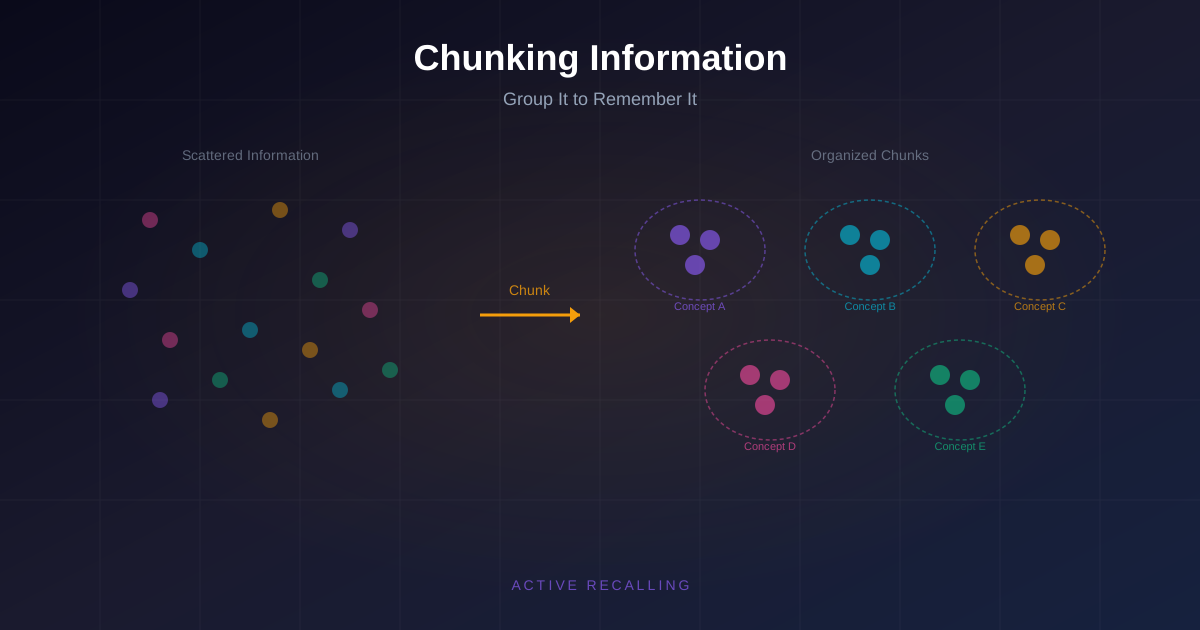
Chunking is a cognitive strategy that involves grouping individual pieces of information into larger, meaningful units — or "chunks" — to make them easier to process and remember. Instead of trying to remember seven separate items, you organize them into two or three groups, dramatically reducing the load on your working memory.
Consider a phone number: 4158927463. Trying to remember ten individual digits is difficult. But if you chunk it into 415-892-7463, suddenly it becomes three manageable groups. You've reduced ten items to three chunks without losing any information. This simple reorganization is the essence of chunking, and it applies to far more than just numbers.
Chunking is not just a memorization trick. It's a fundamental process in how experts in every field organize and access their knowledge. Chess grandmasters don't see 32 individual pieces — they see familiar patterns of pieces that represent known strategies. Experienced programmers don't read code character by character — they recognize entire patterns and structures at a glance. This ability to perceive meaningful units rather than individual elements is what separates novices from experts in virtually every domain.
Miller's Law: The Magical Number 7 Plus or Minus 2
In 1956, cognitive psychologist George Miller published one of the most influential papers in the history of psychology: "The Magical Number Seven, Plus or Minus Two." In it, he argued that the capacity of human working memory — the mental workspace where we hold and manipulate information in the moment — is limited to roughly seven items, give or take two.
This means that at any given moment, you can only actively hold between five and nine separate pieces of information in your mind. Try to exceed that limit, and information starts falling out. This is why you can remember a seven-digit phone number long enough to dial it, but a twelve-digit international number feels impossibly long without writing it down.
However, Miller made a crucial observation: the limit applies to chunks, not to individual pieces of information. A chunk can be a single letter, a word, a phrase, or even an entire concept — as long as it's a meaningful unit that your brain can treat as one item. This means that the effective capacity of working memory is flexible. By creating larger, richer chunks, you can pack more total information into those seven slots.
This insight has profound implications for learning. If you're studying a new subject and every term, fact, and relationship is a separate item, you'll quickly overwhelm your working memory. But if you can organize that information into meaningful groups — chunking it — you can handle far more material at once.
Modern Refinements
More recent research has suggested that Miller's estimate may have been generous. Psychologist Nelson Cowan proposed in 2001 that the true capacity of working memory is closer to four chunks, not seven. The exact number remains debated, but the principle is the same: working memory is severely limited, and chunking is the primary strategy for working within those limits effectively.
How Chunking Works in the Brain
When you encounter new information, it enters working memory as individual, disconnected elements. Each element occupies one slot. As you begin to see relationships between elements — patterns, categories, sequences — your brain starts binding them together into single representations.
This binding process involves the prefrontal cortex, which is responsible for organizing and maintaining information in working memory, and the hippocampus, which helps form new associations between items. Once a chunk is formed, it functions as a single unit in working memory, freeing up capacity for additional information.
Over time, with practice and repetition, chunks become stored in long-term memory. When you encounter them again, you don't need to rebuild the chunk from scratch — you recognize it as a familiar unit and load it into working memory as one item. This is why experts can process information so much faster than novices: they have a vast library of pre-formed chunks in long-term memory that they can deploy instantly.
Expert Chunking: How Professionals Think
Chess Masters
One of the most famous demonstrations of expert chunking comes from chess research. In the 1970s, psychologists Chase and Simon showed chess players arrangements of pieces on a board for a few seconds and then asked them to reconstruct what they had seen.
Grandmasters could reproduce the positions with remarkable accuracy — but only when the pieces were arranged in patterns from real games. When the pieces were placed randomly, grandmasters performed no better than beginners. This proved that the masters weren't relying on superior general memory — they were recognizing meaningful patterns (chunks) from their vast experience with chess positions.
A grandmaster might look at a board and see "a Sicilian Defense setup with a kingside attack developing" — a single complex chunk — where a novice sees 32 individual pieces that need to be individually remembered.
Musicians
Experienced musicians chunk musical notation in similar ways. A beginner reads each note individually. An intermediate player recognizes common scales and chord patterns. A virtuoso sees entire phrases, harmonic progressions, and structural patterns at a glance. This chunking allows them to sight-read complex pieces that would be impossible if they had to process every note as a separate item.
Medical Professionals
Doctors develop diagnostic chunks through years of training and experience. A cluster of symptoms that a medical student must analyze one at a time — fever, rash, joint pain, fatigue — might be instantly recognized by an experienced physician as a single pattern: lupus. This pattern recognition, built through thousands of patient encounters, is expert chunking in action.
Types of Chunking Strategies
Categorical Chunking
Group items by category or shared characteristics. If you're trying to remember a shopping list of twenty items, organize them by store section: produce (apples, broccoli, lettuce), dairy (milk, cheese, yogurt), pantry (rice, pasta, flour), and so on. Instead of twenty individual items, you now have four or five category chunks, each containing a few related items.
This works because categories provide a retrieval structure. When you think "dairy," it activates all the items associated with that category, making them easier to recall.
Sequential Chunking
Group items by their position in a sequence or temporal order. This is how we naturally chunk phone numbers, credit card numbers, and dates. The sequence 14921776186519452001 is nearly impossible to remember as a string of digits, but chunked as 1492-1776-1865-1945-2001, it becomes five recognizable historical dates.
Sequential chunking is particularly useful for procedural knowledge — remembering the steps in a process, the phases of a project, or the order of events in a historical narrative.
Meaningful Association Chunking
Create chunks by finding meaningful connections between items that might not be obviously related. This often involves creating stories, images, or acronyms that link items together.
The acronym "HOMES" for the Great Lakes (Huron, Ontario, Michigan, Erie, Superior) is a classic example. Five separate names become one memorable chunk. Similarly, the sentence "Every Good Boy Does Fine" chunks the notes on the lines of the treble clef (E, G, B, D, F) into a single memorable phrase.
Hierarchical Chunking
Organize information in a multi-level hierarchy where large chunks contain smaller chunks, which in turn contain individual items. This mirrors how most complex knowledge is naturally structured.
For example, when studying biology, you might organize information as: Biology contains several major topics (chunk level 1). One topic is Cell Biology (chunk level 2). Cell Biology includes Cell Structure, Cell Division, and Cell Signaling (chunk level 3). Cell Structure includes Organelles, Membrane, and Cytoskeleton (chunk level 4). Each organelle — mitochondria, nucleus, endoplasmic reticulum — is an individual item within that chunk.
This hierarchical structure means you can navigate from the big picture down to specific details, and the organizational structure itself aids recall.
Practical Chunking Tips for Students
When Reading Textbooks
Don't try to absorb an entire chapter in one pass. Break it into sections and summarize each section in your own words before moving on. Each summary becomes a chunk that represents the key ideas of that section. When you finish the chapter, you have a manageable number of section-level chunks rather than an overwhelming mass of details.
When Taking Notes
Organize your notes using headings and subheadings that reflect the hierarchical structure of the material. Use bullet points to group related facts under each heading. Leave white space between sections. The visual structure of your notes mirrors the chunking structure in your mind, making both note-taking and later review more efficient.
When Memorizing Lists
If you need to memorize a list, first look for natural groupings. Can you sort items by category, by first letter, by chronological order, or by any other meaningful attribute? If no natural grouping exists, impose one. Create acronyms, make up stories, or assign items to categories you invent. Any organizational structure is better than none.
When Learning New Vocabulary
Group new words by theme, word family, or grammatical pattern rather than studying them in random order. Learning all the kitchen-related words in a foreign language at once creates a meaningful chunk anchored to a context you already understand. This contextual chunking makes individual words easier to recall because they're tied to a rich network of associations.
When Studying Complex Processes
Break complex processes into stages, and master one stage before moving to the next. For a process with twelve steps, identify three or four natural phases. Learn the steps within each phase as a group, then connect the phases together. This progressive chunking builds your understanding from manageable pieces into a complete picture.
Chunking and Working Memory in Practice
Reducing Cognitive Overload
One of the most practical applications of chunking is managing cognitive overload — the state where too much information exceeds your working memory capacity. When you feel overwhelmed by the complexity of a topic, that's often a signal that you need to chunk more aggressively.
Step back and ask: What are the three or four big ideas here? Group everything else under those big ideas. This instantly reduces the number of items competing for space in your working memory and gives you a framework for organizing the details.
Building Chunks Through Practice
Chunks don't form instantly. They develop through repeated exposure and practice. The first time you see a chess pattern or a code structure, it's a collection of individual elements. After seeing it ten times, it starts to coalesce into a recognizable unit. After seeing it a hundred times, it's an automatic, effortless chunk.
This is why practice is so important in skill development. You're not just building speed — you're building chunks that allow you to process more information simultaneously, freeing up working memory for higher-level thinking and problem-solving.
Transfer Between Domains
Interestingly, chunks are largely domain-specific. Being an expert chess player doesn't help you chunk medical information, and vice versa. However, the meta-skill of chunking — the ability to recognize and create patterns — does transfer. Once you understand how chunking works and have practiced it in one domain, you become better at applying it to new areas.
Chunking as a Foundation for Deeper Learning
Chunking is not just a memory aid — it's a prerequisite for higher-order thinking. You can't analyze, evaluate, or create with information that you can't hold in working memory. By chunking effectively, you free up mental resources for the deep thinking that transforms memorized facts into genuine understanding.
When a history student chunks a set of events into a narrative arc, they're not just making the events easier to remember — they're creating a framework for understanding cause and effect. When a science student chunks related concepts into a model, they're building the foundation for prediction and experimentation.
Conclusion
Chunking is one of the most fundamental and versatile learning strategies available. It works with the natural constraints of human cognition rather than against them, transforming the severe limitations of working memory from an obstacle into a manageable challenge. Whether you're memorizing vocabulary, studying complex systems, or building expertise in a professional domain, the ability to organize information into meaningful groups is what makes learning possible.
The next time you feel overwhelmed by a mass of new information, remember Miller's insight: you don't need a bigger memory — you need better chunks. Find the patterns. Create the groups. Build the hierarchy. Your working memory is limited, but with effective chunking, what you can accomplish within those limits is extraordinary.