
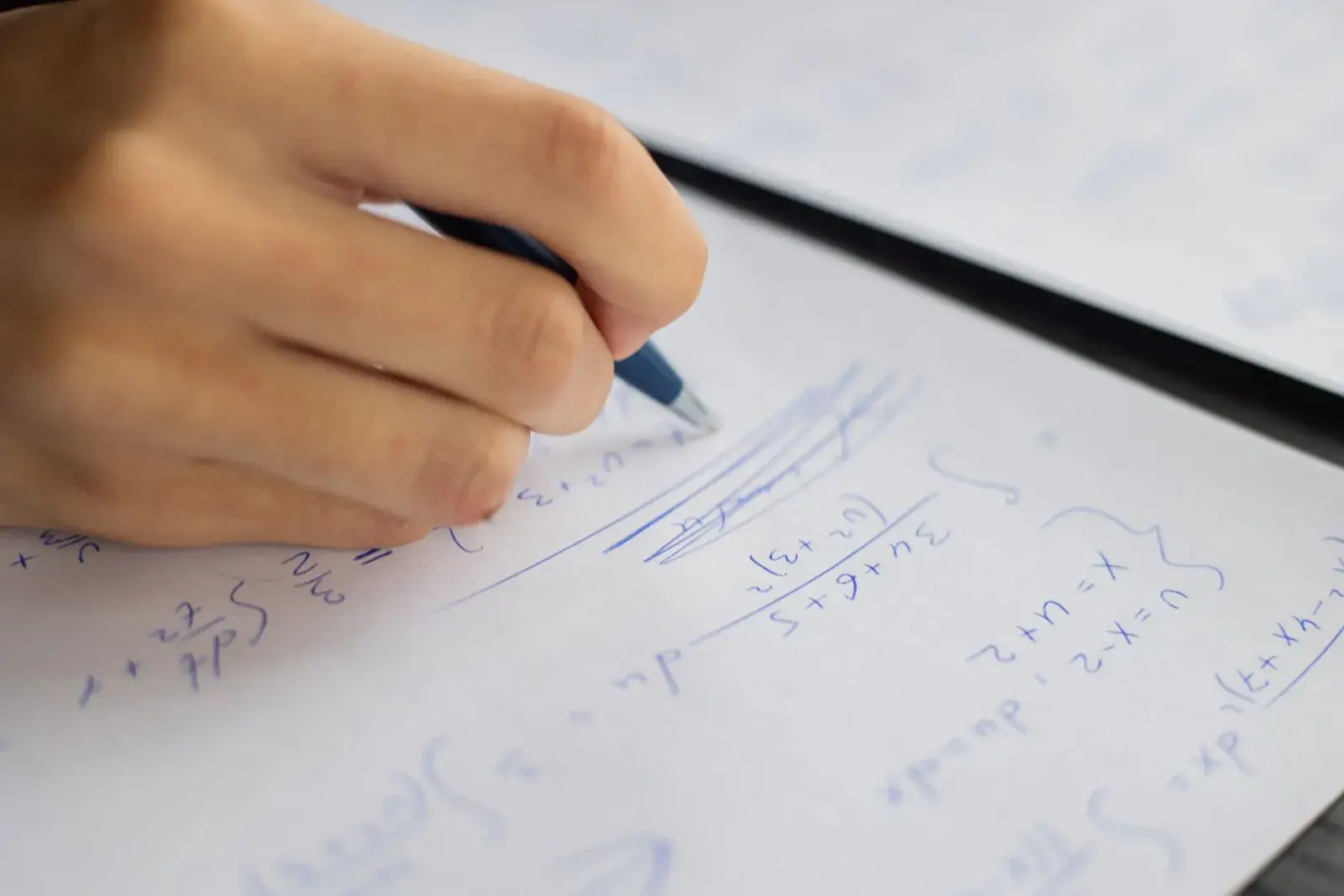
A good JEE Main study plan finishes the NTA syllabus about two months before the January session, then switches to mixed previous-year questions (PYQs) and timed mock tests, with daily formula recall and an error log running the whole time. Plan for 5–7 hours of self-study a day alongside school, or 8–10 if you're preparing full time. Taking NEET instead? Our NEET study plan uses the same recall-first approach.
This guide gives you a month-by-month JEE Main timetable for the 2027 cycle, the exact exam pattern from NTA's 2026 information bulletin, and the study methods that turn hours into marks: active recall for formulas and concepts, spaced review, and mixed practice that trains you to pick the right method under time pressure.
JEE Main study plan: month by month
NTA's exam calendar, released on 16 September 2026, tentatively schedules JEE Main 2027 Session 1 for 22–24 and 28–30 January 2027. Session 2 dates and the 2027 information bulletin weren't out as of October 11, 2026 (in 2026, Session 2 ran in early April), so treat the February–April part of this timeline as a plan to adjust.
| Month | Goal | What a week looks like |
|---|---|---|
| October | Close syllabus gaps | 2–3 pending chapters per subject. After each chapter: blank-page formula recall, 30–40 chapter PYQs, error log entries. |
| November | Finish the syllabus | Last chapters done by month end. Start revising Class 11 chapters with mixed problem sets twice a week. |
| December | Switch to mixed practice | Daily mixed PYQ sets (all chapters, shuffled). One full 3-hour mock every weekend, reviewed the next day. |
| January | Exam conditions | Two or three full mocks a week at your session's time slot. Revise from the error log and formula deck only. Session 1. |
| February | Diagnose Session 1 | Check your recorded responses when NTA publishes them. Pick the 6–8 chapters that cost the most marks and rebuild them. |
| March | Mocks and weak chapters | A full mock every other day. On non-mock days, targeted PYQs on weak chapters and re-attempts from the error log. |
| April | Session 2 | Lighter mocks in the final week, sleep schedule matched to your shift, then the exam. |
JEE study plan for 12 months or more
Spend the first six months learning chapters in your school or coaching order, with the same daily recall and error-log habits. Do chapter-wise PYQs after each chapter, but start mixed sets by month four so you aren't only ever solving problems when you already know which chapter they're from.
JEE study plan for 6 months
If the exam is about six months away, give the first three to finishing and revising the syllabus with chapter-wise PYQs, and the last three to mixed sets and full mocks, as in the table from December onwards. Once you can solve a chapter's PYQs without help, stop rereading it and spend that time on practice.
JEE study plan for 3 months or less
Don't try to cover everything evenly. List the chapters you can score in fastest (often ones you've half-learned already), finish those, and accept some gaps. Start full mocks within three weeks; the exam rewards speed and accuracy on the chapters you know.
What is the JEE Main exam pattern?
These are the rules for Paper 1 (B.E./B.Tech) from NTA's JEE Main 2026 information bulletin. Check the 2027 bulletin when it's released.
| Subject | Section A (MCQs) | Section B (numerical) | Marks |
|---|---|---|---|
| Mathematics | 20 | 5 | 100 |
| Physics | 20 | 5 | 100 |
| Chemistry | 20 | 5 | 100 |
| Total | 60 | 15 | 300 |
- Duration: 3 hours, computer-based, in two shifts (9:00 a.m.–12:00 noon or 3:00–6:00 p.m. IST).
- Marking: +4 for a correct answer, −1 for a wrong one, 0 if unanswered. Negative marking applies to Section B too.
- Section B answers are entered as integers with an on-screen keypad, rounded to the nearest integer.
- No calculator of any kind. NTA issued a public notice in November 2025 clarifying that the on-screen calculator mentioned in the bulletin does not apply to JEE Main.
- Two sessions: you can take one or both. If you take both, your better NTA score counts.
- Normalisation: raw marks are converted to percentile-based NTA scores so different shifts can be compared.
- JEE Advanced: JEE Main is also the eligibility test for JEE Advanced; the 2026 bulletin set the cut at the top 2,50,000 successful candidates across all categories.
Three hours for 75 questions is 2.4 minutes per question. In practice that means you can't solve everything; your mock tests should train you to skip a slow question within a minute and come back to it.
Why careless guessing costs more than you think
If two candidates have the same total NTA score, NTA breaks the tie using the Maths score, then Physics, then Chemistry, and then the candidate with the lower ratio of wrong to right answers ranks higher. A blind guess on a four-option MCQ is worth only +0.25 marks on average, and a wrong numerical answer simply costs a mark. Guess only when you've eliminated at least one option with confidence.
How to use active recall for JEE preparation
Active recall means producing an answer from memory before you check it. In JEE prep, that looks different for each subject. The active recall guide covers the research; here's how it applies.
Formulas and results: the blank-page method
At the end of each study day, take a blank sheet and write every formula, standard result, and condition from the chapter you studied, without notes. Then open your formula sheet and mark what you missed or got wrong in red. Tomorrow, start with the red items.
Good recall prompts are specific:
| Prompt | Answer |
|---|---|
| Escape velocity from Earth's surface in terms of g and R? | √(2gR) |
| Condition for y = mx + c to touch the ellipse x²/a² + y²/b² = 1? | c² = a²m² + b² |
| Hybridisation of S in SF₆? | sp³d² |
| When does a reaction with ΔH < 0 and ΔS < 0 become non-spontaneous? | Above T = ΔH/ΔS (high temperature) |
Our guide on how to memorize formulas goes deeper on making formulas stick.
Derivations and "why" questions
For Physics, recall the derivation, not just the result: derive the time period of a simple pendulum or the field inside a solenoid from first principles on paper, then check. If you can derive it, you can handle the twisted versions JEE likes to ask.
Chemistry facts on flashcards
Inorganic Chemistry and named reactions in Organic Chemistry are fact-heavy, and this is where flashcards earn their place: exceptions in periodic trends, colours of compounds, reagents and products. Keep each card to one fact, phrase the front as a question, and review with spaced repetition so cards come back just before you'd forget them.
Why mixed PYQ practice beats chapter-wise practice
When you solve 30 questions from "Rotational Motion" in a row, you already know which method to use. In the exam, nothing tells you the chapter. Mixing problem types in one session, called interleaving, trains you to recognise which method a problem needs.
A 2019 meta-analysis found that interleaving helps most when the things being mixed are easy to confuse, and that describes JEE well: work-energy vs momentum, integration by parts vs substitution, SN1 vs SN2. Our exam countdown guide charts how the benefit varies by type of material.
A simple way to start: after you finish a chapter, take 15 PYQs from it and 15 from earlier chapters, shuffle them, and solve them as one timed set. The interleaving guide has more ways to set this up.
How to keep a JEE error log and analyse mocks
The error log is where most of your marks will come from in the last three months. For every wrong or skipped question, record:
- the question (screenshot or number) and chapter
- your answer and the correct answer
- why you missed it: concept gap, forgotten formula, calculation slip, misread question, or ran out of time
- the date to re-attempt it (3 days later, then 10 days later)
When you re-attempt, solve it cold, without looking at your old working. If you solve it cleanly both times, drop it from the log. If you miss it again, it goes back in with a shorter gap.
After each mock, spend at least as long reviewing as you spent taking it. Total the marks lost by reason. If careless errors cost 20 marks and concept gaps cost 12, your next week should look different than if the numbers were reversed. For more on building and timing these reviews, see study tips for engineering students. If you're deciding between engineering and medicine, the NEET study plan runs the same mock-and-review loop for physics, chemistry, and biology.
Free official JEE Main resources
- Syllabus and information bulletin on jeemain.nta.nic.in. The 2026 syllabus lists 14 units in Mathematics, 20 in Physics, and 20 in Chemistry; use it as your checklist.
- Question papers and answer keys from recent sessions, posted shift by shift on jeemain.nta.nic.in. These are the most realistic practice you can get.
- NTA mock tests on nta.ac.in, including the National Test Abhyas platform, which run in the same computer-based format.
- Recorded responses after each session, which let you see exactly which of your answers were marked wrong.
A daily JEE Main timetable
Two versions, one for students in Class 12 and one for full-time preparation. Adjust the times; keep the order of the blocks.
| Block | Class 12 (5–6 hours of self-study) | Full-time (8–10 hours) |
|---|---|---|
| Morning | 20 min formula recall; 1 hour problems from yesterday's chapter | 20 min recall; 3 hours on one subject (theory + problems) |
| Afternoon | School or coaching | 3 hours on a second subject |
| Evening | 2 hours new topic or revision with PYQs | 2 hours mixed PYQs (all three subjects, timed) |
| Night | 45 min error-log re-attempts; 15 min flashcards | 1 hour error-log re-attempts and flashcards |
Work in focused blocks of 45–60 minutes with short breaks; the Pomodoro technique with active recall is one way to structure them. Sleep seven to eight hours, especially in the weeks before each session. In a study that followed 535 high-school students through daily diaries, on days when students gave up sleep to study more than usual, they had more trouble understanding the next day's lessons and were more likely to struggle on an assignment or test. Sleep and memory consolidation explains why.
Frequently asked questions
How many hours a day should I study for JEE Main?
A realistic target is 5–7 hours of focused self-study on top of school or coaching in Class 12, and 8–10 hours if you're preparing full time. Quality matters more than the number: an hour of timed mixed problems followed by error analysis is worth more than three hours of rereading notes. Track how many questions you solve and review, not just hours.
Is 6 months enough to prepare for JEE Main?
Yes, if you already know most Class 11 topics and can study consistently. Starting from scratch, six months is tight, so prioritise high-yield chapters you can master quickly and accept some gaps rather than covering everything thinly. Either way, switch to mixed practice and full mocks for the final three months, and keep the error log: it's where late gains come from.
Is there negative marking for numerical questions in JEE Main?
Yes. Under the JEE Main 2026 information bulletin, both Section A (MCQs) and Section B (numerical value questions) carry +4 for a correct answer and −1 for an incorrect one. Unanswered questions score zero. Check the 2027 bulletin when NTA releases it, since the pattern can change between years.
Can I use a calculator in JEE Main?
No. NTA's public notice of 2 November 2025 stated that calculators in any form are not permitted in JEE Main, even though its general computer-based-test instructions mentioned an on-screen calculator. Practise arithmetic, approximations, and logarithm handling by hand in every mock.
When is JEE Main 2027?
NTA's tentative exam calendar, published on 16 September 2026, schedules Session 1 for 22–24 and 28–30 January 2027, with 31 January as a buffer day. Session 2 dates hadn't been announced as of October 11, 2026; in 2026 it ran in the first week of April. Watch jeemain.nta.nic.in for the 2027 information bulletin, which confirms dates, applications, and the pattern.
Sources and further reading
Start with the primary research and official guidance below. Links open in a new tab so you can compare the evidence with the article.
- Read source
JEE (Main) 2026 Information Bulletin
National Testing Agency, 2025
- Read source
Clarification on Use of Virtual Calculator in JEE (Main) 2026
National Testing Agency, 2025
- Read source
JEE (Main) 2026 Syllabus
National Testing Agency, 2025
- Read source
Joint Entrance Examination (Main) official website
National Testing Agency, 2026
- Read source
JEE Main 2027 exam dates out; session 1 from January 22
Careers360, 2026
- Read source
Similarity matters: A meta-analysis of interleaved learning and its moderators
Brunmair & Richter, Psychological Bulletin, 2019
- Read source
To study or to sleep? The academic costs of extra studying at the expense of sleep
Gillen-O'Neel, Huynh & Fuligni, Child Development, 2013