
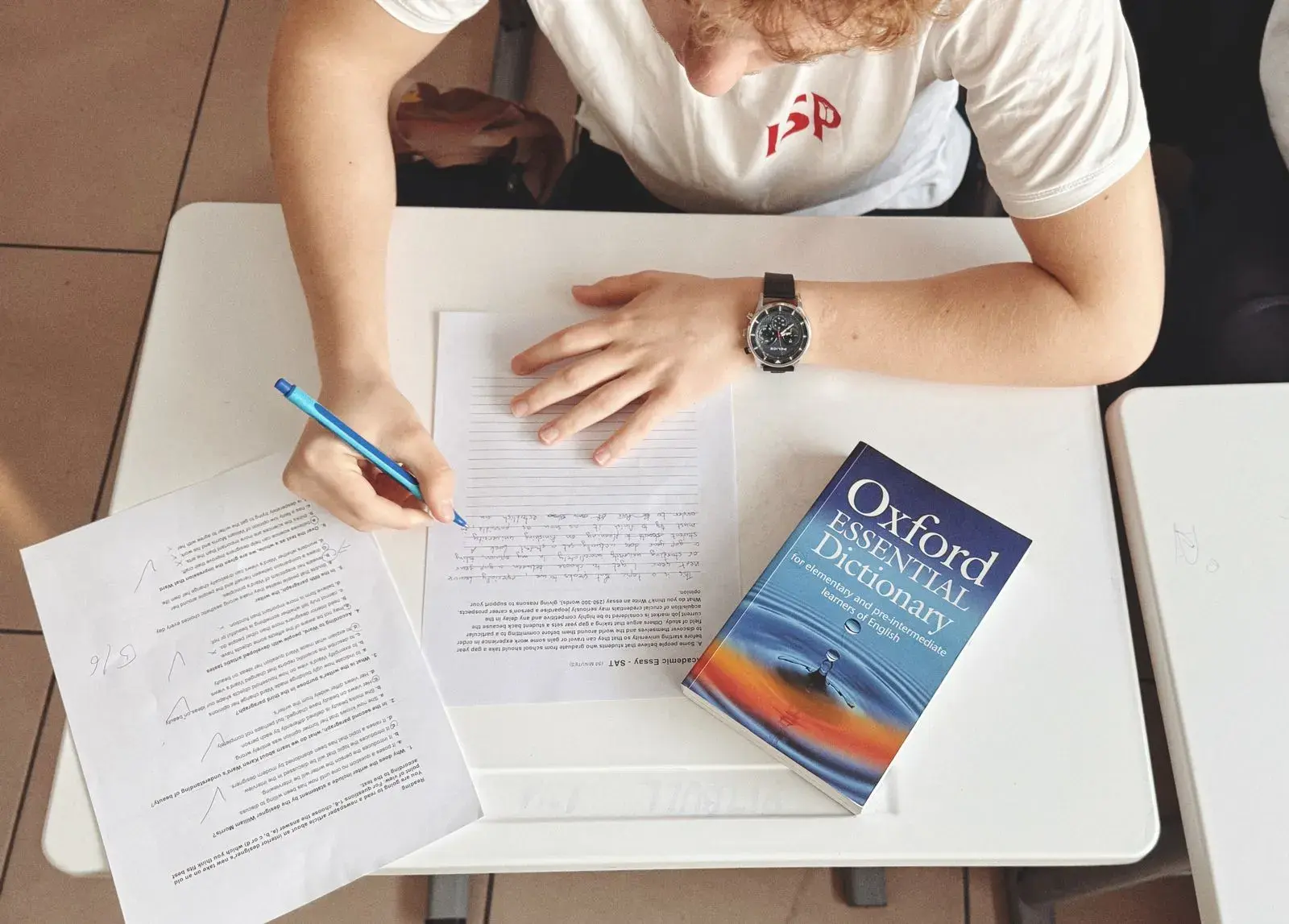
A good IELTS study plan takes about four weeks at 90 minutes to two hours a day: take a timed practice test, spend weeks two and three on your weakest skills with daily timed sets, and use week four for full mock tests and light review. If you need to rise by more than about one band, stretch the same plan over eight weeks or more.
This guide gives you the 4-week IELTS study plan as a table, the exact test format for Academic and General Training, how band scores are calculated, how to use spaced repetition for vocabulary, the free official practice materials, and a daily routine you can keep alongside work or school.
The 4-week (1-month) IELTS study plan
This plan assumes six study days a week, about 90–120 minutes a day, and a test date at the end of week four. It works for both IELTS Academic and General Training; swap in the matching Reading and Writing Task 1 materials.
| Week | Focus | What to do |
|---|---|---|
| 1 | Baseline and format | Day 1: full timed test (Listening, Reading, Writing, then record a Speaking test). Score Listening and Reading. Days 2–6: one question type per day, start an error log and add 10–15 vocabulary items a day. |
| 2 | Listening and Reading accuracy | One timed Listening part and one Reading passage daily. Review every miss by type. Two Writing Task 1 responses. Speaking Part 2 cue cards daily (1 minute to prepare, 2 minutes to talk). |
| 3 | Writing and Speaking | Three Task 2 essays in 40 minutes each; rewrite one after feedback. Speaking Parts 1–3 recorded twice. Keep one mixed Listening or Reading set a day. |
| 4 | Full mocks and taper | Full tests on day 1 and day 4, each reviewed the next day. Days 5–6: vocabulary review, error log, one essay plan, light Speaking. Rest the day before. |
Keep the error log simple: date, section, question type, what you answered, the right answer, and why you missed it (vocabulary, misread, ran out of time, spelling or word limit, didn't know the idea). After two weeks the "why" column tells you exactly what to practice.
If you have 8 weeks or longer
Use the same order but give each phase two weeks. Add 20 minutes a day of grammar work on the errors that keep showing up in your essays (articles, complex sentences, verb tenses for Task 1 trends), and take a full test every second weekend instead of only in the last week.
If you have 2 weeks or less
Don't try to raise your level; work on scores you can control. Take one full test, learn the instructions and timing for every question type, practice the 20/40-minute Writing split, and do three or four timed Speaking runs. Two weeks is enough to fix format mistakes and pacing, which are the easiest marks to recover.
What is the IELTS test format?
IELTS has four sections. Listening and Speaking are the same for both versions; Reading and Writing differ. Choose Academic for university study or professional registration, and General Training for migration, work, or study below degree level.
| Section | Time | What you do |
|---|---|---|
| Listening | About 30 minutes | 4 parts, 40 questions. Recordings are played once. On paper, you get 10 extra minutes to transfer answers. |
| Reading | 60 minutes | 3 sections, 40 questions. Academic: 2,150–2,750 words of academic texts. General Training: 2,150–2,375 words of everyday, workplace, and general-interest texts. |
| Writing | 60 minutes | Task 1 (150+ words, about 20 minutes): describe a graph, table, chart, or process (Academic) or write a letter (General Training). Task 2 (250+ words, about 40 minutes): an essay. |
| Speaking | 11–14 minutes | Part 1 interview (4–5 min), Part 2 long turn (3–4 min, with 1 minute to prepare and up to 2 minutes of talking), Part 3 discussion (4–5 min). |
The whole test takes 2 hours 45 minutes. Speaking is a recorded face-to-face interview with a certified examiner. From mid-2026, IELTS on computer is rolling out a "Writing on Paper" option in selected countries: questions on screen, answers handwritten. Task types, timing, and scoring are the same either way, and the option isn't available for IELTS for UKVI.
Listening and Reading question types to learn first
- True / False / Not Given (facts) and Yes / No / Not Given (the writer's views). "False" means the text contradicts the statement; "Not Given" means it neither agrees nor contradicts it. This distinction causes more lost marks than any other.
- Completion questions with word limits, such as "NO MORE THAN TWO WORDS AND/OR A NUMBER". Writing more than the limit loses the mark even if the idea is right.
- Matching headings and matching information: headings test the main idea of a paragraph; matching information tests whether you can find a specific detail.
- Map, plan, and diagram labelling in Listening. In all Listening parts, questions follow the order of the recording.
How is IELTS scored?
Each section gets a band from 0 to 9 in whole or half bands. Your overall band is the average of the four, rounded to the nearest half band. An average ending in .25 rounds up to the next half band and .75 rounds up to the next whole band, so 6.5 + 6.5 + 5.0 + 7.0 = 25 ÷ 4 = 6.25, which becomes an overall 6.5.
Listening and Reading are marked out of 40 and converted to a band. IELTS publishes the average raw scores for each band; the exact cut-off shifts slightly between test versions.
Correct answers out of 40 needed for each band
Average raw scores at bands 5, 6 and 7 in IELTS Listening and Reading
- Listening
- Academic Reading
- General Training Reading
View data
| Section band score | Listening | Academic Reading | General Training Reading |
|---|---|---|---|
| Band 5 | 16 | 15 | 23 |
| Band 6 | 23 | 23 | 30 |
| Band 7 | 30 | 30 | 35 |
Two things stand out. Band 8 in Listening and Academic Reading sits at about 35 out of 40. And General Training Reading needs more correct answers for the same band, because its texts are less complex: 30 correct is roughly a 6 in General Training but a 7 in Academic.
Writing and Speaking are scored by certified examiners against four equally weighted criteria each:
- Writing: Task Achievement (Task 1) or Task Response (Task 2), Coherence and Cohesion, Lexical Resource, Grammatical Range and Accuracy. Task 2 counts twice as much as Task 1.
- Speaking: Fluency and Coherence, Lexical Resource, Grammatical Range and Accuracy, Pronunciation.
Notice that vocabulary (Lexical Resource) is a quarter of both your Writing and Speaking scores. That's where spaced repetition earns its place.
How to use spaced repetition for IELTS vocabulary
Rare single words won't move your score much. What examiners reward is accurate, natural word choice, so learn collocations and phrases you can actually use: "a sharp rise in", "pose a threat to", "address the issue of", "levelled off at".
Why recall beats rereading a word list
Lexical Resource rewards words you can use, not words you recognise. Reading down a list of "band 7 vocabulary" builds recognition. Covering the meaning and producing the phrase yourself, in a sentence, builds the skill examiners score.
Keep each phrase in rotation even after you get it right. In a memory experiment with foreign-language word pairs, students who kept retrieving words after their first correct answer recalled far more a week later than students who dropped them, and they couldn't tell in advance which method worked; our TOEFL study plan charts the result. The spaced repetition guide explains how to space the reviews.
How to make good IELTS vocabulary cards
Build cards from your own practice, not from a 1,000-word list. Every time you meet a useful phrase in a Reading passage or a model answer, or reach for a word you didn't have while speaking, make a card.
| Card front | Card back |
|---|---|
| Unemployment ______ sharply between 2010 and 2015. (Task 1 trend) | fell / dropped / declined |
| Say it another way: "The government should solve this problem." | The government should address / tackle this problem. |
| Use "pose a threat to" in a sentence about climate. | Rising sea levels pose a threat to coastal cities. |
| What's the difference: "economic" vs "economical"? | economic = about the economy; economical = saves money |
Say each answer aloud before you flip, and make the back a full sentence when you can. For a deeper method, see memorizing vocabulary techniques and how to use flashcards effectively.
A workable pace is 10–15 new items a day, which is roughly 300–400 well-practiced phrases over four weeks. Review takes 10–15 minutes once the deck is running. If reviews start taking longer than 20 minutes, add fewer new cards for a few days.
How to practice each IELTS section
Listening
Do one part at a time under exam conditions: read the questions in the pause, listen once, answer. Then listen again with the transcript and mark exactly where each answer was said and why you missed it. Most misses come from distractors (the speaker corrects themselves) or from writing more words than allowed.
Reading
Forty questions in 60 minutes leaves 90 seconds per question, including reading time. Practice one passage in 20 minutes, then review each miss by type. For True / False / Not Given, write one line explaining your choice; it forces you to check whether the text actually says it.
Writing
Write under time: 20 minutes for Task 1 and 40 for Task 2. Then score your own response against the four criteria using the official band descriptors, and get feedback from a teacher or a strong English speaker on at least a few essays. Two days later, rewrite the same essay from your plan alone, without looking at the corrected version. That's active recall applied to writing.
Keep an eye on length. Responses under 150 or 250 words may not show enough language for higher bands, and writing far over 150 words in Task 1 steals time from Task 2, which counts double.
Speaking
Practice Part 2 with a timer: one minute of notes, then talk for the full two minutes. Record yourself, listen back, and note one fix for next time (repeated words, long pauses, a tense error). For Part 3, practice giving a view, a reason, and an example. Our guide to learning a new language effectively covers ways to build speaking fluency outside test practice.
Free official IELTS practice resources
- Official sample test questions for Academic and General Training on ielts.org, with answers.
- Writing test preparation resources on ielts.org: videos on how Writing is scored.
- Key assessment criteria and band descriptors (PDFs linked from the IELTS scoring page). Use them to score your own essays and Speaking recordings.
- IELTS Trial Test: a free familiarisation test for Listening, Reading, and Writing at participating official locations. An official examiner marks it, and results arrive in about 13 days. Trial scores aren't official results.
- British Council and IDP also publish free practice materials and official apps; check that any practice test you use reflects the current format.
A realistic daily IELTS study routine
This 100-minute routine fits around a full-time job or classes. Split it into a morning and an evening block if that's easier.
| Time | Task |
|---|---|
| 10–15 min | Spaced vocabulary review, answers spoken aloud |
| 30 min | One timed Listening part or Reading passage |
| 15 min | Review misses and update the error log |
| 30–40 min | Writing (one Task 1, or half a Task 2 plus planning) or Speaking practice with a recording |
| 5–10 min | Recall three items from your error log without looking, then plan tomorrow |
On weekends, swap the timed set for a longer block: a full Reading or Listening test, or a full Writing test (both tasks in 60 minutes). In the last few days, keep sessions light and protect your sleep; our exam preparation guide covers the night before and test morning. If nerves are an issue, the techniques in test anxiety management are worth trying during your mock tests, not just on the day.
Frequently asked questions
How long should I study for IELTS?
If you're within about one band of your target, four weeks at 90–120 minutes a day is usually enough to learn the format, fix timing, and polish Writing and Speaking. If you need to raise your English level more than that, plan for two to three months. Take a timed practice test first; the gap between your score and your target is the best guide.
Can I prepare for IELTS at home without classes?
Yes. Listening and Reading are easy to self-study with official sample tests and answer keys. Writing and Speaking are harder because you need feedback, so score your work against the official band descriptors, record your speaking, and get a teacher or fluent speaker to review at least a few essays. A free IELTS Trial Test gives examiner feedback if one runs near you.
Is IELTS General Training easier than Academic?
Listening and Speaking are identical. General Training Reading uses everyday and workplace texts, but it needs more correct answers for the same band: about 30 out of 40 gives a 6 in General Training and a 7 in Academic. Writing Task 1 is a letter instead of describing a chart. Choose the version your university, employer, or immigration body asks for.
How is the overall IELTS band score calculated?
It's the average of your four section bands, rounded to the nearest half band, with .25 and .75 rounding up. IELTS's own examples: an average of 6.125 is reported as 6.0, 6.25 becomes 6.5, and 3.875 becomes 4.0. One weak section is enough to cost you half a band: 7, 7, 7 and 5.5 average 6.625, which is reported as 6.5.
How many words should I learn for IELTS?
There's no official word count. Focus on phrases you can use accurately in Writing and Speaking, taken from your own practice and model answers. Ten to fifteen new items a day gives you roughly 300 to 400 over four weeks, which is plenty if you review them with spaced repetition and use them in sentences.
How long are IELTS results valid?
IELTS recommends that organisations treat results as valid for two years after the test date, based on research into second-language loss. Some organisations accept older results, so check with the one you're applying to before you book.
Sources and further reading
Start with the primary research and official guidance below. Links open in a new tab so you can compare the evidence with the article.
- Read source
IELTS Academic test format and sections
IELTS (ielts.org), 2026
- Read source
IELTS Academic: Writing test format
IELTS (ielts.org), 2026
- Read source
IELTS Academic: Speaking test format
IELTS (ielts.org), 2026
- Read source
IELTS General Training test format and sections
IELTS (ielts.org), 2026
- Read source
IELTS scoring in detail
IELTS (ielts.org), 2026
- Read source
Updates to IELTS Writing test delivery mode
IELTS (ielts.org), 2026
- Read source
IELTS Trial Test
IELTS (ielts.org), 2026
- Read source
The critical importance of retrieval for learning
Karpicke & Roediger, Science, 2008