Every student knows the feeling. An important exam is approaching, and the pressure builds. Your heart races, your palms sweat, and your mind feels simultaneously overloaded and blank. Stress and studying have an intimate and complicated relationship, one that can either enhance or devastate your ability to learn depending on how you manage it.
The truth about stress and learning is more nuanced than the simple advice to "just relax." Some stress actually helps you learn better, while too much stress can shut down your memory systems entirely. Understanding where you fall on this spectrum, and knowing how to adjust, can make the difference between academic success and frustration.
The Biology of Stress: Cortisol and Your Brain
When you perceive a threat, whether it is a charging lion or an upcoming final exam, your body activates the hypothalamic-pituitary-adrenal (HPA) axis, triggering a cascade of hormonal responses. The end product of this cascade is cortisol, the primary stress hormone.
In the short term, cortisol serves an important purpose. It mobilizes energy, sharpens attention, and primes your body for action. This is the fight-or-flight response, and it evolved to help our ancestors survive genuine physical threats.
The problem for modern students is that this same system activates in response to academic pressure, social anxiety, financial worries, and countless other non-physical stressors. And when cortisol levels remain elevated for extended periods, the effects on your brain are profoundly negative.
The hippocampus, your brain's memory formation center, is densely packed with cortisol receptors, making it extremely sensitive to stress hormones. Short bursts of cortisol can actually enhance hippocampal function, improving memory encoding. But chronic exposure to elevated cortisol damages hippocampal neurons and can even reduce the volume of this critical brain region. A study published in Biological Psychiatry found that students with chronically elevated cortisol levels showed measurably smaller hippocampal volumes and performed worse on memory tasks.
The prefrontal cortex, responsible for working memory, attention, and executive function, is equally vulnerable. Under acute stress, the prefrontal cortex can effectively go "offline," shifting cognitive control to more primitive brain regions. This is why you might blank on information during a high-pressure exam that you could easily recall in a relaxed setting.
The amygdala, your brain's fear and emotion center, becomes hyperactive under stress. This creates a bias toward encoding and remembering emotionally threatening information while impairing your ability to process neutral academic content. It is an evolutionary adaptation that prioritizes survival-relevant information but is counterproductive in a classroom setting.
The Yerkes-Dodson Law: The Sweet Spot of Stress
Not all stress is bad for learning. In 1908, psychologists Robert Yerkes and John Dodson discovered a relationship between arousal (which includes stress) and performance that remains one of the most replicated findings in psychology.
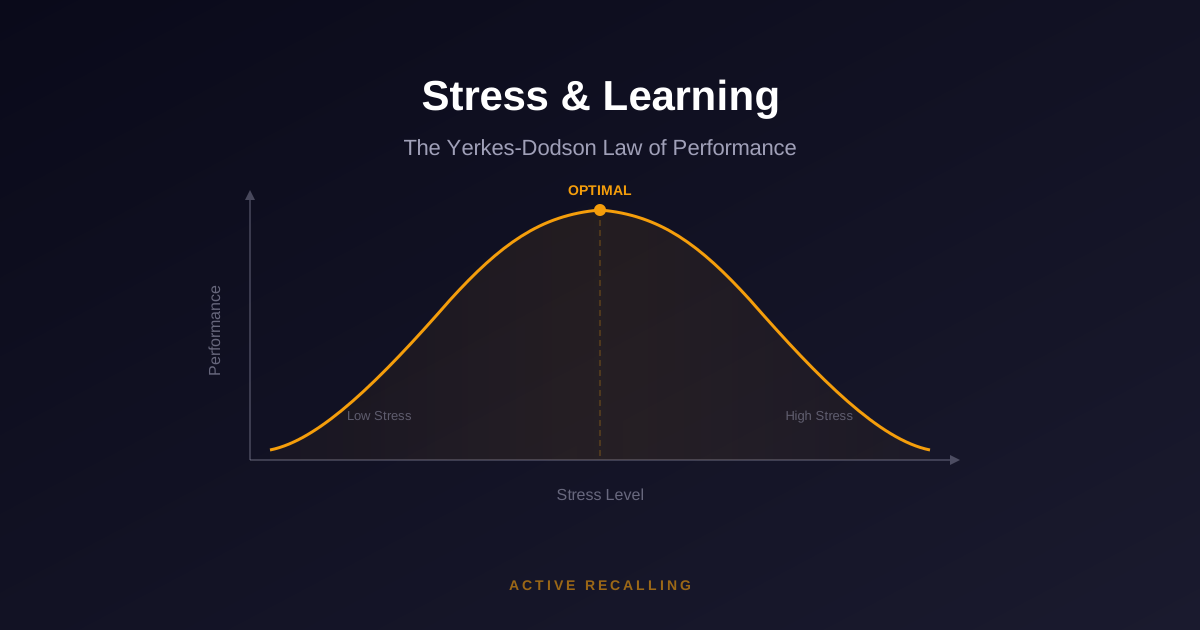
The Yerkes-Dodson law describes an inverted U-shaped curve: performance increases with physiological arousal up to a point, after which further arousal causes performance to decline. In practical terms, this means that a moderate amount of stress can actually improve your focus, motivation, and memory formation.
Low arousal leads to boredom, mind-wandering, and poor encoding. If you feel completely relaxed and unstimulated while studying, you may not be engaged enough to form strong memories. This is why studying material you find completely uninteresting can be so difficult, there is not enough emotional arousal to drive attention and encoding.
Moderate arousal is the sweet spot. A healthy sense of urgency, genuine interest in the material, or mild concern about an upcoming assessment can sharpen your focus and enhance memory formation. This is the state where your brain is alert, engaged, and operating efficiently.
High arousal tips the balance into dysfunction. Panic, overwhelming anxiety, and chronic stress push you past the peak of the curve, impairing working memory, disrupting attention, and interfering with memory consolidation. This is the state most students find themselves in during exam week.
The critical insight is that the optimal level of arousal varies by task complexity. Simple or well-practiced tasks can tolerate higher levels of stress without performance degradation. Complex tasks requiring creative thinking, problem-solving, or deep understanding are much more sensitive to over-arousal. This means that the more difficult the material you are studying, the more important it is to manage your stress levels.
How Stress Impairs Different Stages of Memory
Stress does not affect all aspects of memory equally. Understanding which memory processes are most vulnerable can help you develop targeted strategies.
Encoding is the process of forming new memories. Moderate acute stress during encoding can actually enhance memory for the stressful event itself, which is why you vividly remember embarrassing moments. However, stress impairs encoding of information that is not directly related to the stressor. This means that if you are stressed about a relationship problem while studying chemistry, the chemistry will not stick because your brain is busy encoding the emotionally salient stress rather than the neutral academic content.
Consolidation is the process by which short-term memories are stabilized into long-term storage, primarily during sleep. Chronic stress disrupts sleep architecture, particularly reducing slow-wave sleep, which is critical for consolidating declarative memories. A study in Learning and Memory found that students who experienced high stress during exam periods showed reduced slow-wave sleep and correspondingly poorer memory consolidation.
Retrieval is where stress causes the most immediate and noticeable problems. Even when information has been successfully encoded and consolidated, acute stress at the time of retrieval can block access to those memories. This is the mechanism behind exam anxiety: you studied the material, you know it, but the stress of the exam prevents you from accessing it. Research by Dr. Dominique de Quervain has shown that cortisol directly impairs memory retrieval in the hippocampus, explaining why high-stakes testing environments can produce artificially poor performance.
Chronic vs. Acute Stress: Very Different Effects
It is important to distinguish between acute stress (short-lived stress responses to specific events) and chronic stress (prolonged, ongoing stress states).
Acute stress can be either helpful or harmful depending on its timing and intensity. Brief stress before or during learning can enhance attention and encoding. Brief stress during retrieval impairs performance. The key is that acute stress is temporary, and your body returns to baseline afterward.
Chronic stress is almost universally harmful to learning. When your stress response is constantly activated, cortisol levels remain elevated, leading to hippocampal damage, prefrontal cortex impairment, disrupted sleep, weakened immune function, and reduced motivation. Students experiencing chronic stress from financial difficulties, family problems, social isolation, or overwhelming academic workloads face compounding cognitive impairments that make studying progressively harder.
A longitudinal study published in Psychoneuroendocrinology followed college students over an academic year and found that those with chronically elevated cortisol levels showed progressive declines in memory performance, even after controlling for study time and prior academic achievement. This suggests that chronic stress creates a downward spiral where poor cognitive performance increases stress, which further impairs cognition.
Stress Management Techniques That Actually Work
Managing stress is not about eliminating it entirely, which would leave you unmotivated and disengaged. Instead, the goal is to keep stress within the optimal range described by the Yerkes-Dodson law. Here are techniques supported by research.
Deep Breathing and Relaxation Response
Diaphragmatic breathing is one of the fastest ways to reduce acute stress. When you breathe slowly and deeply, activating your diaphragm rather than your chest muscles, you stimulate the vagus nerve, which triggers the parasympathetic nervous system and reduces cortisol production. Research published in Frontiers in Human Neuroscience found that just five minutes of slow breathing (six breaths per minute) significantly reduced cortisol levels and improved cognitive performance on attention tasks.
A simple technique is box breathing: inhale for four counts, hold for four counts, exhale for four counts, hold for four counts. Practice this before study sessions or exams to bring your arousal level into the optimal range.
Cognitive Reappraisal
Cognitive reappraisal involves reframing how you think about a stressful situation. Instead of viewing an exam as a threat ("If I fail, my life is ruined"), you reframe it as a challenge ("This is an opportunity to demonstrate what I have learned"). This is not just positive thinking; it produces measurable changes in brain activity and hormonal responses.
A study published in Emotion found that students trained in cognitive reappraisal showed reduced amygdala activation and lower cortisol levels when facing academic stressors, leading to improved test performance. The technique works because your brain's stress response is driven not by the objective situation but by your interpretation of it.
Regular Physical Exercise
As covered in depth in our article on exercise and brain function, regular physical activity is one of the most powerful stress management tools available. Exercise reduces baseline cortisol levels, improves stress resilience, and provides a healthy outlet for the physical tension that accumulates during sedentary studying. Aim for at least 30 minutes of moderate exercise most days of the week.
Social Connection
Social support is a potent stress buffer. Research consistently shows that students with strong social networks experience lower cortisol responses to academic stressors. A study in Developmental Psychology found that simply talking to a friend for 10 minutes before a stressful task significantly reduced cortisol levels.
Study groups serve a dual purpose: they provide both academic support and social connection. Even brief social interactions between study sessions can help regulate your stress response and maintain cognitive function.
Time Management and Planning
Much academic stress stems from feeling overwhelmed and out of control. Structured planning directly addresses this by restoring a sense of agency and predictability. Breaking large tasks into smaller, manageable steps reduces the perceived threat of the overall workload.
Research in Anxiety, Stress, and Coping found that students who used structured study schedules reported significantly lower stress levels and performed better academically than those who studied reactively. The planning itself reduces stress by converting an ambiguous threat into a concrete, actionable sequence of steps.
Mindfulness Meditation
Mindfulness meditation trains your ability to observe stressful thoughts without being overwhelmed by them. Regular practice reduces baseline cortisol levels and strengthens the prefrontal cortex's ability to regulate the amygdala's stress response. A meta-analysis in JAMA Internal Medicine found that mindfulness programs produced moderate improvements in anxiety, depression, and stress.
Even brief mindfulness exercises, such as five minutes of focused attention on your breathing before a study session, can reduce stress-related cognitive impairment.
Test Anxiety: A Special Case
Test anxiety affects an estimated 25 to 40 percent of students and represents a specific manifestation of the stress-learning interaction. It is characterized by excessive worry, physical symptoms (nausea, rapid heartbeat, sweating), and cognitive interference during exams.
The cognitive component of test anxiety is particularly damaging. Anxious thoughts consume working memory resources that would otherwise be available for processing test questions. Research by Dr. Sian Beilock at the University of Chicago demonstrated that high-pressure testing situations particularly impair performance on complex problems that require working memory, while leaving simpler retrieval tasks relatively unaffected.
Expressive writing has emerged as a surprisingly effective intervention for test anxiety. Beilock's research showed that students who spent 10 minutes writing about their anxious thoughts immediately before an exam performed significantly better than anxious students who did not write. The mechanism appears to involve offloading worries from working memory onto paper, freeing cognitive resources for the actual test.
Repeated practice under simulated test conditions is another evidence-based approach. By repeatedly exposing yourself to test-like conditions during studying, you gradually desensitize your stress response to the testing environment. This is the principle behind active recall and practice testing: they not only improve memory but also reduce test anxiety by making the retrieval process familiar.
Building Long-Term Stress Resilience
Beyond managing acute stress, building long-term resilience ensures that your cognitive function remains robust throughout your academic career.
Adequate sleep is foundational. Sleep deprivation amplifies the brain's stress response and reduces your capacity to regulate emotions. Prioritize seven to nine hours of quality sleep, especially during high-stress periods like exam weeks.
A balanced lifestyle that includes physical activity, social connection, creative pursuits, and time in nature provides multiple stress buffers. Students who engage in a variety of activities outside of academics report lower overall stress and better cognitive function.
Seeking professional help when stress becomes overwhelming is a sign of strength, not weakness. University counseling services, cognitive behavioral therapy, and in some cases medication can be crucial tools for students whose stress levels have exceeded their coping capacity.
Conclusion
Stress is not the enemy of learning. It is a powerful force that, when properly managed, can sharpen your focus and enhance your memory. The challenge is keeping stress in the productive middle range, enough to stay motivated and engaged, but not so much that it overwhelms your cognitive systems.
By understanding the biology of stress, recognizing your own stress patterns, and applying evidence-based management techniques, you can transform stress from a barrier to learning into a catalyst for academic success. The goal is not a stress-free life, which would be boring and unproductive, but a life where stress serves you rather than controls you.