TL;DR: Human memory has three stages (sensory, short-term, long-term) and forgetting is normal, not a flaw. Hermann Ebbinghaus (1885) showed we lose about 50 percent of new information within 24 hours. Evidence-based counter-strategies include spaced repetition, active recall, and good sleep — Walker and Stickgold (2004) found sleep boosts retention 20-30 percent.
Every student has experienced the frustration of studying for hours, feeling confident walking into an exam, and then drawing a complete blank on material they reviewed just the night before. It feels like a personal failing, as though your brain simply is not up to the task. But the truth is far more reassuring. Forgetting is not a flaw in your brain. It is a fundamental feature of how human memory operates, and once you understand the mechanisms behind it, you can work with your biology instead of against it.
This article explores the science of how memories are formed, why they fade, and what evidence-based strategies you can use to dramatically improve your ability to retain and recall information.
How Human Memory Works
Memory is not a single system. It is a collection of interconnected processes that work together to encode, store, and retrieve information. Understanding these systems is the first step toward using them more effectively.
Sensory Memory
Sensory memory is the briefest form of memory, lasting only a fraction of a second to a few seconds. It acts as a buffer that holds raw sensory input from your eyes, ears, and other senses before your brain decides what to pay attention to.
When you glance at a page of text, your sensory memory briefly holds the entire visual field. But within milliseconds, most of that information is discarded. Only the elements you actively attend to move forward into the next stage of memory processing. This is why attention is so critical to learning. Information that does not capture your attention never makes it past the front door.
Short-Term and Working Memory
Short-term memory holds a small amount of information in an active, readily available state for a brief period, typically around 15 to 30 seconds without rehearsal. The classic research by George Miller in 1956 suggested that short-term memory can hold roughly seven items, plus or minus two, though more recent research suggests the true capacity may be closer to four chunks of information.
Working memory is the closely related system that not only holds information temporarily but actively manipulates it. When you do mental arithmetic, follow a complex argument, or try to understand a difficult paragraph, you are relying on working memory. It is the cognitive workspace where thinking happens.
The limited capacity of working memory has profound implications for learning. When you try to absorb too much new information at once, your working memory becomes overloaded, and learning grinds to a halt. This is why effective study techniques break material into manageable chunks.
Long-Term Memory
Long-term memory is where information goes for more permanent storage. Unlike short-term memory, long-term memory has no known capacity limit and can retain information for days, years, or an entire lifetime.
Long-term memory is further divided into several types. Declarative memory (also called explicit memory) stores facts and events. Within declarative memory, semantic memory holds general knowledge and concepts (the capital of France is Paris), while episodic memory stores personal experiences (your first day at university).
Procedural memory (also called implicit memory) stores skills and habits, such as riding a bicycle or typing on a keyboard. These memories are often acquired through repetition and can be difficult to verbalize even though they guide behavior reliably.
For academic learning, the primary goal is transferring information from working memory into long-term declarative memory in a way that makes it reliably retrievable.
The Journey from Input to Memory: Encoding, Storage, and Retrieval
Understanding memory requires understanding three distinct processes, each of which can succeed or fail independently.
Encoding
Encoding is the process of converting sensory input into a form that can be stored in memory. Think of it as the writing phase. The quality of encoding determines how well information will be retained and recalled later.
Shallow encoding, such as reading words and noticing their visual appearance, produces weak memories. Deep encoding, such as thinking about what a concept means, how it relates to things you already know, or why it matters, produces strong, durable memories. This principle, known as levels of processing theory (proposed by Craik and Lockhart in 1972), is one of the most robust findings in memory research.
This is precisely why active recall and self-testing are so effective. They force deep processing. When you attempt to retrieve an answer from memory, you are engaging with the meaning and structure of the information, not just its surface features.
Storage
Storage refers to the maintenance of encoded information over time. Memories are not stored in a single location in the brain but are distributed across networks of neurons. The process of consolidation gradually stabilizes new memories, transferring them from a fragile initial state (dependent on the hippocampus) to a more stable long-term state (distributed across the cortex).
Consolidation takes time and is significantly enhanced by sleep, which is why pulling an all-nighter before an exam is counterproductive even if it feels productive in the moment.
Retrieval
Retrieval is the process of accessing stored information when you need it. A memory that is perfectly stored but cannot be retrieved is functionally useless. Many instances of "forgetting" are actually retrieval failures rather than storage failures. The information is still in your brain, but you cannot find the path to access it.
Retrieval cues are the keys that unlock stored memories. The more cues associated with a memory, the more ways you have to access it. This is why studying in varied contexts and connecting new information to existing knowledge improves recall. You are essentially creating multiple pathways to the same destination.
The Ebbinghaus Forgetting Curve
In the 1880s, German psychologist Hermann Ebbinghaus conducted a series of groundbreaking experiments on himself, memorizing lists of nonsense syllables and testing his retention at various intervals. His findings, published in 1885, revealed a consistent pattern that has been replicated countless times since.
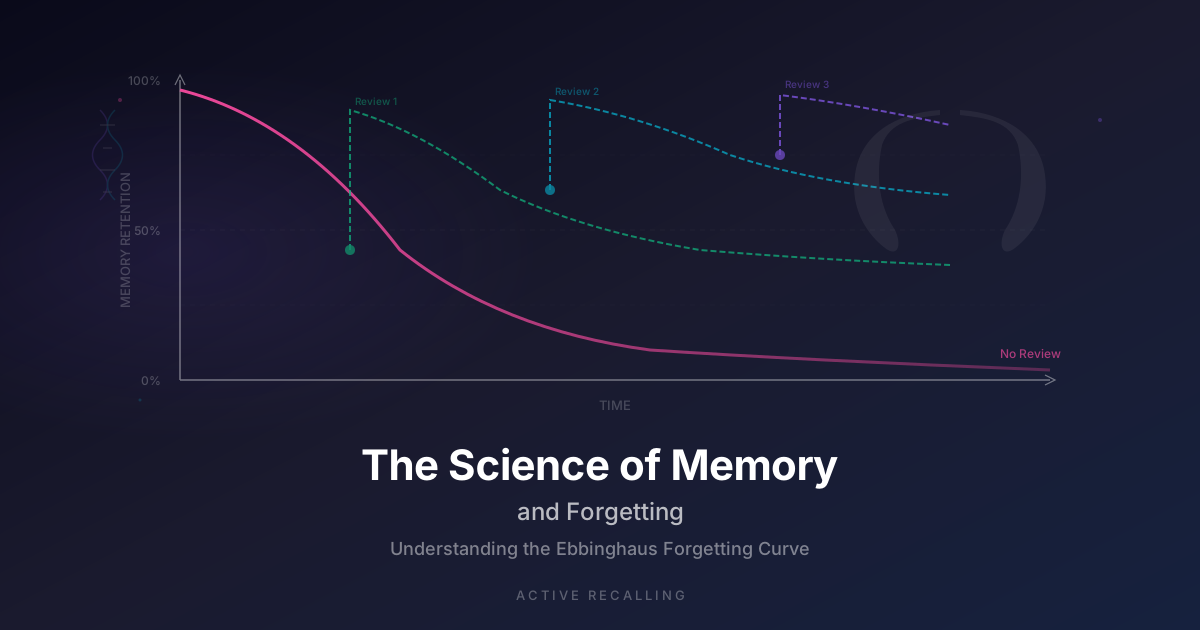
The forgetting curve shows that memory retention drops sharply in the first hours and days after learning, then levels off. Without any review, you can expect to forget roughly 50 to 70 percent of new information within 24 hours, and up to 90 percent within a week.
This sounds discouraging, but the forgetting curve also contains good news. Each time you review material at the right moment, the curve flattens. After several well-timed reviews, information that once faded within hours can be retained for months or years with minimal additional effort. This is the foundation of spaced repetition, one of the most powerful learning strategies ever discovered.
Why We Forget: The Four Main Theories
Forgetting is not random. Cognitive scientists have identified several distinct mechanisms that cause memories to become inaccessible.
Decay Theory
The simplest explanation for forgetting is that memory traces decay over time if they are not used. Like a path through a forest that becomes overgrown without foot traffic, neural connections associated with a memory may weaken without reinforcement.
While decay certainly plays a role, it cannot explain everything. Some memories persist for decades without deliberate review, while others vanish within minutes. Decay is a factor, but it operates alongside other mechanisms.
Interference Theory
Interference occurs when other memories compete with or disrupt the retrieval of a target memory. There are two types.
Proactive interference happens when old memories interfere with the recall of new ones. If you learned French in school and are now studying Spanish, your French vocabulary may intrude when you try to recall Spanish words.
Retroactive interference happens when new learning disrupts old memories. After spending weeks immersed in Spanish, you may find your French has become harder to access.
Interference is one of the most significant causes of forgetting in academic settings, where students are constantly learning new material that can compete with previously studied content.
Retrieval Failure
Sometimes information is stored in long-term memory but cannot be accessed because the right retrieval cues are absent. This is the "tip of the tongue" phenomenon taken to its extreme. The memory exists, but you cannot find the neural pathway to reach it.
Retrieval failure explains why you might fail to recall something during an exam but remember it perfectly the moment you leave the testing room. The exam environment lacked the cues that were present when you originally studied.
Motivated Forgetting
In some cases, forgetting serves a psychological purpose. Motivated forgetting involves the suppression of memories that are threatening, painful, or no longer useful. While this is less relevant to academic learning, it highlights an important principle: your brain is constantly making decisions about what to retain and what to discard, and those decisions are influenced by emotional significance.
Neuroplasticity: Your Brain Can Change
One of the most exciting discoveries in modern neuroscience is neuroplasticity, the brain's ability to reorganize itself by forming new neural connections throughout life. This means your capacity for memory and learning is not fixed at birth. It can be developed and strengthened through deliberate practice.
When you learn something new, neurons in your brain form new synaptic connections. When you review that information repeatedly over time, those connections become stronger and more efficient through a process called long-term potentiation. The more you practice retrieval, the more robust these pathways become, which is why spaced repetition and active recall are not just study hacks but are fundamentally aligned with how your brain physically changes in response to learning.
Sleep and Memory Consolidation
The relationship between sleep and memory is one of the most well-established findings in cognitive science. During sleep, particularly during slow-wave sleep (deep sleep) and REM sleep, your brain replays and consolidates the day's learning experiences.
Research by Walker and Stickgold (2004) demonstrated that a single night of sleep can improve memory retention by 20 to 30 percent compared to an equivalent period of wakefulness. Sleep does not merely prevent forgetting. It actively strengthens memories and integrates them with existing knowledge.
The practical implications are clear. Studying before sleep is more effective than studying at other times of day, because the material benefits from overnight consolidation. And consistently getting seven to nine hours of sleep is one of the single most impactful things you can do for your learning.
All-night study sessions are doubly harmful. They deprive you of the consolidation benefits of sleep while also impairing your cognitive function the next day, including attention, working memory, and the ability to retrieve what you studied.
Emotion and Memory
Emotional arousal has a powerful effect on memory formation. Events that trigger strong emotions, whether positive or negative, are encoded more deeply and recalled more vividly than neutral events. This is mediated by the amygdala, which modulates the activity of the hippocampus during encoding.
You can harness this principle in your studies by finding ways to make material personally meaningful. Connect abstract concepts to real-world examples that matter to you. Discuss ideas with peers in ways that generate genuine curiosity or even friendly debate. When you care about what you are learning, your brain allocates more resources to encoding it.
Conversely, excessive stress and anxiety impair memory formation and retrieval. The stress hormone cortisol, at high levels, interferes with hippocampal function. This is why managing exam anxiety is not just about emotional well-being. It directly affects cognitive performance.
Evidence-Based Strategies to Combat Forgetting
Understanding why we forget points directly to strategies that counteract those mechanisms.
Spaced Repetition
Spaced repetition is the practice of reviewing material at gradually increasing intervals. Instead of cramming everything into one session, you spread reviews across days, weeks, and months. Each review resets and flattens the forgetting curve, building increasingly durable memories.
The optimal spacing depends on when you need to recall the information and how well you have learned it. Digital tools like Active Recalling use algorithms to calculate the ideal review time for each piece of information, taking the guesswork out of scheduling.
Active Recall and Retrieval Practice
Rather than passively re-reading notes, actively test yourself on the material. Close your textbook and try to recall the key points. Use flashcards. Take practice tests. The effort of retrieval is what strengthens memory.
Research consistently shows that retrieval practice outperforms re-reading, highlighting, and summarizing for long-term retention. The more difficult the retrieval (within reason), the greater the learning benefit, a principle known as desirable difficulty.
Elaborative Encoding
When learning new information, elaborate on it. Ask yourself why it is true. Connect it to things you already know. Generate examples. Explain it in your own words. The more deeply you process information during encoding, the more retrieval pathways you create.
Interleaving
Instead of studying one topic exhaustively before moving to the next (blocked practice), interleave different topics within a single study session. This feels harder and may produce lower performance during practice, but it leads to significantly better long-term retention and the ability to discriminate between similar concepts.
Dual Coding
Dual coding theory suggests that information encoded in both verbal and visual formats is remembered better than information encoded in only one format. When studying, combine written explanations with diagrams, charts, mind maps, or mental imagery. The two representations reinforce each other and provide additional retrieval pathways.
Chunking
To work within the limits of working memory, chunk related pieces of information into meaningful groups. A phone number like 8005551234 is hard to remember as ten individual digits but easy to remember as three chunks: 800-555-1234. Apply the same principle to academic material by organizing facts into categories, hierarchies, or narratives.
Practical Tips for Everyday Learning
Understanding the science is valuable, but applying it is what produces results. Here are concrete actions you can take starting today.
Review new material within 24 hours. The forgetting curve is steepest in the first day. A brief review session within 24 hours of initial learning can dramatically reduce forgetting.
Study in multiple locations and contexts. Varying your study environment creates more retrieval cues, making memories more accessible in different settings, including exam rooms.
Test yourself before you feel ready. Premature testing feels uncomfortable, but it identifies gaps in your knowledge early and strengthens memories through retrieval practice.
Prioritize sleep. Treat sleep as a non-negotiable part of your study plan. Eight hours of sleep after studying is more valuable than three additional hours of review.
Manage stress proactively. Regular exercise, mindfulness, and adequate rest keep cortisol levels in check, preserving your brain's ability to encode and retrieve information.
Use multiple modalities. Read, listen, write, draw, discuss, and teach. Each modality creates additional encoding pathways and retrieval cues.
Space your study sessions. Three one-hour sessions spread across a week will produce far better retention than a single three-hour session. Plan your study calendar accordingly.
Frequently Asked Questions
Why do we forget what we study?
Forgetting happens for four main reasons: decay (memory traces weaken without use), interference (new and old memories compete), retrieval failure (the memory is there but cues are missing), and motivated forgetting (the brain suppresses unhelpful information). Understanding the cause helps you choose the right countermeasure.
What are the three types of memory?
Sensory memory (fraction of a second buffer for sensory input), short-term/working memory (15-30 seconds, about 4 chunks per Cowan's 2001 research), and long-term memory (essentially unlimited capacity, divided into declarative for facts/events and procedural for skills).
How much do we forget in 24 hours?
Ebbinghaus's original research showed 50-70 percent of new information is forgotten within 24 hours without review. The exact rate depends on how meaningful, emotional, and deeply encoded the material is.
Does sleep really improve memory?
Yes. Walker and Stickgold (2004) and subsequent research show sleep actively consolidates memories, especially during slow-wave and REM sleep. A single night of sleep can improve retention by 20-30 percent compared to an equivalent period of wakefulness.
What is the most effective memory improvement technique?
Spaced repetition combined with active recall. The spacing effect (distributed practice produces better retention) and the testing effect (retrieval strengthens memory) are among the most robust findings in cognitive psychology, and they compound when used together.
Does stress hurt memory?
Acute moderate stress can enhance memory formation, but chronic or excessive stress impairs both encoding and retrieval. The stress hormone cortisol, at high levels, interferes with hippocampal function — one reason cramming under anxiety is less effective than calm, spaced study.
Conclusion
Forgetting is not your enemy. It is a natural, even necessary, function of a brain that must manage an overwhelming flood of information every day. The key to effective learning is not preventing forgetting entirely but working with your brain's natural rhythms to ensure the information that matters most is retained and accessible when you need it.
By understanding how memory works, from encoding through consolidation to retrieval, you gain the ability to choose study strategies that are aligned with your biology. Spaced repetition, active recall, adequate sleep, and elaborative encoding are not just academic theories. They are practical tools that anyone can use to learn more effectively, retain information longer, and perform better under pressure.
The science is clear, and the strategies are accessible. The only remaining step is to put them into practice.