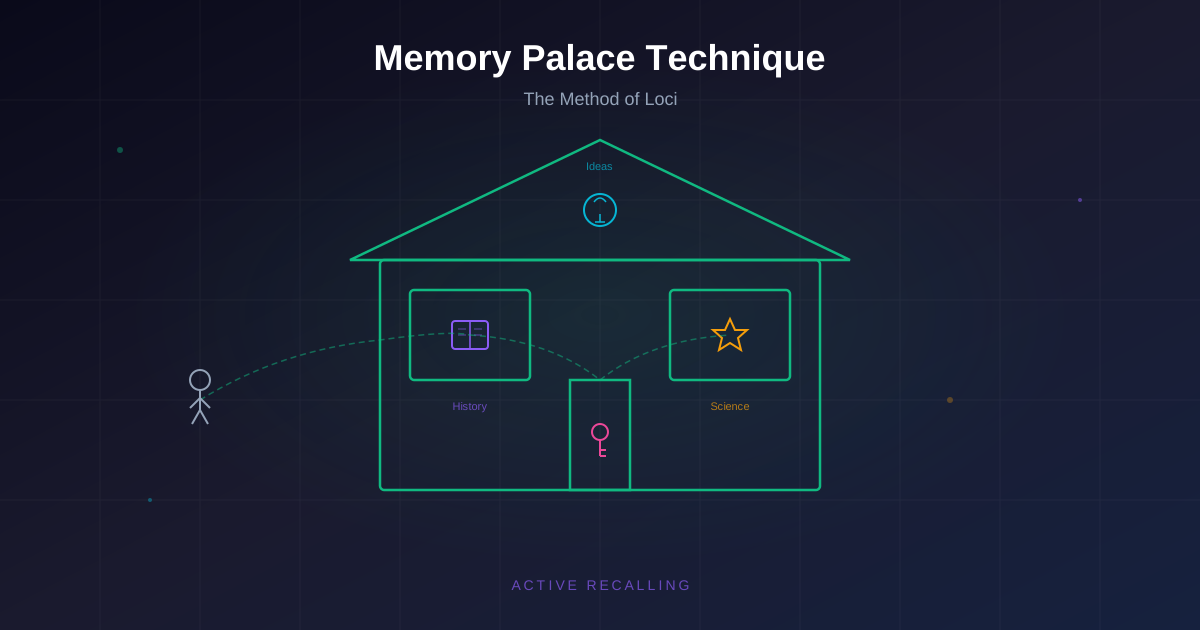
TL;DR: The Memory Palace (Method of Loci) is a mnemonic technique dating to ancient Greece, attributed to the poet Simonides of Ceos around 500 BCE. You place vivid, exaggerated mental images at stations along a familiar route, then mentally walk that route to retrieve them in order. A 2017 Dresler et al. study in Neuron found 6 weeks of training doubled recall performance and produced lasting brain changes.
What Is the Memory Palace Technique?
The Memory Palace technique, also known as the Method of Loci, is a mnemonic strategy that uses visualization and spatial memory to organize and recall information. The idea is simple yet remarkably powerful: you imagine placing pieces of information at specific locations along a familiar route or within a well-known building, and then mentally "walk" through that space to retrieve the information in order.
This technique leverages a fundamental feature of human cognition — our brains are extraordinarily good at remembering spatial information and visual scenes. You can probably describe the layout of your childhood home in vivid detail, even decades after moving away. The Memory Palace technique harnesses that natural spatial memory and uses it as scaffolding for remembering anything, from grocery lists to entire textbook chapters.
Memory champions who compete in events like the World Memory Championships rely heavily on this technique. They can memorize the order of a shuffled deck of cards in under a minute, recall hundreds of random digits, and learn the names and faces of dozens of strangers — all using memory palaces. But you don't need to be a competitor to benefit from this approach. Anyone can build and use a memory palace with practice.
A Brief History of the Method of Loci
The Method of Loci is one of the oldest known mnemonic devices, dating back to ancient Greece. According to the Roman orator Cicero, the technique was discovered by the poet Simonides of Ceos around 500 BCE.
The story goes that Simonides was attending a banquet when he was called outside. While he was away, the roof of the building collapsed, killing everyone inside. The bodies were so badly crushed that they couldn't be identified. But Simonides realized he could remember exactly where each person had been sitting by mentally walking through the banquet hall. By recalling the spatial layout, he identified each victim.
This tragic event led to a profound insight: spatial memory can serve as a framework for remembering anything. Greek and Roman orators adopted the technique to memorize lengthy speeches. They would mentally place each section of their speech at a different location in a familiar building, then "walk" through the building during delivery, encountering each point in order.
The word "loci" is Latin for "places," and the technique's name — Method of Loci — directly references this spatial foundation. For centuries, it was a core part of rhetorical training and education. While it fell out of common use with the spread of printed books and written notes, modern memory research has confirmed its remarkable effectiveness.
How to Build Your First Memory Palace
Step 1: Choose Your Palace
Your memory palace should be a place you know intimately. The best starting palace is usually your own home. You know every room, every piece of furniture, every corner. Other good choices include your workplace, your school, your regular commute route, or any building you've spent significant time in.
The key requirement is familiarity. You should be able to close your eyes and mentally walk through the space with ease, noticing details along the way. If you have to think about the layout, the palace is adding cognitive load rather than reducing it.
You can have multiple memory palaces for different subjects or purposes. Some experienced practitioners maintain dozens of palaces — their childhood home, their gym, favorite restaurants, hiking trails, and more. Each palace can hold a different set of information.
Step 2: Define a Route
Choose a specific path through your palace. This route should move through the space in a logical, consistent order. For a house, you might start at the front door, move through the entryway, into the living room, through the kitchen, down the hallway, into each bedroom, and end in the backyard.
Identify specific stations along this route — distinct locations where you will place information. In a typical room, you might have three to five stations: the door, the window, the couch, the television, the bookshelf. These stations should be visually distinct and spaced apart enough that they don't blur together in your imagination.
Write down your route and stations the first time. A typical memory palace might have 15 to 30 stations, which means you can store 15 to 30 pieces of information in a single walk-through.
Step 3: Encode Information at Each Station
This is where the creative work happens. Take each piece of information you want to remember and create a vivid, memorable image that represents it. Then mentally place that image at the corresponding station in your palace.
The more vivid, unusual, and emotionally engaging the image, the better it will stick. Your brain is wired to remember things that are surprising, funny, absurd, or dramatic. Mundane images fade quickly; bizarre ones persist.
For example, if you're trying to remember a grocery list and the first item is eggs, don't just imagine a carton of eggs sitting on your doorstep. Instead, imagine cracking your front door open and having hundreds of eggs cascade down on you like an avalanche, splattering everywhere. The absurdity of the image makes it memorable.
Step 4: Walk Through and Retrieve
To recall the information, simply close your eyes and mentally walk through your palace along the established route. At each station, the image you placed there should appear in your mind's eye, and with it, the information it represents.
The first few times, the recall might be slow. With practice, the walk-through becomes rapid and automatic. Experienced memory palace users can "speed walk" through their palaces, retrieving dozens of items in seconds.
Encoding Strategies That Work
Make It Vivid and Exaggerated
The number one rule of memory palace encoding is exaggeration. Normal, everyday images are forgettable. Your brain has evolved to pay attention to things that are unusual, large, loud, colorful, or emotionally charged.
Instead of imagining a book on a table, imagine a book the size of a car crashing through your table. Instead of picturing a phone on a shelf, imagine the phone ringing so loudly that the shelf shakes and items fall off. The more outrageous the image, the more reliably you'll remember it.
Engage Multiple Senses
Don't limit your mental images to the visual. Incorporate sound, smell, touch, and even taste when possible. If you're placing an image of coffee at a station, imagine the rich aroma filling the room, the warmth of the cup in your hands, the bitter taste on your tongue. Multi-sensory encoding creates richer memory traces that are easier to retrieve.
Use Action and Movement
Static images are less memorable than dynamic ones. Put your images in motion. Instead of a dog sitting at a station, imagine the dog running in circles, barking, and knocking things over. Movement captures attention and makes the scene more distinctive.
Create Interactions
Have your images interact with the location. If your station is a bathtub and you need to remember "World War II started in 1939," you might imagine a bathtub filled with tiny soldiers in 1930s uniforms, with the number 39 painted on the side of the tub in bright red. The interaction between the image and the location creates a stronger association.
Use Emotional Content
Emotions amplify memory. Images that provoke laughter, surprise, disgust, or even mild shock are remembered far better than neutral ones. Don't be afraid to make your images funny, ridiculous, or slightly uncomfortable — these are for your mind only, and their purpose is to stick in your memory.
Practical Uses of the Memory Palace
Academic Study
Students can use memory palaces to remember lists, sequences, and structured information. The stages of cell division, the order of historical events, the steps in a chemical process — any sequential information maps naturally onto a memory palace route.
For a biology exam, you might create a palace where each room represents a different body system. The cardiovascular system room has a giant heart pumping at the entrance (the heart's function), rivers of red flowing across the floor (blood vessels), and tiny delivery trucks carrying packages to furniture throughout the room (oxygen delivery to cells).
Professional Presentations
Like the ancient Greek orators, modern professionals can use memory palaces to deliver presentations without notes. Place each key point at a station in your palace. During the presentation, mentally walk through your palace, and each station reminds you of the next point to discuss. This creates a natural, conversational delivery that feels more confident than reading from slides.
Language Learning
Memory palaces work exceptionally well for vocabulary acquisition. Create a palace for each language topic — food vocabulary in your kitchen, travel vocabulary along your commute, body parts in your bathroom. The spatial organization helps you group related words and recall them by context.
Memorizing Numbers and Dates
Combine the memory palace with a number-image system (where each number from 0 to 9 is associated with a specific image) to memorize phone numbers, dates, formulas, and other numerical information. Place the number images at your stations, and you can recall long sequences of digits effortlessly.
Everyday Life
Beyond academic and professional use, memory palaces can help with daily tasks: remembering shopping lists, to-do items, names of people you meet at events, key points from books you've read, and more. Once you're comfortable with the technique, you'll find yourself naturally reaching for it whenever you need to remember something.
Building Advanced Memory Palaces
Expanding Your Palace Network
As you become more experienced, you'll want more palaces for more information. Survey your life for familiar spaces: relatives' houses, vacation destinations, stores you visit regularly, parks, gyms, and restaurants. Each new palace adds capacity to your memory system.
Nested Palaces
For complex topics, you can create palaces within palaces. A station in your main palace might represent a broad topic, and "entering" that station opens up a sub-palace with its own route and stations for the subtopics. This hierarchical structure mirrors how knowledge is organized and allows you to store vast amounts of interconnected information.
Refreshing and Maintaining Palaces
Memory palaces, like all memories, fade over time without review. Walk through your palaces periodically to keep the images fresh. This review process is much faster than the initial encoding — a palace that took 30 minutes to build might only take 2 minutes to review. Combine palace review with spaced repetition for maximum retention.
Reusing Palaces
Can you reuse a palace for different information? Experienced practitioners disagree on this. Some find that old images linger and create interference. Others find that with enough time between uses, a palace can be "cleared" and reloaded. A safe approach is to maintain separate palaces for information you need to retain long-term, and use a few "disposable" palaces for temporary information like shopping lists.
Common Mistakes and How to Avoid Them
Choosing unfamiliar locations. Your palace must be a place you know well. If you have to think about the layout, you're dividing your attention between spatial recall and information recall, which defeats the purpose.
Making images too abstract. Abstract concepts need to be converted into concrete, visual images. "Democracy" is hard to visualize, but a crowd of people voting with raised hands is not. Always find a concrete representation.
Placing too many items at one station. Each station should hold one piece of information (or one tightly related group). Overcrowding a station leads to confusion and interference.
Rushing the encoding process. Take time to create vivid, detailed images. Spending an extra 10 seconds making an image more absurd or multi-sensory will save you minutes of struggling to recall it later.
Not practicing retrieval. Building the palace is only half the process. You must walk through it multiple times, retrieving the information at each station, to solidify the memories. The retrieval practice is where the real learning happens.
Frequently Asked Questions
Who invented the Memory Palace technique?
According to the Roman orator Cicero, the Greek poet Simonides of Ceos discovered the Method of Loci around 500 BCE, after being able to identify bodies in a collapsed banquet hall by recalling where each guest had been sitting. The technique was codified in the Roman rhetoric manual Rhetorica ad Herennium (circa 80 BCE).
Does the Memory Palace really work?
Yes. A 2017 study by Dresler and colleagues in Neuron found that 6 weeks of Memory Palace training roughly doubled recall performance in ordinary subjects and produced brain activity patterns similar to those of world memory champions. The effect persisted 4 months after training.
How long does it take to build a Memory Palace?
A simple 10-station palace can be set up in 10-15 minutes if you use a space you already know well (your home, your commute). Encoding 10 items into that palace takes another 10-20 minutes. With practice, both steps become much faster.
Can I reuse the same Memory Palace for different information?
Yes, but with caveats. Some practitioners find that old images interfere with new ones. A safer approach is to maintain separate palaces for different subjects and use "disposable" palaces (for example, a hotel lobby) for temporary information. Experienced users maintain dozens of palaces.
Does the Memory Palace work for conceptual subjects?
It works best for sequential, list-based information (speeches, phone numbers, lists of presidents). For conceptual subjects that require understanding relationships, combine Memory Palace with other techniques — for example, place key concepts at stations and rely on active recall for the explanation of each.
What is the difference between Method of Loci and Memory Palace?
They are the same technique under different names. "Method of Loci" is the Latin scholarly term (loci = places); "Memory Palace" is the popularized modern term, partly because users often choose a palace or cathedral as their space. Both refer to the spatial-mnemonic technique from ancient Greece.
Conclusion
The Memory Palace technique has endured for over 2,500 years because it works with, rather than against, the natural strengths of human memory. Our brains evolved to navigate physical spaces and remember visual scenes — the Method of Loci simply redirects those abilities toward any information we want to retain.
Building your first memory palace takes practice, and the initial results might feel clumsy. But with each palace you build, the process becomes faster and more natural. The key ingredients are a familiar space, a consistent route, vivid and exaggerated images, and regular retrieval practice. Master these elements, and you'll have a memory tool that can serve you for a lifetime — one that Simonides himself would recognize and approve of.