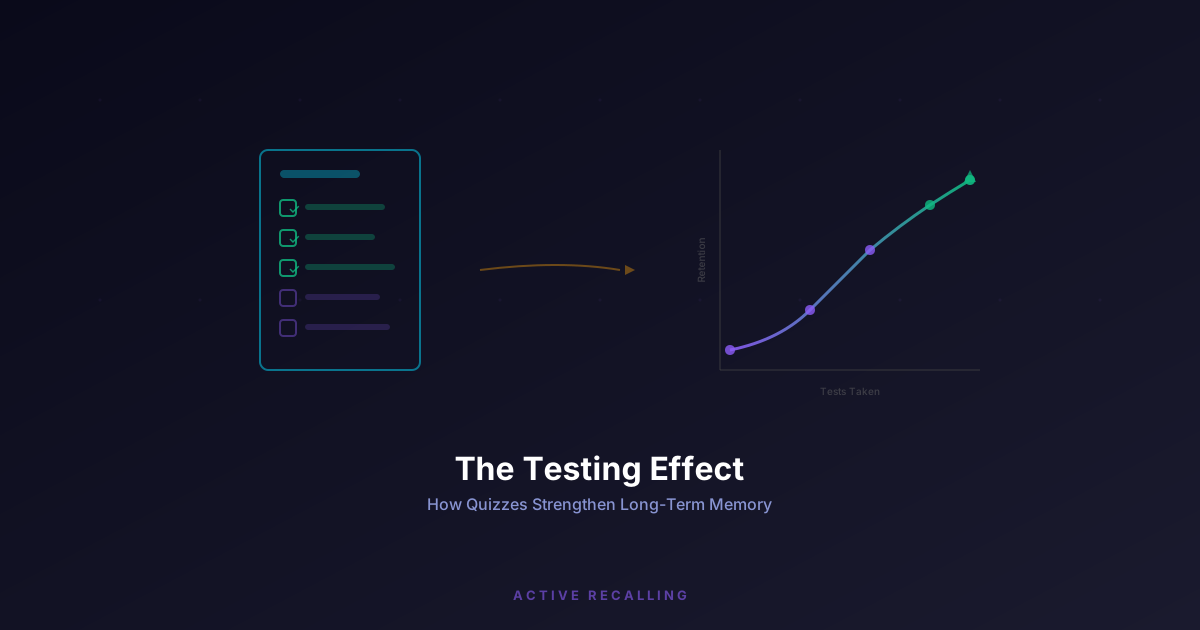
TL;DR: The testing effect — the finding that retrieving information strengthens memory more than re-studying it — is one of the most robust results in cognitive psychology. Roediger and Karpicke (2006) found students who took practice tests retained about 50 percent more after a week than those who re-read, and Rowland's 2014 meta-analysis of 159 studies confirmed the effect across virtually every condition tested.
For most students, tests and quizzes represent moments of judgment. They are the events where your knowledge is evaluated, graded, and measured. Tests are something to survive, not something to seek out. But what if tests were not just measurement tools but powerful learning tools in their own right? What if the act of taking a test actually made you smarter, strengthening your memory and improving your ability to learn new information? This is exactly what decades of research on the testing effect have demonstrated, and the implications for how you study are profound.
What Is the Testing Effect?
The testing effect, also known as retrieval practice or test-enhanced learning, refers to the finding that retrieving information from memory through testing produces better long-term retention than spending an equivalent amount of time restudying the same material. In other words, quizzes and tests are not just ways to measure what you know. They are one of the most effective ways to increase what you know.
This is a counterintuitive idea. Common sense suggests that studying inputs information into memory while testing merely checks what is there. The testing effect reveals that this model is wrong. Testing modifies memory. Each time you successfully retrieve a piece of information, you strengthen the memory trace, making it more durable and more accessible in the future. And even when retrieval is unsuccessful, the attempt itself can enhance subsequent learning.
The testing effect is not a small or fragile finding. It has been replicated in hundreds of studies over more than a century of research, making it one of the most robust phenomena in cognitive psychology.
Landmark Research on the Testing Effect
The Gate Studies
The modern era of testing effect research began with a landmark study by Roediger and Karpicke (2006). In their experiment, students read short prose passages and then either restudied the passages or took a free recall test where they wrote down everything they could remember. When tested five minutes later, the restudy group performed slightly better. But when tested one week later, the testing group dramatically outperformed the restudy group, recalling approximately 50 percent more material.
This crossover pattern, where restudying appears superior in the short term but testing is decisively superior in the long term, is one of the most important findings in the testing effect literature. It explains why students who rely on restudying feel confident about their preparation but often underperform on delayed assessments. The strategy that feels effective is not the strategy that produces lasting learning.
Karpicke and Blunt's Comparative Study
Karpicke and Blunt (2011) published a widely cited study in the journal Science that compared four study methods: a single study session, repeated study, elaborative concept mapping, and retrieval practice through testing. Retrieval practice produced the best performance on a delayed test, even when the test required students to make inferences that went beyond direct recall. This demonstrated that the testing effect is not limited to rote memorization but extends to deeper, more meaningful learning.
Remarkably, retrieval practice outperformed concept mapping, a strategy that is often considered a "deep learning" approach. This challenged the assumption that active strategies requiring obvious elaboration are always superior and highlighted that the specific cognitive act of retrieval is uniquely powerful.
McDaniel and Colleagues' Classroom Research
McDaniel, Agarwal, Huelser, McDermott, and Roediger (2011) conducted a series of studies in actual middle school classrooms that provided some of the strongest real-world evidence for the testing effect. Students who took low-stakes quizzes on material covered in class scored significantly higher on chapter tests and end-of-semester exams compared to material that was reviewed but not quizzed. The benefits were substantial, representing approximately a full letter grade improvement.
These findings were particularly compelling because they occurred in authentic educational settings with real students, real curricula, and real exams. The quizzes were brief, low-stakes, and integrated into normal class activities, demonstrating that the testing effect can be harnessed without major changes to educational practices.
Rowland's Meta-Analysis
Rowland (2014) conducted a comprehensive meta-analysis of 159 testing effect studies. The analysis confirmed a reliable, moderate-to-large testing effect across a wide range of conditions. Testing produced better long-term retention than restudying for verbal materials, visual materials, and educational content. The effect was present for both recall and recognition tests and was enhanced when feedback was provided after testing.
The Forward Testing Effect
One of the most exciting developments in testing effect research is the discovery of the forward testing effect: taking a test on previously studied material can enhance your ability to learn and remember new material studied afterward.
How It Works
Pastotter and Bauml (2014) reviewed a substantial body of evidence showing that interpolated testing, taking a test in between studying different sets of material, improves memory for the material studied after the test, not just the material that was tested. This means that quizzing yourself on chapter one before studying chapter two actually helps you learn chapter two better.
Several mechanisms explain this forward effect:
Reset of proactive interference. When you study a large amount of material continuously, earlier material can interfere with the encoding of later material, a phenomenon called proactive interference. Testing appears to reset this interference, giving later material a fresh start in memory.
Enhanced attention and engagement. After taking a test, students show increased attention and deeper processing during subsequent study. The test activates a more engaged cognitive state that benefits new learning.
Improved encoding strategies. The experience of being tested helps students develop better encoding strategies for subsequent material. Having just experienced what it feels like to retrieve information, students may study new material in ways that are more retrieval-friendly.
Implications for Study Design
The forward testing effect suggests that the optimal study session is not a long block of uninterrupted studying but rather a sequence of study-test-study-test cycles. By interspersing brief self-tests between study segments, you not only strengthen memory for what you have already studied but also prepare your brain to learn the next segment more effectively.
Test-Enhanced Learning: Beyond Simple Recall
The testing effect is not limited to helping you remember isolated facts. Research has demonstrated that testing enhances several higher-order aspects of learning.
Transfer to New Contexts
Butler (2010) demonstrated that testing improves the ability to transfer knowledge to new contexts and new types of questions. Students who were tested on material using one type of question (such as short answer) showed improved performance on a different type of question (such as inference-based questions) compared to students who restudied. This suggests that testing builds a more flexible and robust knowledge representation that can be applied across different situations.
Reducing False Memories
Roediger and colleagues have shown that testing can reduce the formation of false memories, incorrect memories that feel genuine. When students are tested on information shortly after studying it, they are less likely to develop false memories related to that information. The testing process seems to strengthen accurate memories while weakening the influence of misleading information.
Improving Metacognitive Accuracy
Testing provides accurate feedback about what you know and what you do not know. Students who regularly take practice tests develop more accurate metacognitive judgments. They become better at predicting their future test performance and can allocate their study time more effectively as a result. This contrasts sharply with restudying, which tends to inflate confidence without improving accuracy.
Organizing Knowledge
Research by Zaromb and Roediger (2010) showed that testing helps students organize their knowledge more effectively. Students who were tested on a list of words subsequently recalled those words in more organized clusters compared to students who restudied. The act of retrieval seems to activate organizational processes that improve the structure of knowledge in memory.
How to Use Quizzes as a Study Tool
Understanding the testing effect transforms how you should approach quizzes and tests. Instead of dreading them as evaluation events, you should actively seek them out as learning events.
Self-Testing During Study Sessions
The simplest way to harness the testing effect is to regularly test yourself during your study sessions. After reading a section of your textbook, close the book and try to write down or recite everything you can remember. After watching a lecture video, pause and quiz yourself on the key points. After studying your flashcards, put them away and try to recall the information without looking.
The key is to make retrieval the core activity of your study session rather than an afterthought. Spend more time testing yourself and less time re-reading or reviewing.
Low-Stakes Practice Quizzes
Create or find practice quizzes that cover the material you are studying. These quizzes should be low-stakes, meaning there is no grade or penalty attached, so you can focus on learning rather than performance anxiety. Many textbooks include review questions, and online resources offer practice quizzes for a wide range of subjects.
The format of the quiz matters less than the fact that it requires retrieval. Multiple-choice questions provide some retrieval benefit, but free recall and short answer formats typically produce larger testing effects because they require more effortful retrieval.
The Read-Recite-Review Method
The Read-Recite-Review (3R) method is a simple protocol for incorporating the testing effect into your reading. First, read a section of text. Then, put the text aside and recite the key points from memory. Finally, review the text to check what you remembered correctly and what you missed. This method has been shown to produce significantly better retention than simply reading and re-reading.
Flashcard-Based Testing
Flashcards are a natural vehicle for the testing effect. When using flashcards, always attempt to recall the answer before flipping the card. If you simply read both sides of the card, you are restudying rather than testing, and you miss the retrieval benefit. Rate your confidence or performance on each card so you can identify which items need more practice.
Cumulative Testing
Do not limit your self-testing to the most recently studied material. Regularly include questions from earlier topics in your practice quizzes. This cumulative testing provides distributed practice, interleaving, and the testing effect simultaneously, creating a powerful combination of evidence-based learning strategies.
Study Group Quizzing
Study groups can be excellent settings for leveraging the testing effect. Take turns quizzing each other on the material. The person answering benefits from retrieval practice, and the person asking benefits from the generation effect of creating questions. Group quizzing also provides immediate feedback and opportunities for discussion and clarification.
Feedback and the Testing Effect
Research consistently shows that the testing effect is enhanced by feedback. While testing without feedback still produces meaningful learning benefits, providing the correct answer after each test question amplifies the effect substantially.
Butler, Karpicke, and Roediger (2007) demonstrated that feedback is particularly important when the initial retrieval attempt is unsuccessful. When you attempt to recall something and fail, receiving the correct answer afterward produces a strong learning benefit. Without feedback, unsuccessful retrieval attempts can leave incorrect information or gaps in knowledge unaddressed.
The timing of feedback matters as well. Immediate feedback, provided right after each question, and delayed feedback, provided after a short delay, both produce benefits. Some research suggests that slightly delayed feedback may produce marginally stronger learning, though the difference is typically small. The most important thing is that feedback is provided at all.
Addressing Test Anxiety
One potential concern about using testing as a learning tool is test anxiety. Some students experience significant anxiety in testing situations, which can impair performance and make the experience unpleasant. However, research suggests that the type of testing that produces the testing effect, low-stakes, self-directed practice testing, produces far less anxiety than high-stakes evaluative testing.
Agarwal, D'Antonio, Roediger, McDermott, and McDaniel (2014) found that students who regularly practiced with low-stakes quizzes actually experienced less anxiety on subsequent high-stakes exams. The practice testing built both knowledge and confidence, reducing the uncertainty that drives test anxiety. In this way, using tests as learning tools can actually help alleviate the very anxiety that tests can cause.
Additionally, framing practice tests as learning opportunities rather than evaluations helps reduce anxiety. When you self-test, there is no grade, no judgment, and no consequence for wrong answers. The only purpose is to strengthen your learning.
The Testing Effect Across Different Subjects
Sciences
The testing effect has been extensively demonstrated in science education. Students who take practice quizzes on biology, chemistry, and physics concepts consistently outperform those who restudy. The effect extends beyond factual recall to include understanding of scientific processes and the ability to apply scientific reasoning to new problems.
Mathematics
Testing on mathematical concepts and procedures improves both procedural fluency and conceptual understanding. Practice testing helps students develop more flexible problem-solving skills by strengthening their retrieval of mathematical principles and techniques.
Humanities
The testing effect applies equally well to learning in history, literature, philosophy, and other humanities disciplines. Quizzing on historical events, literary analysis, and philosophical arguments produces better retention and deeper understanding than restudying.
Languages
Vocabulary acquisition, one of the most studied domains in testing effect research, benefits enormously from retrieval practice. Students who test themselves on vocabulary words rather than re-reading word lists show dramatically better long-term retention.
Professional and Medical Education
Research in medical education has demonstrated that practice testing improves medical students' retention of clinical knowledge and their performance on board examinations. Similar findings have been reported in legal education, nursing education, and professional training programs.
Frequently Asked Questions
What is the testing effect in psychology?
The testing effect is the finding that retrieving information from memory through testing or quizzing produces stronger long-term retention than spending the same amount of time restudying. It has been documented in hundreds of studies dating back over a century and is one of the most robust findings in cognitive psychology.
Who discovered the testing effect?
Early evidence dates to Abbott (1909) and Gates (1917), but the modern era began with Roediger and Karpicke's 2006 study in Psychological Science, which popularized the term and established the classic experimental paradigm. McDaniel, Agarwal, and colleagues extended the findings into real classrooms.
Does the testing effect work for multiple-choice questions?
Yes, though free-recall and short-answer formats generally produce larger effects because they require more effortful retrieval. Multiple-choice questions with plausible distractors still generate meaningful learning benefits, especially when followed by feedback.
What is the forward testing effect?
A surprising finding that taking a test on previously studied material improves learning of new material studied afterward. Pastotter and Bauml (2014) showed this effect is robust across many conditions, likely because testing resets proactive interference and activates deeper encoding.
Does test anxiety cancel out the testing effect?
No — and in fact low-stakes practice testing actually reduces test anxiety on later high-stakes exams. Agarwal et al. (2014) found students who regularly practiced with ungraded quizzes reported less anxiety on final exams than students who did not.
Can I use the testing effect without a teacher creating quizzes?
Absolutely. Self-testing is as effective as instructor-created testing, as long as you genuinely attempt to retrieve before checking. Flashcards, practice problems, and the Read-Recite-Review method all harness the testing effect for self-directed learners.
Conclusion
The testing effect overturns a deeply ingrained assumption about what tests are for. Tests are not just measurement instruments that passively assess what you know. They are active learning events that strengthen memory, improve understanding, enhance transfer, and build accurate self-knowledge. The research evidence is overwhelming: regularly quizzing yourself on the material you are studying is one of the most effective things you can do to improve your long-term learning. Make testing a central part of your study routine, not something you endure at the end of a learning period. Seek out opportunities to test yourself early and often, provide yourself with feedback, and embrace the productive difficulty of retrieval. Your future self will thank you for the durable, flexible knowledge that test-enhanced learning builds.