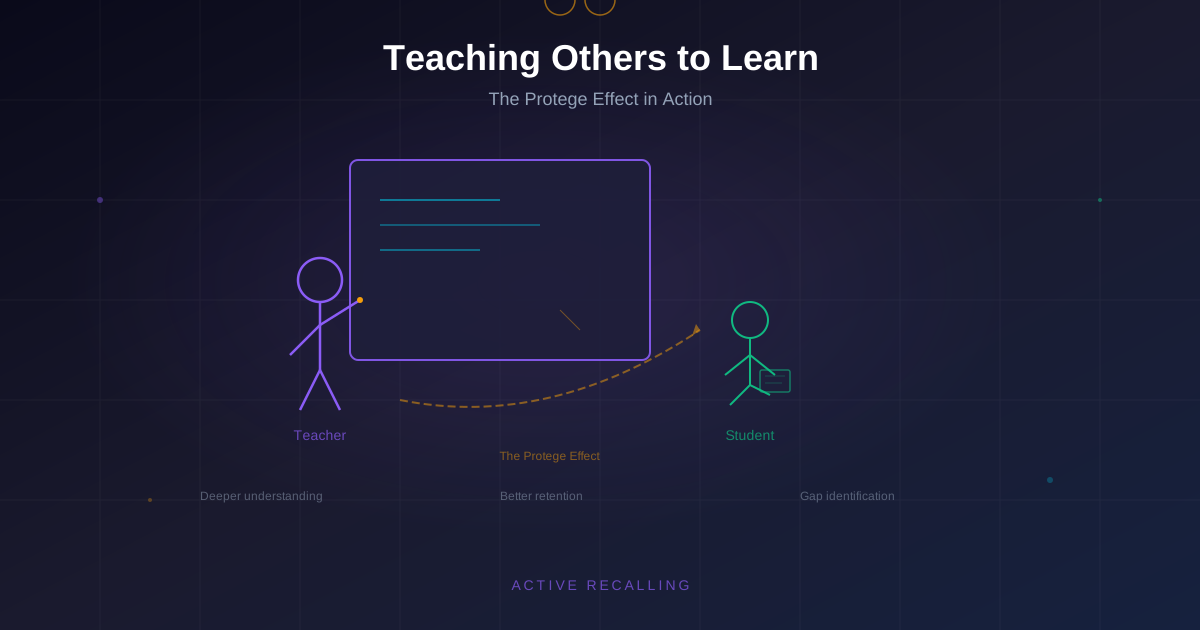
Learning by Teaching: A Counterintuitive Truth
One of the most reliable findings in learning science is also one of the most counterintuitive: you learn material better when you teach it to someone else than when you study it for yourself. This phenomenon, known as the protege effect, has been documented across dozens of studies, multiple age groups, and a wide range of subjects. The person who benefits most from a teaching interaction is often not the student — it's the teacher.
If you've ever tutored a classmate and found that you understood the material far better afterward, you've experienced the protege effect firsthand. But this isn't just an anecdotal observation. The effect is robust, replicable, and grounded in well-understood cognitive mechanisms. Understanding why it works — and how to harness it deliberately — can transform your approach to learning.
The implications extend beyond academia. Professionals who train colleagues, parents who help children with homework, and anyone who explains their expertise to others all benefit from the same effect. Teaching isn't just a way of transferring knowledge; it's one of the most effective ways of building it.
The Research Behind the Protege Effect
The Landmark Studies
The term "protege effect" was popularized by researchers Chase, Chin, Oppezzo, and Schwartz in a 2009 study at Stanford University. They had students use a computer-based "teachable agent" — a virtual character that the students were responsible for teaching. The students studied material and then "taught" it to their digital protege by inputting information that the agent would use to answer quiz questions.
The key finding: students who learned material in order to teach their virtual protege studied harder, learned more deeply, and retained information longer than students who studied the same material for their own benefit. The effect persisted even though the teaching was done through a computer interface, not face-to-face.
This was significant because it ruled out many alternative explanations. The protege effect wasn't just about social pressure, the desire to impress, or the benefits of dialogue. Something about the mindset of teaching — the sense of responsibility for another's learning — fundamentally changed how students engaged with the material.
The Expectancy Effect
A 2014 study by Nestojko, Bui, Kornell, and Bjork at Washington University in St. Louis took the research further. They gave students a passage to study and told half of them they would be tested on it afterward, while telling the other half they would need to teach it to another student.
Both groups were actually tested in the same way. But the group that expected to teach scored significantly higher on the test. Simply anticipating the need to teach changed how they studied — even though they never actually taught anyone.
This finding reveals that much of the protege effect operates during the preparation phase. The expectation of teaching triggers different study behaviors: more organized note-taking, greater attention to the overall structure of the material, and a focus on understanding concepts rather than memorizing surface details.
Meta-Analytic Evidence
A comprehensive meta-analysis by Fiorella and Mayer in 2013, covering 33 experiments, confirmed that the learning-by-teaching effect was consistent and significant. They found that students who taught material (or prepared to teach it) outperformed control groups on measures of both comprehension and transfer — the ability to apply knowledge to novel situations.
The effect was particularly strong when teaching involved generative activities such as explaining, summarizing, creating examples, and answering questions from learners. Merely presenting information without these generative components produced smaller benefits.
Why Teaching Deepens Understanding
The Preparation Effect
When you know you need to teach something, you study differently. Research shows that teachers-in-training engage in several behaviors that promote deeper learning:
Organizing information hierarchically. Instead of treating all facts as equally important, you identify the main ideas and the supporting details. You think about the logical structure of the material — what comes first, what depends on what, and how the pieces fit together. This organizational processing creates a more coherent and accessible mental model.
Anticipating questions. When preparing to teach, you naturally think about what a learner might find confusing. "They'll probably ask why this happens" or "This part is tricky — I need to explain it carefully." This anticipation forces you to consider the material from multiple angles and to prepare explanations for the most difficult parts.
Filling gaps proactively. As a test-taker, you might skim over a section you don't fully understand and hope it won't be on the exam. As a teacher, you can't afford that luxury. If a student asks about the part you skipped, you need to have an answer. This sense of responsibility motivates more thorough study.
Focusing on deep structure rather than surface features. Test preparation often focuses on what might be asked — specific facts, definitions, and formulas. Teaching preparation focuses on understanding — why things work the way they do, how concepts connect, and what the deeper principles are. This shift toward deep structure produces more durable and transferable learning.
The Explanation Effect
The act of explaining — whether to a real person or to an imagined audience — forces cognitive processes that don't occur during passive study.
Coherence building. An explanation must be coherent — it must flow logically from one point to the next. Creating this coherence requires you to understand the causal and logical relationships between ideas, not just the facts themselves. When your explanation hits a logical gap, you immediately notice and must fill it.
Simplification demands understanding. When you explain something to a novice, you can't hide behind jargon or assume shared knowledge. You must translate complex ideas into accessible language, which requires a level of understanding that goes far beyond recognition. As physicist Richard Feynman famously noted, "If you can't explain it simply, you don't understand it well enough."
Example generation. Good teachers use examples to illustrate abstract concepts. Generating your own examples requires you to connect the abstract concept to concrete situations, which deepens your understanding and creates additional retrieval cues in memory.
The Feedback Loop
When you teach a real person, their reactions provide immediate feedback on the quality of your understanding. A confused expression tells you your explanation wasn't clear. A good question reveals an angle you hadn't considered. A follow-up discussion deepens both your and the learner's understanding.
This feedback loop is rapid, specific, and motivating. It operates much faster than the feedback cycle of homework-grade-correction, and it targets exactly the areas where your understanding is weakest.
Even without a real audience, the process of producing an explanation provides self-generated feedback. You can hear or read your own explanation and evaluate whether it makes sense, catches all the key points, and flows logically. This self-monitoring function helps you identify and correct gaps in real time.
The Responsibility Factor
One of the most interesting aspects of the protege effect is the role of responsibility. When you study for yourself, the only person affected by your performance is you. When you study to teach someone else, another person's understanding depends on your preparation. This added responsibility changes your motivation and your behavior.
Studies on the protege effect have found that students report greater effort, greater engagement, and greater persistence when they believe someone else is counting on them. They spend more time studying, they review the material more carefully, and they're more likely to seek out additional resources when something is unclear.
This responsibility effect helps explain why the protege effect works even with virtual "teachable agents" — computer characters that aren't real people. The mere perception of responsibility for another's learning activates a more diligent and thorough approach to study.
In practical terms, this means that creating a sense of teaching responsibility — even an artificial one — can boost your learning. Tell yourself "I need to be able to explain this to my study group on Thursday" and your brain shifts into a more productive mode of study.
How to Practice Teaching for Better Learning
Teach a Study Partner
The most direct approach is to find a study partner and take turns teaching each other. Divide the material so that each person is responsible for teaching specific topics. Prepare as though you'll be giving a mini-lecture, and encourage your partner to ask questions and challenge your explanations.
This reciprocal teaching approach doubles the benefit: you learn deeply from the topics you teach, and you get a fresh perspective on the topics your partner teaches. The questions and discussions that arise are often the most valuable part of the exchange.
Volunteer as a Tutor
Many schools and organizations offer peer tutoring programs. Volunteering as a tutor gives you regular opportunities to teach material you're studying, with the added benefit of helping someone else succeed. Tutoring first-year students in subjects you studied last year is an excellent way to maintain and deepen that knowledge.
The tutoring context also provides authentic teaching challenges — real students with real confusions, questions you hadn't anticipated, and the need to adapt your explanations on the fly. These challenges push your understanding further than any scripted exercise could.
Use the Feynman Technique
The Feynman Technique is essentially a solo version of teaching. Choose a concept, write an explanation as if teaching it to a beginner, identify where your explanation breaks down, go back and study those areas, and refine your explanation. This captures many of the benefits of the protege effect without requiring an audience.
Teach a Teachable Agent
If you don't have a study partner available, create your own teachable agent. This could be as simple as a rubber duck on your desk, a voice memo app on your phone, or a blank document where you type your explanation. The key is to frame the activity as teaching rather than self-study. Address your explanation to an imagined learner who needs your help understanding the material.
Write Study Guides for Others
Create study guides, summaries, or tutorials designed for other students. Writing for an audience forces the same organizational and explanatory processing as in-person teaching. Share your guides with classmates — their feedback tells you which parts of your understanding are solid and which need work.
Create Teaching Content
In the digital age, there are countless platforms for sharing knowledge. Consider creating blog posts, videos, or social media content that explains concepts you're studying. The process of creating polished educational content requires deep understanding, clear organization, and the ability to anticipate and address common points of confusion.
You don't need a large audience. Even creating content that you never publish provides the cognitive benefits of the teaching mindset. But if you do share it, the feedback and questions from readers or viewers add another layer of learning.
Explain to Family Members
Explaining your coursework to family members or friends who aren't in your field is an underutilized practice. Your non-expert audience will ask fundamental questions that force you to examine your assumptions and explain concepts from scratch. "Why does that matter?" and "What does that actually mean?" are questions that a professor might never ask but that your parent or partner naturally will.
These conversations are also an opportunity to practice translating complex ideas into everyday language — a skill that's valuable in any profession.
Teaching in Different Contexts
In the Classroom
Students who participate actively in classroom discussions — asking questions, answering the instructor's questions, and explaining concepts to peers — benefit from many of the same mechanisms as the protege effect. Every time you raise your hand and explain your understanding of a concept, you're engaging in a mini-teaching moment that deepens your learning.
If your class includes group work or presentations, approach these as genuine teaching opportunities rather than obligatory assignments. The more seriously you take the teaching component, the more you'll learn.
In the Workplace
The protege effect extends beyond academia. Professionals who mentor junior colleagues report deeper understanding of their own expertise. Training sessions, onboarding, and knowledge-sharing meetings all provide opportunities to solidify your knowledge through teaching.
If you're a software developer, explaining your code architecture to a new team member forces you to articulate decisions you might have made intuitively. If you're a marketer, teaching a colleague about your campaign strategy requires you to organize and justify your approach. In every field, teaching is a path to expertise.
Online Communities
Participating in online forums, Q&A sites, and community discussions is a form of teaching that scales infinitely. Answering questions on topics you're studying forces you to produce clear, accurate explanations under the scrutiny of a potentially knowledgeable audience. The feedback from upvotes, corrections, and follow-up questions accelerates your learning.
Overcoming the Fear of Teaching
Many people hesitate to teach because they feel they don't know enough. "Who am I to teach this? I'm still learning it myself." But this objection misunderstands the protege effect. You don't need to be an expert to benefit from teaching — in fact, the effect is strongest when you're actively learning the material.
Teaching doesn't require perfection. It requires engagement. When you teach something you're still learning, you discover your gaps faster, you're motivated to fill them more thoroughly, and you build a deeper understanding than passive study alone could provide.
Start small. Explain one concept to one person. If you get something wrong, that's not a failure — it's the most valuable piece of information you could get. It tells you exactly where to focus your next study session.
Conclusion
The protege effect reveals a fundamental truth about learning: the best way to understand something deeply is to explain it to someone else. The preparation, the organization, the simplification, the example generation, the question anticipation, and the feedback — all of these processes that teaching demands are precisely the processes that produce lasting, transferable understanding.
You don't need to be a professional teacher to benefit. You need only the intention to teach and the willingness to explain. Prepare as though you'll be teaching every topic you study. Seek out opportunities to share your knowledge — with study partners, tutoring clients, family members, or online communities. Each teaching moment is a learning moment, and the person who learns the most is always the one doing the teaching.