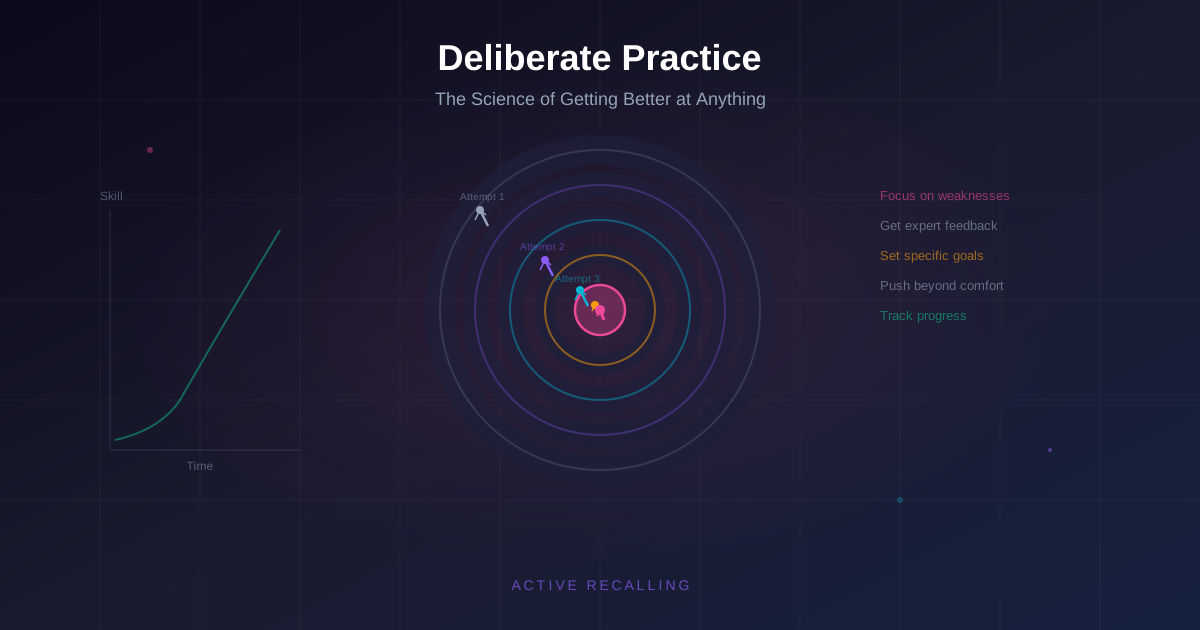
What Is Deliberate Practice?
Deliberate practice is a specific type of practice that is purposeful, systematic, and designed to improve performance. It's not just doing the same thing over and over, and it's not just putting in hours. Deliberate practice involves pushing beyond your current abilities, receiving feedback, and making targeted adjustments — repeatedly and consistently over time.
The concept was developed by psychologist K. Anders Ericsson, whose decades of research on expertise across fields ranging from music to chess to medicine revealed a consistent pattern: the people who reach the highest levels of performance are not necessarily those with the most natural talent. They are the ones who engage in the most hours of deliberate practice.
This finding challenged the popular notion that expertise is primarily a matter of innate ability. While talent certainly plays a role, Ericsson's research showed that the quality and quantity of practice is a far better predictor of expertise than any measure of natural aptitude. This is both an encouraging and a demanding message: greatness is available to more people than we typically assume, but it requires a kind of practice that most people find uncomfortable.
Deliberate practice is not the same as simply showing up and going through the motions. A musician who plays their favorite pieces for an hour is practicing. A musician who spends that hour working on the three measures they can't play cleanly, slowly analyzing their finger positioning, adjusting their technique, and repeating until the passage improves — that's deliberate practice. The difference in outcomes over months and years is enormous.
Ericsson's Research: How Experts Are Made
The Berlin Study
Ericsson's most famous study, conducted with colleagues Krampe and Tesch-Romer in 1993, examined violinists at the Berlin Academy of Music. The researchers divided the students into three groups based on skill level: the "best" violinists (those identified by faculty as having the potential for solo careers), the "good" violinists (deemed strong but not exceptional), and the "music teachers" (competent players unlikely to become professional performers).
When the researchers examined the practice histories of these three groups, a clear pattern emerged. By age 20, the best violinists had accumulated an average of 10,000 hours of deliberate practice. The good violinists had accumulated about 8,000 hours. The music teachers had accumulated about 4,000 hours.
Crucially, the researchers found no "naturals" — violinists who had reached the top tier without extensive practice. And they found no "grinds" — violinists who had practiced just as much as the best players but failed to reach their level. The amount of deliberate practice was the single best predictor of expertise.
Beyond the 10,000 Hour Rule
The "10,000 hour rule" was popularized by Malcolm Gladwell in his book Outliers, but Ericsson himself was careful to note several important qualifications that the popular version often misses.
Not all practice is equal. Ten thousand hours of mindless repetition will not produce expertise. The hours must be spent in deliberate practice — focused, effortful, and targeted at specific weaknesses. An amateur who plays guitar casually for 10,000 hours will not become a virtuoso. The quality of practice matters as much as the quantity.
The number varies by domain. Ten thousand hours is an average for one specific study of one specific group. In some domains, expertise develops faster; in others, it takes longer. The important principle is not the specific number but the consistent relationship between deliberate practice and performance level.
Talent interacts with practice. Ericsson acknowledged that individual differences exist and that some people may progress faster than others. But his consistent finding was that even highly talented individuals require extensive deliberate practice to reach their potential, and that practice differences explain far more variance in performance than talent differences do.
Across Domains
Subsequent research has confirmed the deliberate practice model across a remarkable range of fields. Studies have found similar patterns in chess, sports, music, mathematics, medicine, typing, and even memory performance. In every domain studied, the highest performers are those who have engaged in the most structured, focused practice.
The Key Components of Deliberate Practice
Specific Goals
Deliberate practice requires clear, specific objectives for each practice session. "Get better at piano" is not a specific goal. "Improve the smooth transition between measures 24 and 28 of this sonata" is. The more precisely you can define what you're working on, the more effectively you can direct your attention and measure your progress.
Before each practice session, identify exactly what you want to improve. After the session, evaluate whether you made progress toward that specific goal. This cycle of goal-setting, practice, and evaluation keeps your practice focused and prevents the drift toward comfortable, unproductive repetition.
Operating at the Edge of Your Abilities
Deliberate practice occurs in the zone just beyond your current competence — what psychologist Lev Vygotsky called the zone of proximal development. If the task is too easy, you're not being challenged and won't improve. If it's too hard, you can't perform it well enough to learn from the attempt. The sweet spot is material that you can almost do but not quite — where success requires focused effort and stretching your current abilities.
This is one of the reasons deliberate practice is uncomfortable. By definition, you're spending your time on things you can't yet do well. This means frequent mistakes, frustration, and the feeling of being out of your depth. These feelings are not signs that you're doing it wrong — they're signs that you're doing it right.
In contrast, practicing things you can already do comfortably feels good but produces minimal improvement. If your practice sessions feel easy and enjoyable, you're probably not engaging in deliberate practice.
Immediate Feedback
Feedback is the mechanism that turns practice into improvement. Without feedback, you can't know whether your performance is improving, staying the same, or getting worse. You can't identify specific errors or adjust your approach.
The best feedback is immediate, specific, and actionable. A music teacher who stops a student mid-phrase to correct their bowing technique is providing ideal feedback. A student who records themselves playing and listens back is getting slightly delayed but still useful feedback. A student who plays through a piece and simply moves on to the next one is getting almost no feedback at all.
Sources of feedback include:
Expert coaches and teachers. The most reliable source of feedback, especially for complex skills. A good coach can identify subtle errors that you can't detect yourself and prescribe specific corrections.
Self-monitoring. Recording yourself (video, audio, or written work) and reviewing the recording. This requires discipline and honest self-assessment but provides feedback even when a coach isn't available.
Objective metrics. Time, speed, accuracy, score — any measurable outcome that reflects your performance. These numbers don't tell you what to fix, but they do tell you whether your practice is producing results.
Peer feedback. Other practitioners at or above your level can often identify issues and suggest improvements. While less authoritative than expert coaching, peer feedback is more accessible and still valuable.
Repetition with Refinement
Deliberate practice involves doing things again and again — but not mindlessly. Each repetition is an opportunity to make a small adjustment based on feedback from the previous attempt. The cycle is: attempt, observe the result, identify what to change, adjust, and attempt again.
This is fundamentally different from the kind of repetition most people do. Playing through a piece of music ten times without changing anything is repetition without refinement. Playing a difficult passage, noticing that the third note is consistently flat, adjusting your finger placement, and playing again to check whether the adjustment worked — that's deliberate practice.
The refinement doesn't need to be dramatic. Small, incremental adjustments compounded over hundreds of repetitions produce significant improvement. The key is that each repetition is intentional and informed by feedback.
Mental Engagement
Deliberate practice requires sustained concentration. This is why it's mentally fatiguing and why even elite performers can typically sustain it for only a few hours per day. Studies of world-class musicians, athletes, and chess players consistently show that they practice deliberately for an average of three to five hours per day, often broken into sessions of 60 to 90 minutes with rest breaks in between.
When your mind wanders during practice — when you start going through the motions without paying attention — the practice stops being deliberate. The physical repetition might continue, but the mental engagement that drives improvement has ceased. Recognizing when this happens and either refocusing or taking a break is an important meta-skill.
Building a Feedback Loop
The quality of your feedback loop largely determines the quality of your practice. Here's how to build an effective one:
Identify Observable Indicators
For any skill, determine what good performance looks like in observable, measurable terms. For a tennis serve, it might be the placement of the ball, the speed, and the consistency. For writing, it might be the clarity of argument, the precision of language, and the coherence of structure. For public speaking, it might be pace, eye contact, and audience engagement.
These indicators become the basis for your feedback. After each practice session, evaluate your performance against these specific criteria.
Create Short Feedback Cycles
The shorter the gap between action and feedback, the faster you learn. If possible, get feedback during practice, not just after. A video recording you review in real time is better than one you watch the next day. A coach who gives feedback between attempts is better than one who provides a summary at the end of the session.
Design your practice so that you can evaluate each attempt quickly and adjust for the next one. This might mean practicing in smaller units — individual sentences rather than whole paragraphs, individual measures rather than whole movements, individual problems rather than whole exams.
Track Progress Over Time
Keep a practice journal or log that records what you practiced, what you observed, what adjustments you made, and what results you got. Over weeks and months, this record reveals patterns that individual sessions don't: which techniques are producing the most improvement, which weaknesses are persisting, and whether your overall trajectory is upward.
Progress tracking also provides motivation. When practice feels frustrating in the moment, looking back at your journal to see how far you've come can restore perspective and determination.
Practical Application Across Domains
Academic Learning
Students can apply deliberate practice by focusing study time on their weakest areas rather than reviewing material they already understand. After an exam, analyze your errors. What types of questions did you get wrong? What misconceptions or knowledge gaps do they reveal? Design your next study session to address those specific weaknesses.
For problem-solving subjects like mathematics or physics, work through problems that are just beyond your current skill level. When you get stuck, analyze why. Seek feedback from professors, tutors, or solution guides. Then attempt similar problems to see if your understanding has improved.
Music and Performing Arts
Musicians already use deliberate practice more than almost any other group, but many still fall into the trap of running through pieces from start to finish rather than targeting weak passages. Isolate the difficult sections. Practice them slowly, at a tempo where you can play them perfectly. Gradually increase the speed. Only after the difficult passages are solid should you integrate them into the full piece.
Record yourself regularly and listen critically. Compare your recordings to performances by artists you admire. Notice the specific differences and work on closing those gaps.
Sports and Physical Skills
Athletes benefit from breaking complex skills into component parts and practicing each part separately before combining them. A basketball player might practice free throws, then dribbling drills, then defensive footwork — each with specific goals and feedback mechanisms — rather than just playing pickup games.
Video analysis is particularly valuable in sports. Recording your performance and reviewing it frame by frame reveals technical issues invisible in real time.
Professional Skills
For skills like writing, public speaking, negotiation, or leadership, deliberate practice requires more creativity in designing practice activities and obtaining feedback. Write regularly and seek critical feedback from skilled peers. Record presentations and review them. Role-play negotiations with a partner who provides honest assessments.
The challenge in professional domains is that many skills are practiced only in high-stakes situations (real negotiations, real presentations) where the consequences of failure are significant. Creating low-stakes practice environments — writing groups, speaking clubs, simulation exercises — is essential for deliberate practice in these areas.
The Role of Rest and Recovery
Deliberate practice is mentally and often physically exhausting. Research consistently shows that experts don't practice all day — they alternate between intensive practice and intentional rest. Sleep, in particular, plays a crucial role in consolidating the skills developed during practice. Many studies have shown that performance improves after a night of sleep, even without additional practice, because the brain continues processing and integrating new learning during rest.
Design your practice schedule to include adequate rest. Practicing for two focused hours with a long break is far more productive than grinding through five unfocused hours. Listen to your body and mind — when concentration deteriorates significantly, stop and rest. Pushing through extreme fatigue produces diminishing returns and increases the risk of injury or burnout.
Common Misconceptions About Deliberate Practice
"It's just about putting in more hours." Hours matter, but only if they're spent on deliberate practice. Ten hours of mindless repetition is worth far less than two hours of focused, goal-directed practice with feedback.
"It should feel good." Deliberate practice is often uncomfortable because it involves confronting your weaknesses and making frequent mistakes. If practice always feels easy and enjoyable, you're likely staying in your comfort zone and not improving.
"Natural talent doesn't matter at all." Ericsson's work showed that practice matters more than most people think, but he didn't claim talent is irrelevant. Individual differences in learning speed and ultimate potential do exist. The point is that practice differences explain far more of the variation in performance than most people assume.
"Any practice counts as deliberate practice." Running through activities you can already do, practicing without goals, and ignoring feedback are all common but unproductive. Deliberate practice has specific characteristics that distinguish it from ordinary repetition.
Getting Started with Deliberate Practice
If you want to apply deliberate practice to your own learning or skill development, start with these steps:
Identify your current level. Be honest about where you stand. What can you do well? What can you do poorly? Where are the specific gaps between your current performance and your goals?
Set specific practice goals. For each session, define exactly what you'll work on and what improvement looks like. Write these goals down.
Find a source of feedback. Ideally, this is a coach or mentor. If that's not available, find ways to evaluate your own performance — recordings, metrics, or structured self-assessment.
Practice in focused sessions. Aim for 60 to 90 minutes of concentrated practice. Minimize distractions. When your focus fades, take a break.
Track your progress. Keep records of your practice goals, methods, and outcomes. Review them periodically to ensure you're on track.
Be patient. Deliberate practice produces results, but not instantly. Skill development is a long game, measured in months and years rather than days and weeks. Trust the process and focus on consistent daily improvement rather than immediate transformation.
Conclusion
Deliberate practice is not a shortcut. It's the opposite — it's the long, difficult, often uncomfortable path that leads to genuine expertise. But it's also the most reliable path. Across every domain that researchers have studied, the pattern is the same: those who engage in the most focused, feedback-driven, goal-directed practice reach the highest levels of performance.
The good news is that deliberate practice is a learnable skill in itself. You can get better at practicing. You can learn to identify your weaknesses more accurately, to seek and use feedback more effectively, and to design practice sessions that target exactly the right challenges. And as you improve at practicing, your improvement in every other skill accelerates.
Whatever you're trying to learn or master — an academic subject, a musical instrument, a sport, a professional skill — deliberate practice is the engine that drives progress. Set your goals. Get your feedback. Push beyond your comfort zone. And give it time. The science is clear: excellence is not born. It's practiced.