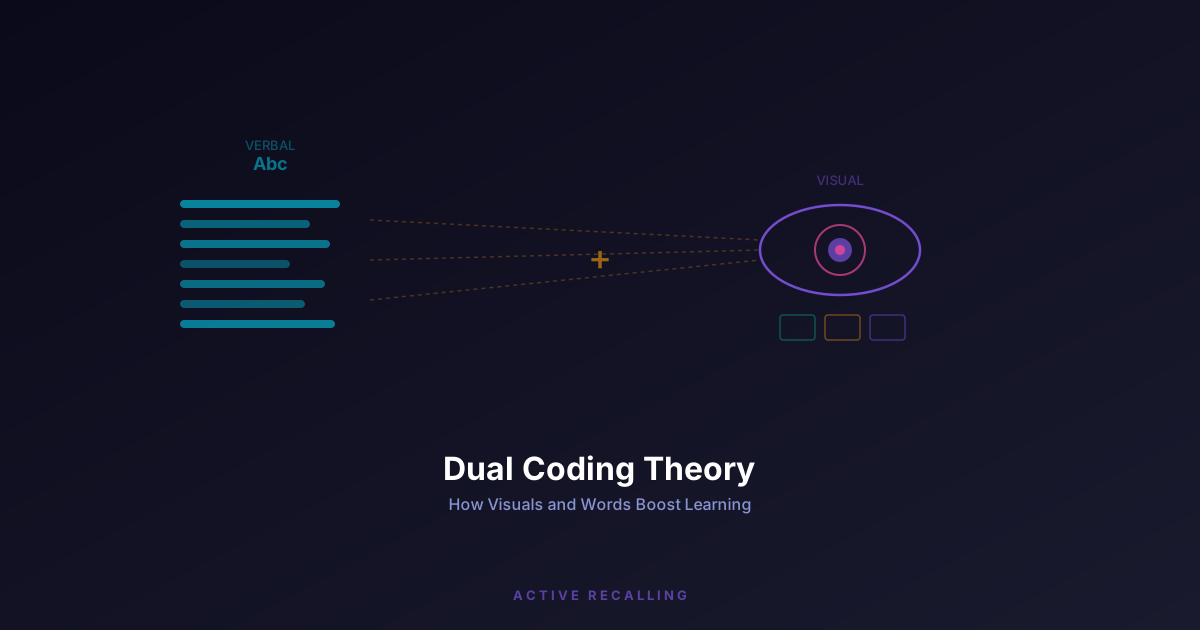
Close your eyes and think about a dog. Did you see an image of a dog in your mind, or did you think of the word "dog"? Most people experience some combination of both. This simple observation points to something fundamental about how the human brain processes and stores information. We have not one but two distinct systems for representing knowledge: one for verbal information like words and language, and another for visual information like images, diagrams, and spatial relationships. Dual coding theory, developed by psychologist Allan Paivio, explains how leveraging both systems simultaneously creates more powerful and durable memories.
What Is Dual Coding Theory?
Dual coding theory proposes that human cognition operates through two distinct but interconnected processing channels: a verbal channel that processes language-based information including words, sentences, and text, and a nonverbal channel that processes imagery-based information including pictures, diagrams, spatial layouts, and other visual or sensory representations.
The theory's central claim is that information encoded through both channels simultaneously is remembered significantly better than information encoded through either channel alone. When you read a description of how a heart pumps blood and simultaneously view a diagram of the cardiovascular system, you create two complementary memory traces. Each trace can independently support recall, and they reinforce each other through referential connections that link the verbal and visual representations.
Think of it as having two separate filing systems for the same piece of information. If one system fails to locate the memory, the other can often retrieve it. Having two independent pathways to the same knowledge roughly doubles your chances of successful recall.
Allan Paivio's Foundational Research
Allan Paivio, a Canadian psychologist at the University of Western Ontario, developed dual coding theory in the 1970s and 1980s, publishing his seminal work "Mental Representations: A Dual Coding Approach" in 1986. His research program was motivated by a simple but striking observation: concrete words like "apple," "bicycle," and "mountain" are consistently easier to remember than abstract words like "justice," "theory," and "probability."
Paivio hypothesized that concrete words are easier to remember because they automatically evoke mental images in addition to their verbal representations. When you hear the word "apple," you effortlessly generate a mental picture of an apple, creating a dual code. Abstract words, by contrast, are primarily encoded through the verbal channel alone because they do not readily evoke specific mental images.
In his experiments, Paivio demonstrated that participants recalled concrete words at rates nearly twice as high as abstract words. When participants were instructed to form mental images of abstract concepts, their recall improved significantly, providing direct evidence that the imagery channel was responsible for the memory advantage.
Paivio also conducted paired-associate learning experiments in which participants learned pairs of words. Pairs that included at least one concrete, imageable word were learned much more effectively than pairs of abstract words. The easiest pairs to learn were those where both words were concrete, confirming that dual coding provides an additive memory benefit.
The Two Channels: Verbal and Visual
Understanding the characteristics of each processing channel clarifies how to use dual coding effectively.
The Verbal Channel
The verbal channel processes information sequentially and linguistically. It handles spoken words, written text, inner speech, and any information organized through language. When you read a textbook, listen to a lecture, or talk through a problem, you are primarily engaging the verbal channel.
The verbal channel excels at representing abstract relationships, logical arguments, sequential procedures, and precise definitions. It is essential for understanding grammar, mathematical notation, and complex reasoning chains. However, information encoded only through the verbal channel is often fragile and susceptible to interference from other verbal information.
The Visual Channel
The nonverbal or visual channel processes information simultaneously and spatially. It handles mental images, diagrams, maps, physical demonstrations, and any information organized through spatial or sensory relationships. When you visualize a concept, study a diagram, or observe a physical demonstration, you are primarily engaging the visual channel.
The visual channel excels at representing spatial relationships, structural features, patterns, and holistic overviews. It is particularly effective for understanding systems, processes, anatomical structures, and any information with inherent spatial organization. Images tend to be highly distinctive in memory, which is why a single vivid image can be more memorable than paragraphs of text.
Referential Connections
The two channels are not independent silos. They are linked through referential connections that allow information in one channel to activate corresponding information in the other. When you see a diagram of a cell and read the label "nucleus," you form a referential connection between the visual representation of the nucleus and the verbal label. These cross-channel connections are a powerful feature of dual coding because they provide additional retrieval pathways.
Research Supporting Dual Coding
Beyond Paivio's original work, extensive research has confirmed and extended the principles of dual coding theory.
Mayer's Multimedia Learning Research
Richard Mayer at the University of California, Santa Barbara, has conducted decades of research on multimedia learning that strongly supports dual coding principles. Mayer's multimedia learning principle states that people learn better from words and pictures together than from words alone. Across hundreds of experiments, Mayer and his colleagues have consistently found that combining verbal explanations with visual illustrations produces superior learning outcomes.
Mayer's research also identified important boundary conditions. The spatial contiguity principle states that corresponding words and images should be placed near each other rather than far apart on a page. The temporal contiguity principle states that corresponding narration and animation should be presented simultaneously rather than sequentially. The coherence principle states that extraneous material should be excluded because it can overload processing channels without contributing to learning.
The Picture Superiority Effect
The picture superiority effect is one of the most reliable findings in memory research. People remember pictures substantially better than words, even after long delays. Shepard (1967) demonstrated that participants could recognize over 98 percent of previously viewed pictures, a recognition rate far exceeding that for words. This advantage is explained by dual coding: pictures are automatically encoded both visually and verbally (people spontaneously name what they see), while words are primarily encoded verbally.
Concrete vs. Abstract Concept Learning
Research by Sadoski and Paivio (2001) demonstrated that dual coding principles apply broadly to education. Students who were taught abstract concepts using concrete examples and visual representations showed significantly better comprehension and retention than those taught through verbal explanations alone. This finding has practical implications for teaching subjects like mathematics, physics, and philosophy, where abstract concepts are central.
Practical Applications of Dual Coding
Here are specific strategies for applying dual coding to your learning.
Create Your Own Diagrams
When studying a concept, create a visual representation alongside your verbal notes. This might be a diagram, flowchart, mind map, concept map, or simple sketch. The act of creating the visual representation forces you to think about the spatial and structural relationships within the material, and it produces a dual-coded memory trace that is stronger than either words or images alone.
For example, when studying the causes of World War I, you might create a concept map showing the web of alliances, arms races, imperial rivalries, and the specific triggering events, with arrows indicating causal relationships. This visual overview complements your written notes and helps you see the big picture.
Use Timelines for Historical and Sequential Information
Timelines are a powerful dual coding tool for any information with a temporal or sequential structure. Rather than reading a list of dates and events, plot them on a visual timeline. The spatial arrangement of events along the timeline encodes both the sequence and the relative spacing between events, providing visual information that supplements the verbal details.
Annotate Diagrams with Explanations
If your textbook or course materials include diagrams, do not just glance at them. Annotate them with your own explanations. Write brief notes next to each component of a diagram explaining what it does and how it relates to other components. This process of connecting verbal labels and explanations to visual elements builds the referential connections that make dual coding effective.
Transform Text into Visuals
When you encounter a purely text-based explanation of a process or system, challenge yourself to translate it into a visual format. If a paragraph describes how a bill becomes a law, draw a flowchart. If a passage explains the structure of an atom, sketch a diagram. If a section discusses the relationship between supply and demand, draw a graph. This translation process deepens your understanding and creates a dual-coded memory.
Combine Verbal Rehearsal with Mental Imagery
When reviewing flashcards or practicing retrieval, do not just recite the answer verbally. Also try to visualize the concept. If you are studying anatomy, visualize the organ or structure you are trying to recall. If you are studying history, try to form a mental image of the events or the geographic setting. This combination of verbal recall and mental imagery engages both channels and strengthens memory.
Use Color Coding Strategically
Color coding can add a visual dimension to otherwise purely verbal notes. Use different colors to represent different categories, themes, or levels of importance. For example, you might use one color for definitions, another for examples, and a third for key principles. The visual pattern created by the color coding adds a nonverbal layer of organization to your notes.
Limitations and Considerations
While dual coding is a powerful principle, there are important considerations for its effective use.
Avoid Redundancy That Adds No Value
Simply duplicating the same information in both verbal and visual form is less effective than using each format for what it does best. For example, displaying a paragraph of text on screen while simultaneously narrating the exact same text can actually hurt learning, a finding Mayer calls the redundancy effect. Instead, use visuals to show spatial relationships, structures, and processes while using words to explain, narrate, and provide context.
Keep Visuals Simple and Relevant
Complex, cluttered, or decorative visuals can overload the visual channel without adding meaningful information. The most effective visuals are simple, clear, and directly relevant to the learning content. A clean diagram that highlights key relationships is far more effective than an elaborate illustration that looks impressive but obscures the main ideas.
Individual Differences
While dual coding benefits virtually all learners, people vary in their relative strength with verbal and visual processing. Some learners naturally generate vivid mental images and benefit enormously from visual materials, while others may need more practice developing this skill. The key insight is that dual coding is not about identifying your "learning style." It is about using both channels regardless of preference, because the combination is more effective than either alone.
Dual Coding and Modern Learning Tools
Modern educational technology offers unprecedented opportunities for dual coding. Mind mapping tools allow you to create rich visual representations linked to verbal descriptions. Flashcard applications can incorporate images alongside text. Video-based learning naturally combines visual and verbal information. Interactive simulations allow you to see and manipulate visual representations while receiving verbal explanations.
When choosing study tools and creating study materials, look for opportunities to engage both processing channels. If your current study approach is primarily text-based, adding visual elements will likely produce significant improvements. If your approach is primarily visual, adding verbal explanations and labels will strengthen your representations.
Conclusion
Dual coding theory provides a clear, research-supported framework for improving learning. By deliberately combining verbal and visual representations of the information you study, you create richer, more durable, and more accessible memories. Allan Paivio's insight that the mind works through two complementary coding systems has been confirmed by decades of subsequent research. The practical implication is straightforward: do not rely on words alone or images alone. Use both, connect them, and give your brain two pathways to the knowledge you need.