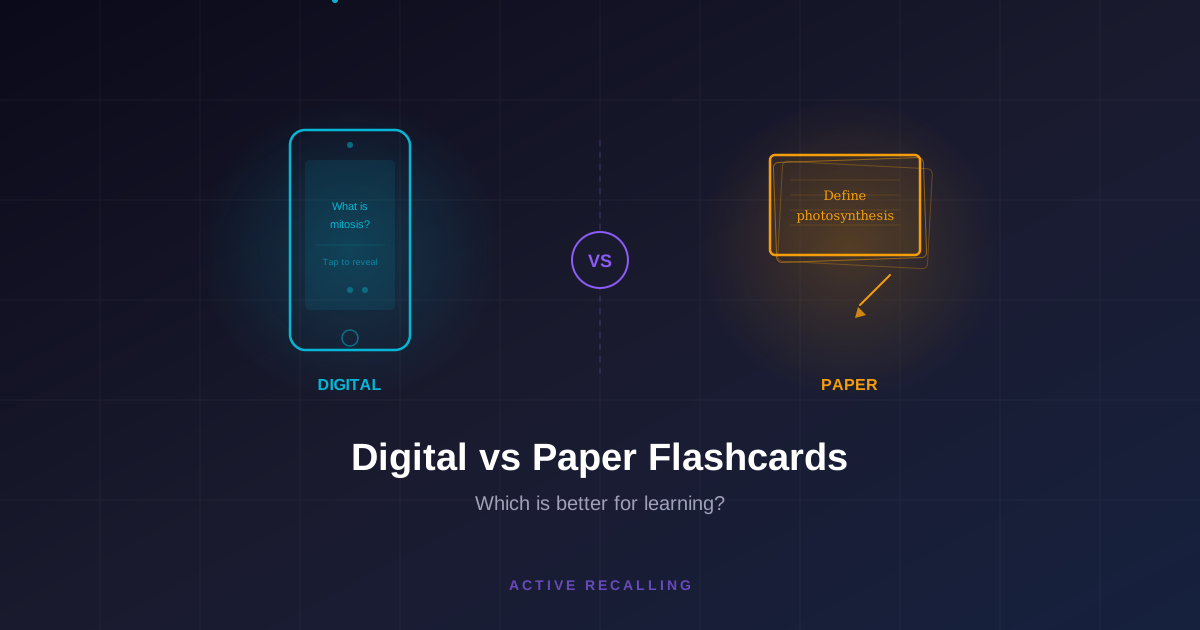
Flashcards have been a staple of effective studying for centuries. From handwritten Latin vocabulary cards in the 19th century to the AI-generated decks of today, the core principle remains the same: test yourself on one side, check the answer on the other. But a debate has intensified in recent years. Are digital flashcards genuinely better than their paper counterparts, or does the act of physically writing cards by hand give paper an edge?
The answer, as with most things in learning science, is nuanced. Both formats have genuine strengths backed by research, and the best choice depends on your subject matter, learning goals, and personal habits. In this article we examine the evidence on both sides and help you decide when to reach for a pen and when to open an app.
The Case for Paper Flashcards
The Handwriting Effect
One of the most cited arguments for paper flashcards is the handwriting effect. Multiple studies, including influential research by Pam Mueller and Daniel Oppenheimer published in Psychological Science, have shown that writing information by hand leads to deeper cognitive processing than typing. When you physically form letters and words, your brain engages motor memory, spatial reasoning, and linguistic processing simultaneously. This multi-sensory engagement creates stronger memory traces.
The effect is particularly pronounced for conceptual learning. When students handwrite notes, they are forced to paraphrase and summarize because they cannot write as fast as a lecturer speaks. This processing — selecting what is important and putting it in your own words — is itself a powerful learning activity.
Tactile and Spatial Memory
Paper flashcards engage tactile memory in ways that digital screens cannot replicate. The physical sensation of holding a card, flipping it over, and sorting it into "know" and "don't know" piles creates spatial and kinesthetic associations that reinforce the content. Research on embodied cognition suggests that physical interaction with learning materials can enhance memory encoding.
Many students also report that they can mentally picture where a piece of information was on a physical card — the position on the page, the color of the ink, even the texture of the paper. These contextual cues act as additional memory hooks that make retrieval easier during exams.
Fewer Distractions
A stack of paper flashcards does not send notifications, tempt you with social media, or drain your attention with an endless feed. The simplicity of paper is itself an advantage. When you sit down with a physical deck, the only thing you can do is study. This focused environment can lead to higher quality study sessions, especially for learners who struggle with digital distraction.
The Creation Process as Learning
The act of making paper flashcards is a study session in itself. Selecting what to write, deciding how to phrase questions, and physically writing the content requires you to engage with the material deeply before you even begin reviewing. This generation effect — the finding that actively producing information leads to better retention than passively receiving it — gives paper flashcard creators a head start.
The Case for Digital Flashcards
Spaced Repetition Algorithms
The single most powerful advantage of digital flashcards is the spaced repetition algorithm. Paper flashcards require you to manually manage your review schedule. Most students either review everything every day, which is inefficient, or review randomly, which misses the optimal timing for reinforcement.
Digital apps calculate exactly when you should see each card based on your past performance. Cards you know well appear less frequently, while cards you struggle with appear more often. This adaptive scheduling has been shown in hundreds of studies to dramatically improve long-term retention compared to fixed review schedules. The efficiency gains are substantial: you spend your limited study time on the material that needs the most attention.
Scalability and Portability
A typical university course might require hundreds or even thousands of flashcards. Carrying that many paper cards is physically impractical. Digital flashcards live on your phone, always accessible during commutes, waiting rooms, or lunch breaks. The ability to study in small pockets of time throughout the day adds up to significant extra review without requiring dedicated study blocks.
Scaling to thousands of cards is effortless with digital tools, and searching through them takes seconds rather than minutes of manual sorting.
Rich Media Support
Paper flashcards are limited to what you can write or draw by hand. Digital flashcards can include high-resolution images, audio clips for language pronunciation, diagrams, mathematical notation, and even embedded videos. For subjects like anatomy, where visual identification is crucial, or language learning, where hearing correct pronunciation matters, digital media support is a game-changer.
AI-Powered Content Generation
Perhaps the most transformative advantage of modern digital flashcard platforms is AI-powered content generation. Tools like Active Recalling can analyze your uploaded notes, textbooks, or documents and automatically generate high-quality flashcards, quizzes, and mind maps. This eliminates the most time-consuming part of the flashcard workflow — creation — while still providing the retrieval practice benefits of review.
This is a capability that paper simply cannot match. What might take hours of manual card writing can be accomplished in minutes with AI assistance, freeing up more time for actual review and deeper study.
Analytics and Progress Tracking
Digital platforms provide detailed analytics on your learning progress. You can see which topics you are weakest in, track your accuracy over time, and identify patterns in your forgetting curve. This data-driven approach to studying helps you make smarter decisions about where to focus your efforts.
Paper flashcards give you a rough sense of what you know and what you do not, but the granularity and objectivity of digital tracking is vastly superior.
What the Research Actually Says
The research literature paints a complex picture. Studies on the handwriting effect are robust, but they primarily compare handwriting to typing during lectures, not to digital flashcard review. The learning benefit of handwriting comes from the cognitive processing involved in creating the cards, not from the paper itself.
Meanwhile, the evidence for spaced repetition is among the strongest in all of cognitive psychology. Decades of research consistently show that algorithmically scheduled review produces dramatically better long-term retention than massed or random review. This advantage is difficult to replicate with paper cards.
A 2019 meta-analysis published in the Journal of Educational Psychology found that digital flashcards with spaced repetition produced significantly higher retention scores than unscheduled review methods, regardless of whether the original content was handwritten or typed. The scheduling, not the medium, was the dominant factor.
When Paper Flashcards Work Best
Paper flashcards are the better choice in several specific situations. For learning new vocabulary in a foreign language, the act of handwriting unfamiliar characters or scripts activates motor memory that aids recognition. Studies on Chinese and Japanese character learning consistently show handwriting advantages.
For conceptual subjects where you need to understand relationships and nuance rather than memorize discrete facts, the slower pace of handwriting forces deeper processing. Philosophy, literature analysis, and theoretical frameworks may benefit from paper cards.
If you are someone who struggles with digital distraction, paper flashcards remove the temptation entirely. The discipline required to avoid checking your phone during a digital study session is a real cost that paper eliminates.
Paper also works well for small decks of 50 cards or fewer, where the lack of algorithmic scheduling is less of a disadvantage and the tactile benefits are fully realized.
When Digital Flashcards Work Best
Digital flashcards are the better choice when you are dealing with large volumes of material. Medical students, law students, and anyone preparing for comprehensive exams will find the scalability and spaced repetition scheduling indispensable.
For fact-heavy subjects where the content is relatively straightforward — dates, definitions, formulas, anatomical terms — digital flashcards with spaced repetition are dramatically more efficient than paper.
When your study material includes images, audio, or complex diagrams, digital is the clear winner. Trying to hand-draw anatomical structures or chemical reaction mechanisms on index cards is frustrating and often inaccurate.
If you are a student with limited study time, digital flashcards maximize the return on every minute. The combination of AI-generated content and algorithmic scheduling means you spend less time on creation and more time on the reviews that matter most.
The Hybrid Approach
Many successful learners use a hybrid approach that captures the benefits of both formats. They handwrite notes and initial flashcard drafts during lectures and study sessions, engaging the handwriting effect and generation effect during the creation phase. They then transfer the most important material into a digital spaced repetition system for long-term review and scheduling.
This approach gives you the deep processing benefits of handwriting during the initial learning phase and the efficiency of algorithmic review during the retention phase. It requires more setup time, but for high-stakes exams, the combined benefits can be significant.
Another hybrid strategy is to use digital tools for content generation and paper for targeted review. Upload your notes to an AI tool to generate flashcard content, then handwrite the cards you find most challenging. This lets AI handle the bulk creation while you invest handwriting effort where it matters most.
Practical Tips for Each Format
Getting the Most from Paper Flashcards
Write one concept per card to keep retrieval focused. Use colored pens or highlighters to add visual variety, which creates additional memory cues. Sort your cards into three piles after each session: know well, know somewhat, and do not know. Focus your next session on the last two piles. Keep your deck manageable — once it grows beyond about 100 cards, consider graduating well-known cards out of active rotation.
Getting the Most from Digital Flashcards
Trust the algorithm and review cards when the app tells you to, even if you feel like you already know the material. Rate your confidence honestly — overrating your knowledge defeats the purpose of spaced repetition. Take advantage of rich media by adding images and diagrams to cards. Use tags and folders to organize your decks by topic, making it easy to focus on specific subjects when needed.
Conclusion
The digital vs. paper flashcard debate does not have a single winner because the two formats excel in different dimensions. Paper flashcards offer deeper encoding through handwriting, fewer distractions, and tactile memory benefits. Digital flashcards offer algorithmic scheduling, scalability, rich media, AI-powered creation, and detailed analytics.
For most students in 2026, digital flashcards with spaced repetition will be the primary study tool simply because the efficiency gains of adaptive scheduling are too significant to ignore. But paper still has a meaningful role, especially during the initial creation phase and for subjects that benefit from handwriting. The smartest approach is to understand the strengths of each and use them where they shine, rather than committing dogmatically to one format over the other.