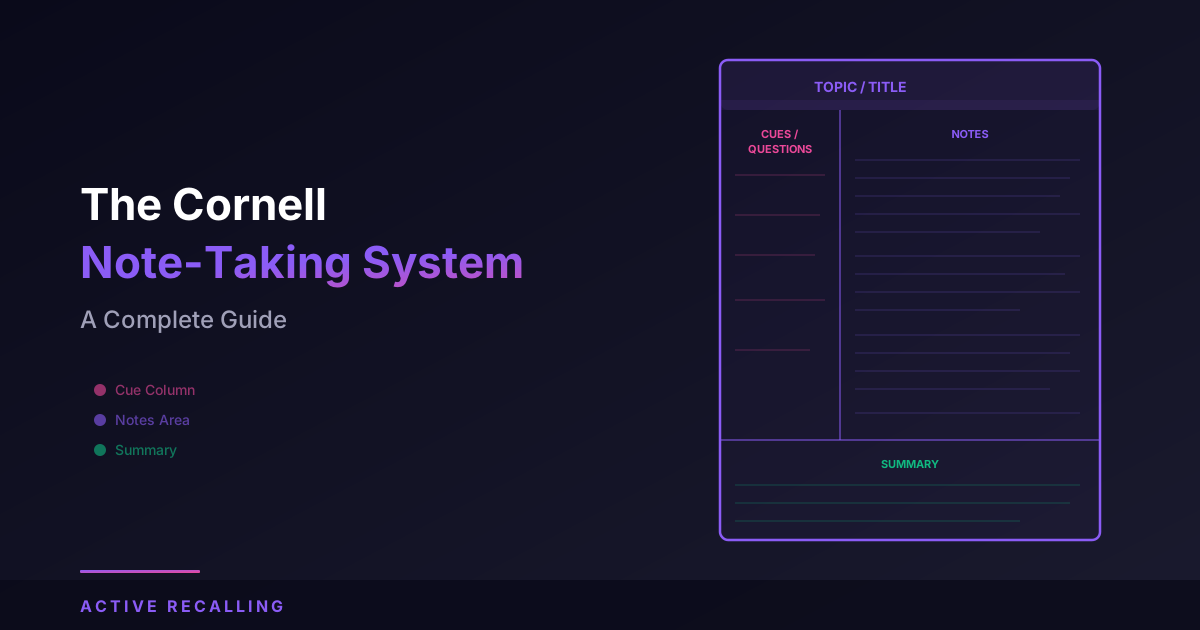
TL;DR: The Cornell Note-Taking System, developed by Walter Pauk at Cornell University in the 1950s, splits each page into a cue column, a note column, and a summary section. The design builds active recall directly into note-taking: you cover the note column and use the cues to self-test. It is one of the few note methods supported by modern cognitive science research on retrieval practice.
What Is the Cornell Note-Taking System?
The Cornell note-taking system is one of the most well-known and widely used study methods in the world. Developed in the 1950s by Walter Pauk, an education professor at Cornell University, the system was designed to help students take more effective notes and, crucially, to use those notes as active study tools rather than passive records.
What sets the Cornell system apart from other note-taking methods is its integration of note-taking and review into a single, unified framework. While most note-taking methods focus only on recording information, the Cornell system includes built-in mechanisms for self-testing, summarization, and spaced review. This makes it one of the few note-taking approaches that is directly supported by cognitive science research on learning and memory.
Despite being over seven decades old, the Cornell system remains remarkably relevant. Its emphasis on active processing, self-testing, and review aligns perfectly with what modern research tells us about effective learning. In this guide, we will explore the system in detail, from its historical origins to practical implementation strategies, and show you how to combine it with active recall for maximum learning effectiveness.
The History and Science Behind Cornell Notes
Walter Pauk and the Origins
Walter Pauk developed the Cornell system while working with students at Cornell University who were struggling academically despite putting in long hours of study. Pauk observed that these students were taking notes diligently but reviewing them ineffectively, typically by rereading their notes passively before exams.
Pauk's insight was that the note-taking format itself could be designed to encourage active review. By structuring the page to include cue questions alongside notes and a summary section at the bottom, he created a system that naturally guided students toward the kinds of active processing that research was beginning to show were essential for learning.
Pauk published the Cornell system in his influential textbook "How to Study in College", which has been through multiple editions and remains in use today. The system's enduring popularity is a testament to both its practical effectiveness and its alignment with fundamental principles of human learning.
The Cognitive Science Support
Modern cognitive science provides strong support for the principles underlying the Cornell system. The system incorporates several evidence-based learning strategies.
Active recall is built into the cue column, which transforms notes into a self-testing tool. When you cover the note column and use the cues to prompt retrieval, you are engaging in the kind of effortful retrieval practice that research has shown to be one of the most powerful learning strategies available.
Elaborative processing occurs during the summarization step, where you must synthesize the material in your own words. This requires you to identify the most important ideas, understand their relationships, and express them concisely, all of which involve deep cognitive processing that enhances encoding.
Spaced review is encouraged by the system's design, which makes it easy to return to notes periodically and use the cue column for self-testing at increasing intervals after the initial learning session.
The Three Sections Explained
The Cue Column (Left Side)
The cue column occupies approximately one-third of the page width on the left side. This column is the secret weapon of the Cornell system, and it is the section that most students underutilize.
The cue column is completed after the lecture or reading session, not during it. Once you have reviewed your notes, go back and generate cues that correspond to the information in the note column. These cues can take several forms.
Questions are the most effective type of cue. If your notes describe the three branches of government, your cue question might be "What are the three branches of government, and what are their primary functions?" Questions force active retrieval during review, which strengthens memory far more effectively than simple keyword cues.
Keywords and key phrases can also serve as cues, particularly for factual information. However, be aware that keyword cues can lead to shallow recall if they simply prompt you to recognize information rather than produce it. Whenever possible, frame your cues as questions that require you to generate an answer.
Diagrams or symbols in the cue column can help with visual material. A small sketch of a diagram structure can serve as a prompt to reproduce the full diagram from memory during review.
The Note Column (Right Side)
The note column occupies approximately two-thirds of the page width on the right side. This is where you record information during the lecture, reading session, or study period.
The note column should contain your notes in whatever format works best for the material. You can use bullet points, short phrases, diagrams, or any combination that captures the key information effectively. The important principle is to record ideas in your own words rather than transcribing verbatim.
Effective note column entries are concise but meaningful. Each entry should capture a complete idea or fact that can stand on its own when paired with its corresponding cue. Avoid writing so little that the notes are cryptic and meaningless during review, but also avoid writing so much that the notes become a transcript that encourages passive rereading.
Leave some space between different topics or ideas within the note column. This visual separation makes it easier to match notes to cues and to navigate your notes during review. Some students draw a horizontal line between distinct topics to further clarify the organization.
The Summary Section (Bottom)
The summary section occupies a strip at the bottom of each page, typically about two inches high. After completing your notes and cues, write a brief summary of the page's content in this section.
The summary should be written in your own words and should capture the essential ideas of the page in two to four sentences. This summary serves multiple purposes.
First, writing the summary forces you to engage in synthesis and abstraction, identifying the most important ideas and expressing them concisely. This is a form of elaborative processing that deepens your understanding and improves encoding.
Second, the summary section provides a quick review tool. When you need to review your notes, you can read just the summaries to get an overview of the material without reading every page in detail. This is particularly useful before exams when time is limited.
Third, the summary section serves as a comprehension check. If you cannot summarize a page of notes in a few sentences, that is a signal that you may not fully understand the material or that your notes need reorganization.
How to Set Up Cornell Notes
Page Layout
Setting up a Cornell note page is straightforward. Take a standard sheet of paper and draw a vertical line approximately 2.5 inches (6.5 cm) from the left edge, running from the top of the page to about two inches from the bottom. Then draw a horizontal line approximately two inches (5 cm) from the bottom of the page. This creates the three sections: the cue column on the left, the note column on the right, and the summary section at the bottom.
If you prefer digital notes, many note-taking applications offer Cornell note templates. You can also create your own template in any word processor by setting up a two-column table with a single-row summary section below it.
The Five Rs of Cornell Notes
Walter Pauk described the Cornell process using the Five Rs: Record, Reduce, Recite, Reflect, and Review.
Record: During the lecture or reading, record the main ideas and important details in the note column. Focus on capturing ideas rather than transcribing words.
Reduce: As soon as possible after the session, review your notes and create cues in the left column. Reduce each section of notes to a key question or keyword that captures the essential idea.
Recite: Cover the note column with a sheet of paper and use the cues to prompt recall. Try to answer each question or explain each keyword from memory, then uncover the notes to check your accuracy.
Reflect: Think about the material and how it connects to other things you know. Ask yourself questions about the significance of the ideas, how they relate to the broader course, and how you might apply them.
Review: Schedule regular review sessions where you repeat the recite step at increasing intervals. Brief, frequent review sessions are more effective than long, infrequent ones.
Review Strategies for Cornell Notes
Daily Review
The most critical review session occurs within 24 hours of taking the notes. During this session, complete the cue column if you have not already, write the summary, and practice reciting the material using the cue column as prompts.
This first review session is essential because it catches the material before it has had time to fade significantly from memory. Research on the forgetting curve shows that the greatest memory loss occurs in the first 24 hours after learning, so timely review has a disproportionate impact on long-term retention.
Weekly Review
Once a week, review all Cornell notes from the previous week using the cue column for self-testing. This weekly review session should take only fifteen to thirty minutes per subject if you have been doing daily reviews consistently.
During the weekly review, pay special attention to material that you had difficulty recalling during your daily reviews. These difficult items are the ones most at risk of being forgotten and therefore benefit most from additional retrieval practice.
Pre-Exam Review
Before an exam, your Cornell notes serve as a complete study system. Begin by reading through just the summary sections to get an overview of all the material covered. Then use the cue columns for systematic self-testing, working through your notes from beginning to end.
Track your performance during pre-exam review. Mark cues that you answered correctly and cues that you struggled with. Focus your remaining study time on the difficult items rather than reviewing everything equally. This targeted approach ensures that your study time is spent where it will have the greatest impact.
Cumulative Review With Spaced Repetition
For subjects that require long-term retention, incorporate your Cornell notes into a spaced repetition schedule. The cue column essentially functions as a set of flashcards, with each cue prompting recall of the corresponding notes.
Review your notes at increasing intervals: one day after creation, three days later, one week later, two weeks later, and one month later. After the one-month review, most material will be firmly established in long-term memory and will require only occasional maintenance review.
Combining Cornell Notes With Active Recall
The Natural Synergy
The Cornell system is one of the few note-taking methods that has active recall built into its design. The cue column exists specifically to facilitate retrieval practice, and the recite step of the Five Rs is explicitly an active recall exercise. However, many students underutilize these features, treating the cue column as a table of contents rather than a self-testing tool.
To maximize the active recall potential of Cornell notes, commit to using the cue column as it was intended: as a testing tool rather than a navigation aid. Every review session should involve covering the note column and genuinely attempting to retrieve the information prompted by each cue. Only after making a genuine retrieval attempt should you uncover the notes to check your accuracy.
Adding Digital Active Recall
While Cornell notes are traditionally paper-based, you can extend their active recall power by converting key cues into digital flashcards for spaced repetition practice. After creating your Cornell notes, identify the most important questions from your cue column and add them to a digital spaced repetition system.
This hybrid approach gives you the deep processing benefits of handwritten Cornell notes during initial learning and the systematic spacing benefits of digital spaced repetition during review. The combination is particularly powerful for subjects that require long-term retention across an entire academic term or career.
The Recall-First Approach
An advanced technique is to begin each study session with a recall-first approach before even looking at your Cornell notes. Take a blank sheet of paper and write down everything you can remember about the topic you are about to review. Then compare your free recall output against your Cornell notes, noting gaps and errors.
This pre-review recall exercise provides a baseline assessment of your current knowledge and ensures that your subsequent review focuses on genuine gaps rather than familiar material. It is more cognitively demanding than starting with the cue column, but it produces stronger learning outcomes because it requires retrieval from a completely blank state.
Common Mistakes and How to Avoid Them
Writing Cues During the Lecture
Some students try to write cues in the left column during the lecture, simultaneously recording notes and generating questions. This is a mistake because it divides your attention and reduces the quality of both your notes and your cues. Record notes during the lecture, and create cues afterward when you can give the task your full attention.
Cues That Are Too Vague
Cues like "important concept" or "key idea" are useless for retrieval practice because they do not specify what you need to recall. Every cue should be specific enough to prompt a definite, verifiable response. Instead of "causes," write "What were the three main causes of World War I?"
Skipping the Summary Section
Many students skip the summary section because it seems redundant. In reality, the summary section provides one of the most valuable learning opportunities in the Cornell system. The act of synthesizing a page of notes into a few sentences requires deep processing that significantly enhances understanding and retention.
Reviewing Passively
The most common and most damaging mistake is to review Cornell notes by rereading rather than by reciting. If you simply read through your notes without testing yourself using the cue column, you are wasting the primary advantage of the Cornell system. Every review session should be an active recall exercise.
Neglecting Regular Review
Creating excellent Cornell notes provides no benefit if you never review them. The system is designed for regular, spaced review, and notes that are only reviewed once before an exam will be far less effective than notes reviewed multiple times at increasing intervals.
Adapting Cornell Notes for Different Subjects
Sciences
For science courses, adapt the cue column to include diagram prompts that ask you to draw and label structures from memory. The note column can include equations, definitions, and process descriptions, while the summary section captures the key principles covered on each page.
Humanities
For humanities courses, use the cue column for analytical questions that go beyond simple recall. Instead of "What happened in 1789?" try "Why did the French Revolution occur in 1789 rather than earlier?" These higher-order questions promote deeper understanding and better prepare you for essay exams.
Mathematics
For math courses, the cue column might contain problem types while the note column contains the solution methods. During review, cover the note column and try to recall the solution approach for each problem type from memory. The summary section can capture the key theorems or techniques covered on each page.
Frequently Asked Questions
Who invented the Cornell Note-Taking System?
Walter Pauk, an education professor at Cornell University, developed the system in the 1950s and formalized it in his textbook How to Study in College, first published in 1962. The book is now in its eleventh edition and has sold millions of copies.
What are the three sections of a Cornell note page?
A cue column on the left (roughly one-third of the page width) for questions and keywords, a note column on the right (two-thirds of the page) for the actual notes, and a summary section at the bottom (about two inches high) for a brief synthesis. The cues and summary are written after class, not during.
How is Cornell note-taking different from regular note-taking?
Regular note-taking is a passive record; the Cornell method builds active recall into the format. The cue column transforms your notes into flashcards — cover the right side and use the cues on the left to self-test. This integration of recording and review is the core innovation.
Does Cornell note-taking work for digital notes?
Yes. Applications like Notion, Obsidian, OneNote, and Roam Research all support two-column layouts that mirror the Cornell format. However, Mueller and Oppenheimer (2014) found handwriting advantages for conceptual learning, so consider using paper for initial note-taking and digital only for long-term storage.
When should I complete the cue column and summary?
As soon as possible after the lecture or reading session — ideally within 24 hours, before the steep part of Ebbinghaus's forgetting curve kicks in. Writing the cues later forces a review of the material and makes your cues sharper because you can see what actually mattered.
How often should I review my Cornell notes?
Daily review (10-15 minutes) within the first week, weekly review for the first month, and then monthly maintenance reviews. Use the cue column for self-testing every time; do not simply re-read the note column.
Conclusion: A System That Stands the Test of Time
The Cornell note-taking system has endured for over seventy years because it addresses the fundamental challenge of learning: transforming information from a temporary impression into lasting, retrievable knowledge. Its elegant three-section format guides students naturally from recording to processing to review, incorporating active recall at every stage.
The system is not difficult to learn or to implement. It requires only a sheet of paper and the discipline to complete all three sections and to review regularly. Yet this simple system, when used consistently, produces learning outcomes that far exceed what passive note-taking and rereading can achieve.
Whether you are a college student, a professional learner, or anyone who needs to retain and apply information from lectures, readings, or meetings, the Cornell system offers a proven framework for effective note-taking. Start with your next class or study session. Divide your page, record your notes, create your cues, write your summary, and practice reciting. Within a few weeks, you will see a meaningful difference in how much you remember and how well you understand the material you encounter.