The Note-Taking Dilemma
Taking notes is one of the most universal study activities, yet most students have never received formal instruction on how to do it effectively. They default to whatever method feels natural, typically transcribing lectures verbatim or jotting down scattered phrases, without considering whether their approach actually supports learning and retention.
The research on note-taking reveals a surprising truth: the act of taking notes is often more valuable than the notes themselves. The cognitive processing that occurs when you select, organize, and record information is what drives learning. However, not all note-taking methods engage these processes equally. Some methods encourage deep processing and active engagement, while others promote passive transcription that provides little benefit beyond having a record to review later.
In this guide, we will examine the five most popular note-taking methods, compare their strengths and weaknesses, and show you how to choose the right method for your learning goals. Most importantly, we will explore how each method can be enhanced with active recall to maximize retention and understanding.
The Cornell Note-Taking Method
How It Works
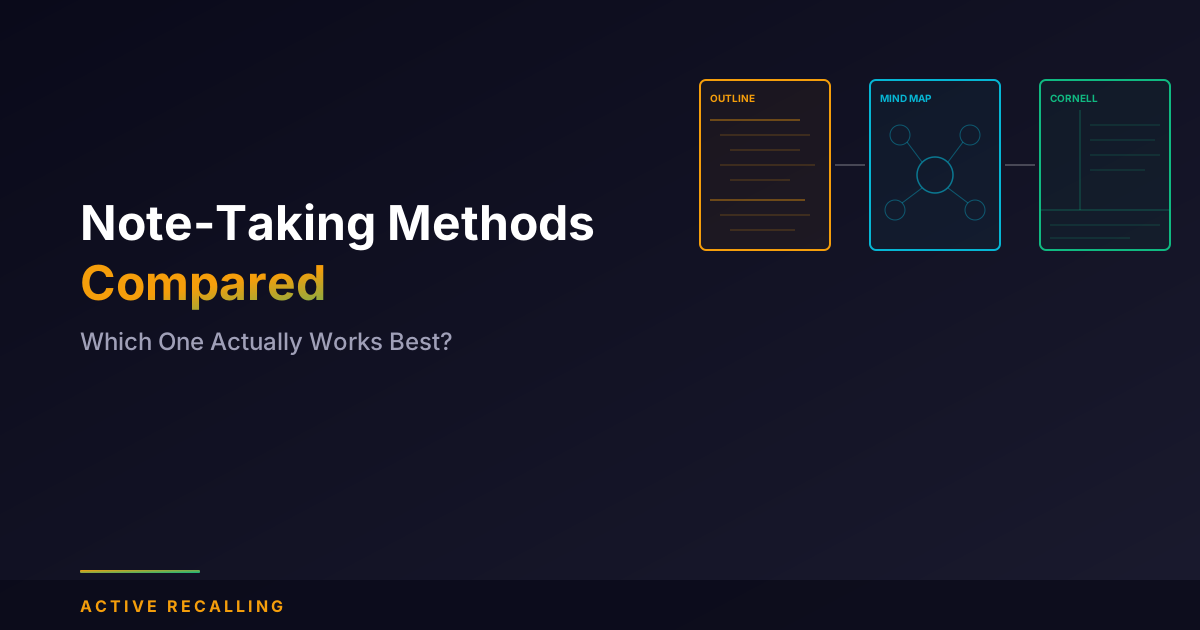
The Cornell method divides each page into three sections: a narrow left column for cues, a wider right column for notes, and a bottom section for summaries. During a lecture or reading session, you record notes in the right column. After the session, you generate questions or keywords in the left cue column that correspond to your notes. Finally, you write a brief summary of the page in the bottom section.
Strengths
The Cornell method's greatest strength is its built-in review system. The cue column transforms your notes into a self-testing tool. By covering the right column and using the cues to prompt recall, you can practice active retrieval directly from your notes without creating separate study materials.
The summary section forces you to synthesize and condense the material, which requires deeper processing than simply recording information. This synthesis step helps you identify the most important ideas and express them in your own words.
The Cornell method also provides excellent organization. The structured format makes it easy to find specific information during review and ensures that every page of notes has associated recall cues and a summary.
Weaknesses
The Cornell method can feel rigid, particularly for subjects that do not fit neatly into a linear format. Highly visual or interconnected material may be difficult to capture in the note-taking column. Some students also find that dividing the page reduces the available space for notes, which can be problematic during fast-paced lectures.
Best For
The Cornell method is ideal for lecture-based courses in the humanities, social sciences, and any subject where information is presented in a structured, sequential manner. It is particularly effective for students who want a single system that integrates note-taking and review into a unified workflow.
The Outline Method
How It Works
The outline method organizes information hierarchically using indentation to show the relationship between main topics, subtopics, and supporting details. Main ideas are placed at the left margin, with each level of detail indented further to the right. The result is a structured, tree-like representation of the material.
Strengths
The outline method excels at capturing hierarchical relationships between ideas. It makes the structure of a lecture or text immediately visible, showing how specific details relate to broader themes. This structural clarity aids both comprehension during note-taking and navigation during review.
Outlining is also fast and efficient. Once you are comfortable with the method, you can capture a large amount of information quickly using abbreviations and shorthand. The hierarchical format also makes it easy to identify the level of detail you need during review: you can scan the main headings for a broad overview or drill down into the indented details for specific information.
Weaknesses
The outline method assumes that the material has a clear hierarchical structure, which is not always the case. Cross-cutting themes, complex relationships, and non-linear connections are difficult to represent in an outline format. If a lecture jumps between topics or revisits earlier points, maintaining a clean outline can be challenging.
Additionally, outlining can become a passive transcription exercise if you simply record information in the order it is presented without actively processing and reorganizing it. The method is only effective when you are genuinely thinking about how ideas relate to each other as you write.
Best For
The outline method works best for subjects with clear hierarchical structures, such as biology (kingdom, phylum, class), history (era, event, consequence), and law (rule, exception, application). It is also well-suited for students who think in organized, linear terms and prefer structured notes.
The Mind Map Method
How It Works
Mind mapping places the central topic in the middle of the page and uses branches radiating outward to represent related subtopics, details, and connections. Each branch can have sub-branches, and connections between different branches can be drawn to show relationships. Mind maps often incorporate colors, images, and symbols to enhance visual distinctiveness.
Strengths
Mind mapping is the most visual of the common note-taking methods, making it excellent for capturing complex relationships and connections between ideas. Unlike the linear outline method, mind maps can represent non-hierarchical relationships through cross-links between branches.
The visual and spatial nature of mind maps also supports memory encoding. The combination of spatial layout, color, and imagery creates multiple encoding pathways, which can improve recall. Many students find that they can visualize their mind map during an exam and use its spatial layout to retrieve information.
Mind mapping also encourages creative thinking and the discovery of unexpected connections. The non-linear format frees you from the constraints of sequential note-taking and allows ideas to develop organically.
Weaknesses
Mind maps can become cluttered and difficult to read if too much detail is included. They are not well-suited for capturing large amounts of sequential information, such as step-by-step processes or detailed arguments. Creating effective mind maps also requires practice; beginners often produce maps that are disorganized and hard to review.
Mind mapping is also slower than linear methods for capturing real-time lectures, particularly fast-paced ones. The need to determine spatial placement and draw connections takes more time than simply writing in sequence.
Best For
Mind mapping is ideal for brainstorming, synthesis, and review sessions where you want to understand how ideas connect across a topic. It works well for subjects with complex, interconnected concepts, such as ecology, philosophy, and systems engineering. It is also an excellent method for creating study summaries that consolidate material from multiple sources.
The Charting Method
How It Works
The charting method organizes information into a table or grid format, with columns representing categories and rows representing individual items or topics. For example, a chart for a history course might have columns for date, event, key figures, causes, and consequences, with each row representing a different historical event.
Strengths
The charting method excels at organizing information for comparison. When you need to compare multiple items across the same set of criteria, a chart provides immediate visual clarity. It is easy to spot similarities, differences, and patterns across the rows.
Charts also impose a useful organizational discipline on your note-taking. The predefined columns force you to identify the key attributes of each topic and ensure that you capture the same types of information consistently. This consistency makes review more efficient and helps prevent gaps in your notes.
Weaknesses
The charting method requires you to know the relevant categories before you begin, which is not always possible during a first exposure to new material. If the lecture introduces unexpected categories or does not fit the grid structure you anticipated, maintaining the chart can be difficult.
Charts are also not suitable for all types of information. Narrative content, complex arguments, and process descriptions do not translate well into tabular format. The charting method works best for factual, categorical information that naturally lends itself to comparison.
Best For
The charting method is excellent for subjects that involve comparing and contrasting multiple items, such as pharmacology (comparing drug classes), history (comparing civilizations or events), and biology (comparing organ systems or species). It is also useful for consolidating information from multiple sources into a single, easy-to-review format.
The Sentence Method
How It Works
The sentence method is the simplest note-taking approach. Each new piece of information is written as a separate sentence or short phrase, with each sentence starting on a new line. There is no formal organizational structure; information is recorded in the order it is presented.
Strengths
The sentence method is fast and requires minimal cognitive overhead. During a fast-paced lecture, you can capture a large amount of information without worrying about organizational structure. This makes it useful as a capture method when you need to record everything and will organize it later.
The method is also universally applicable. Unlike the charting method or mind mapping, the sentence method does not require any advance knowledge of the material's structure. It works equally well for any type of content.
Weaknesses
The sentence method produces notes that are poorly organized and difficult to review. Without hierarchical structure, comparison categories, or visual relationships, reviewing sentence-method notes requires reading through them sequentially, which is time-consuming and often unproductive.
The method also encourages passive transcription rather than active processing. When your goal is simply to write down what the lecturer says, sentence by sentence, you are not engaging in the kind of deep processing that supports learning. Research on laptop note-taking, which often produces something similar to the sentence method, has shown that students who transcribe lectures verbatim learn less than those who take more selective, organized notes.
Best For
The sentence method works as a first-pass capture tool for fast-paced lectures or when you are encountering entirely new material and do not yet know how to organize it. However, it should always be followed by a reorganization step using one of the other methods. Sentence-method notes left in their raw form provide minimal study value.
Comparing Effectiveness: What the Research Says
Depth of Processing Matters Most
Research on note-taking consistently points to one conclusion: the depth of cognitive processing during note-taking matters more than the specific method used. Methods that force you to select, organize, and rephrase information in your own words produce better learning outcomes than methods that allow passive transcription.
By this criterion, the Cornell method and mind mapping tend to be the most effective for learning because they both require active processing. The outline method and charting method can be effective if used thoughtfully but can also become passive if students simply transcribe information into a predetermined format. The sentence method, while useful for capture, provides the least processing benefit.
The Note-Taking Paradox
There is an interesting paradox in note-taking research: more complete notes tend to be less effective for learning during the note-taking process but more effective for later review. Students who transcribe lectures verbatim learn less during the lecture but have more complete records to study from later. Students who take selective, processed notes learn more during the lecture but may have less comprehensive records.
The resolution to this paradox is to combine the best of both worlds. Capture sufficient detail during the note-taking session, then use active recall during review to deepen your processing and retention.
Enhancing Any Method With Active Recall
The Retrieval Practice Add-On
Regardless of which note-taking method you choose, you can dramatically enhance its effectiveness by adding active recall practice to your review process. The principle is simple: before reviewing your notes, close them and try to recall the key points from memory. Only after testing yourself should you open your notes to check and fill in gaps.
This retrieval step transforms note review from a passive rereading exercise into an active learning session. The effort of retrieval strengthens your memory for the material and reveals specific gaps that need attention.
Turning Notes Into Self-Testing Tools
Each note-taking method can be adapted into a self-testing format. Cornell notes have this built in through the cue column. For outline notes, cover everything below a main heading and try to recall the subtopics and details. For mind maps, start with the central topic and try to reconstruct the branches from memory. For charts, cover one column at a time and try to fill in the missing information.
The key insight is that notes are not just records of what you learned but tools for continued learning through retrieval practice. When you view your notes through this lens, every review session becomes an opportunity to strengthen your memory and deepen your understanding.
Combining Methods for Maximum Effect
Many effective learners use multiple note-taking methods at different stages of the learning process. For example, you might use the sentence method for initial capture during a fast-paced lecture, reorganize those notes into an outline that same evening, and then create a mind map at the end of the week to synthesize everything you have learned.
Each method engages different cognitive processes, and the act of translating information between formats forces you to reprocess and reorganize the material. This multi-method approach, combined with active recall during each transition, produces exceptionally strong learning outcomes.
Choosing the Right Method for You
Consider Your Subject
Different subjects naturally lend themselves to different note-taking methods. Hierarchical subjects like biology and law work well with outlines. Comparative subjects like pharmacology and history benefit from charts. Conceptual subjects with complex interconnections suit mind maps. Lecture-heavy courses are well-served by the Cornell method.
Consider Your Learning Style
While the concept of fixed learning styles has been largely debunked by research, people do have genuine preferences for how they process information. If you think in structured, linear terms, the outline method may feel most natural. If you are a visual thinker, mind mapping might resonate more strongly. The best method is one that you will actually use consistently.
Consider Your Goals
Are you taking notes primarily for exam preparation, for reference, or for deep understanding? Exam preparation benefits most from methods with built-in self-testing, like Cornell. Reference notes should be comprehensive and well-organized, favoring outlines or charts. Deep understanding is best served by methods that emphasize connections and synthesis, like mind mapping.
Conclusion: Method Matters Less Than Practice
The most important takeaway from comparing note-taking methods is that no single method is universally best. Each method has strengths and weaknesses, and the most effective approach depends on the subject, the context, and the learner.
What matters far more than the specific method is whether you are using your notes for active recall practice. Notes that are never reviewed provide zero long-term value regardless of how they were created. Notes that are reviewed through active retrieval practice provide tremendous value regardless of their format.
Choose a note-taking method that works for you, adapt it to your subjects and goals, and commit to regular active recall practice using your notes as the foundation. This combination of effective note-taking and deliberate retrieval practice is the key to transforming the information you encounter into lasting, accessible knowledge.