Have you ever tried to learn something that was so far beyond your current abilities that you felt completely lost? Or, conversely, have you ever been stuck doing exercises that were so easy they felt like a waste of time? Both experiences share a common problem: you were studying outside your optimal learning zone.
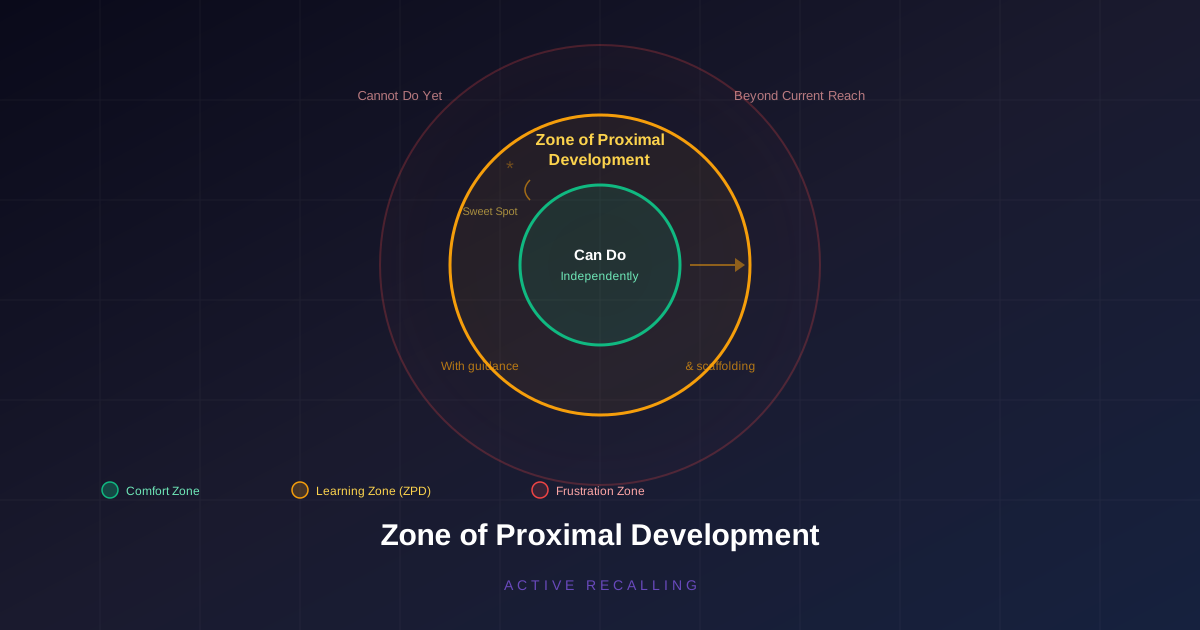
The concept of the Zone of Proximal Development (ZPD), introduced by Soviet psychologist Lev Vygotsky in the early twentieth century, describes the sweet spot between what you can already do independently and what is too far beyond your current capabilities. Learning is most effective when it takes place within this zone, and understanding how to find and work within it can dramatically improve your study outcomes.
In this article, we will explore Vygotsky's original theory, the concept of scaffolding that grew from it, practical methods for identifying your own ZPD, and strategies for making the most of your learning sweet spot.
Lev Vygotsky and the Origins of the ZPD
Lev Semyonovich Vygotsky (1896-1934) was a Russian psychologist whose work on cognitive development, language, and learning has had an enormous influence on education, despite his tragically short life. Vygotsky died of tuberculosis at age 37, but his ideas, many of which were not widely known in the West until decades after his death, have become foundational concepts in developmental psychology and educational theory.
Vygotsky's central insight was that learning is fundamentally a social process. Unlike Jean Piaget, who emphasized the individual child's independent exploration of the world, Vygotsky argued that cognitive development is driven by social interaction, particularly interactions with more knowledgeable others such as parents, teachers, and more advanced peers.
The ZPD emerged from Vygotsky's observation that intelligence tests and assessments that measured only what a child could do independently missed a crucial dimension of development: what the child could do with appropriate help. Two children who scored identically on an independent test might have vastly different potentials for learning, depending on how much they could accomplish with guidance.
Understanding the Three Zones
To understand the ZPD, it helps to think about learning as divided into three zones.
The Zone of Actual Development
The Zone of Actual Development encompasses everything you can already do independently, without any assistance. These are the skills you have mastered, the knowledge you have consolidated, and the problems you can solve on your own. Working exclusively in this zone feels comfortable and easy, but it produces minimal new learning because you are not being challenged beyond your current capabilities.
Studying within this zone feels productive because you can answer questions correctly and complete tasks without difficulty, but this sense of competence can be misleading. Fluency in already-mastered material is not the same as genuine learning. It is review, which has its place, but it is not where growth happens.
The Zone of Proximal Development
The Zone of Proximal Development is the range of tasks and concepts that you cannot yet handle independently but can accomplish with appropriate guidance, support, or collaboration. This is where the magic of learning happens.
Vygotsky defined the ZPD as "the distance between the actual developmental level as determined by independent problem solving and the level of potential development as determined through problem solving under adult guidance or in collaboration with more capable peers."
Within the ZPD, you are stretched beyond your comfort zone but not so far that you are overwhelmed. You encounter difficulties, but with the right support, you can overcome them. The effort involved in working within the ZPD is what drives genuine cognitive growth.
The Zone Beyond Current Reach
Beyond the ZPD lies material that is simply too advanced for you at this point, even with assistance. Attempting to learn in this zone leads to frustration, confusion, and discouragement because the gap between your current knowledge and the target knowledge is too large to bridge, even with support.
This does not mean you will never be able to learn this material. As your ZPD shifts outward through learning and development, material that was once beyond reach enters the ZPD and becomes learnable. The key is to approach it at the right time, when you have built the necessary foundation.
Scaffolding: The Bridge Within the ZPD
The concept most closely associated with the ZPD is scaffolding, a term introduced not by Vygotsky himself but by Jerome Bruner, David Wood, and Gail Ross in the 1970s, inspired by Vygotsky's ideas.
What Is Scaffolding?
Scaffolding refers to the temporary support provided to a learner that enables them to accomplish tasks within their ZPD that they could not accomplish alone. Just as physical scaffolding supports a building during construction and is removed once the structure can stand on its own, instructional scaffolding supports a learner during the learning process and is gradually withdrawn as the learner becomes more competent.
Effective scaffolding is characterized by several features. It is temporary, designed to be removed as the learner gains proficiency. It is adjustable, calibrated to the learner's current level and increased or decreased in response to their performance. And it is intentional, designed to support the learner's active engagement rather than doing the work for them.
Forms of Scaffolding
Scaffolding can take many forms, depending on the learning context and the learner's needs.
Modeling involves demonstrating a skill or thought process so the learner can observe and imitate. A teacher working through a problem aloud, showing their reasoning at each step, provides a model that students can internalize and eventually replicate independently.
Prompting and questioning guides the learner's thinking without providing the answer directly. Instead of telling a student the next step in a problem, a teacher might ask, "What do you think should happen next?" or "What principle applies here?" These prompts keep the learner actively engaged while providing just enough direction to prevent them from getting stuck.
Breaking tasks into manageable steps reduces the cognitive load of a complex task by dividing it into smaller, more manageable components. Each step is within the learner's ZPD, and successfully completing each step builds the foundation for the next.
Providing worked examples gives learners a template they can study and then adapt. Worked examples are especially valuable for novices because they reduce the cognitive demands of problem-solving while still requiring the learner to actively process the solution strategy.
Offering feedback provides information about the learner's performance that they can use to adjust their approach. Effective feedback is specific, timely, and focused on the process rather than just the outcome.
Gradual Release of Responsibility
A widely used instructional model based on scaffolding is the gradual release of responsibility framework, often described as "I do, we do, you do."
In the first phase, the teacher demonstrates the skill or concept (I do). In the second phase, the teacher and students work through examples together, with the teacher providing decreasing amounts of support (we do). In the final phase, students practice independently, applying what they have learned without assistance (you do).
This progression mirrors the natural movement through the ZPD: from guided performance, to supported independence, to full independence.
Identifying Your Own Zone of Proximal Development
As a self-directed learner, you may not always have a teacher to identify your ZPD for you. Fortunately, there are practical strategies for finding it yourself.
The Struggle Test
A useful heuristic is what might be called the struggle test. When studying or practicing, pay attention to your level of difficulty.
If the material feels effortless, you are probably in your Zone of Actual Development. This is comfortable but not productive for new learning.
If the material feels challenging but manageable, requiring effort and occasional support but ultimately yielding to your persistence, you are likely in your ZPD. This is where you should be spending most of your study time.
If the material feels impossibly difficult, leaving you confused and unable to make progress even with help, you have gone beyond your ZPD. You need to step back and build more foundational knowledge first.
Pre-Assessment
Before diving into a new topic, pre-assess your existing knowledge. Take a diagnostic test, review the prerequisites, or skim the material to identify what you already know and what is new. This helps you calibrate where your ZPD lies for that particular topic.
Error Analysis
Pay attention to the types of errors you make. If you rarely make errors, the material is too easy. If your errors are random and you cannot understand why they are wrong, the material is too hard. If your errors are systematic and you can understand the correction when it is explained, you are in your ZPD.
Progressive Difficulty
Many effective learning resources are organized with progressive difficulty, starting with easier material and gradually increasing the challenge. Use this structure to identify where you begin to struggle. That transition point is the lower boundary of your ZPD for that topic.
Practical Applications for Self-Directed Learners
Understanding the ZPD has several practical applications for anyone engaged in self-directed learning.
Calibrating Study Materials
Choose study materials that match your current level and push you just beyond it. If a textbook is too basic, find a more advanced one. If it is too advanced, look for a gentler introduction that will build the foundations you need.
Do not be afraid to use materials designed for a lower level when you are building foundational knowledge. There is no shame in starting where you are, and a solid foundation makes everything that follows easier and faster to learn.
Seeking Appropriate Help
The ZPD concept highlights the value of seeking help strategically. When you are stuck on something within your ZPD, the right kind of help, a hint, an explanation, a worked example, can enable you to break through and continue learning. This is very different from having someone simply give you the answer, which bypasses the learning process entirely.
Identify resources that provide the right level of support: tutors, study groups, online forums, office hours, and educational tools that offer hints and explanations rather than just answers.
Using Technology as a Scaffold
Modern educational technology can serve as highly effective scaffolding. Adaptive learning platforms adjust the difficulty of material based on your performance, automatically keeping you within your ZPD. Spaced repetition systems scaffold your review schedule by presenting material at the moment when it is optimally challenging: just as you are about to forget it, but before it has completely faded.
Flashcard applications that allow you to rate the difficulty of each card and adjust the review frequency accordingly are a form of self-directed scaffolding. Active recall platforms that generate questions at appropriate difficulty levels provide scaffolding by guiding your retrieval practice.
Collaborative Learning
Vygotsky's emphasis on social learning has direct implications for study strategies. Learning with others, particularly those who are slightly more advanced, can provide the scaffolding needed to work within your ZPD.
Study groups where members explain concepts to each other create natural scaffolding. The explainer consolidates their understanding by teaching, while the listener receives scaffolded instruction from a peer who recently learned the same material and may understand the common difficulties.
Peer tutoring arrangements, where a slightly more advanced student helps a less advanced one, benefit both parties. The tutor deepens their understanding through teaching, and the learner receives personalized scaffolding within their ZPD.
The Role of Productive Struggle
An important implication of the ZPD is that struggle is a feature, not a bug, of effective learning. When you are working within your ZPD, you will encounter difficulty. You will make mistakes. You will need to think hard. This is not a sign that something is wrong. It is a sign that you are in the zone where learning happens.
The key distinction is between productive struggle, where the difficulty is within your capacity to resolve with appropriate effort and support, and unproductive struggle, where the difficulty is beyond your current reach and leads only to frustration. Productive struggle should be embraced; unproductive struggle should prompt you to step back and build more foundation.
The ZPD and Motivation
The ZPD has important connections to motivation theory. Psychologist Mihaly Csikszentmihalyi described the state of flow as the experience of being fully immersed and engaged in a task that is challenging enough to require your full attention but not so challenging that it induces anxiety. The conditions for flow map closely onto the ZPD: both describe a zone where challenge and ability are well-matched.
When you study within your ZPD, you are more likely to experience engagement, satisfaction, and the sense of progress that fuels continued motivation. When you study material that is too easy, you experience boredom. When you study material that is too hard, you experience anxiety and discouragement. Staying in the ZPD keeps you in the motivational sweet spot.
This connection between the ZPD and motivation underscores the importance of self-awareness in learning. Monitoring your emotional and cognitive state while studying provides valuable information about whether you are in the zone. If you feel bored, increase the challenge. If you feel overwhelmed, decrease it or seek more support.
The ZPD Is Dynamic
An important characteristic of the ZPD is that it is not static. As you learn and develop, your Zone of Actual Development expands, and your ZPD shifts outward accordingly. Material that was once in your ZPD becomes easy, and material that was once beyond reach enters your ZPD.
This dynamic nature means that your study plan should evolve continuously. What challenged you last month may be too easy today. Regularly reassessing your ZPD and adjusting your study materials and strategies accordingly ensures that you are always working at the optimal level of challenge.
Tracking Your Progress
Keeping a learning journal or progress log can help you track the movement of your ZPD over time. Record what you found challenging, what you mastered, and what remains beyond reach. Over weeks and months, this log provides a clear picture of your growth and helps you calibrate your study plan.
Common Misconceptions About the ZPD
Several misconceptions about the ZPD are worth addressing.
The ZPD is not a fixed band. It varies by domain, topic, and even by the specific task within a topic. You might be in a very different ZPD for reading comprehension versus mathematical problem-solving, even within the same subject.
Working in the ZPD does not always require another person. While Vygotsky emphasized social interaction, scaffolding can come from many sources: books, technology, self-questioning strategies, and even your own metacognitive monitoring.
The ZPD is not about working at maximum difficulty. It is about working at optimal difficulty, the level where challenge and support combine to produce the most effective learning. Pushing yourself to the absolute limit of your abilities without adequate support is not working in the ZPD; it is working beyond it.
Conclusion
The Zone of Proximal Development is one of the most powerful and practical concepts in learning science. It tells us that the most effective learning happens not in the comfort zone of mastered material, nor in the panic zone of impossibly difficult challenges, but in the stretch zone between them, where we are challenged just beyond our current abilities and supported in meeting that challenge.
For self-directed learners, the practical implications are clear. Assess your current level honestly. Choose materials and tasks that push you just beyond what you can do independently. Seek appropriate scaffolding from people, resources, and technology. Embrace productive struggle as a sign that you are in the zone where growth happens. And continuously reassess and adjust as your abilities develop.
The ZPD reminds us that learning is not about comfort, but it is not about suffering either. It is about finding that sweet spot where effort meets support, where challenge meets capability, and where the brain does its best work. Find your zone, and you will find your most effective path to learning.