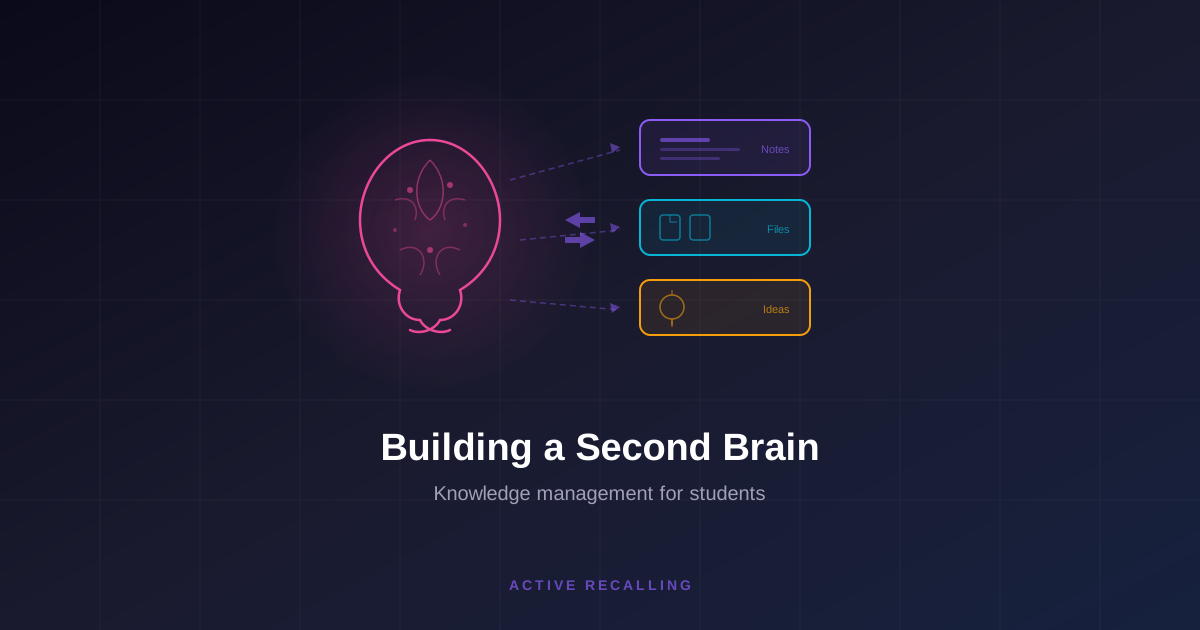
Every semester, students accumulate thousands of pages of notes, readings, handouts, and study materials. By the end of the year, most of this information is scattered across notebooks, folders, cloud drives, and apps — effectively lost despite being technically saved. When exam time arrives or a paper requires referencing earlier material, finding what you need feels like searching for a needle in a haystack you built yourself.
The Building a Second Brain (BASB) methodology, developed by productivity expert Tiago Forte, offers a systematic solution to this problem. It is a framework for organizing your digital information so that the right knowledge surfaces at the right time, reducing the cognitive burden of remembering where everything is and freeing your mind to focus on understanding and creating.
For students, a well-built second brain is not just a productivity hack — it is a competitive advantage that compounds over the course of an entire academic career.
What Is a Second Brain?
A second brain is an external, digital system for storing, organizing, and retrieving the information that matters to you. Think of it as an extension of your biological memory — a trusted place where you can offload facts, ideas, insights, and resources so that your mind is free to think rather than remember.
The concept is rooted in the idea that human memory is excellent at pattern recognition, creative thinking, and making connections, but relatively poor at precise recall and long-term storage of arbitrary information. By externalizing the storage function to a digital system, you play to your brain's strengths while compensating for its weaknesses.
For students, a second brain serves several critical functions. It ensures that lecture notes remain accessible and organized months after the class. It creates a searchable archive of readings, key quotes, and references for essays and research papers. It provides a planning framework for managing courses, deadlines, and projects. And over time, it builds a personal knowledge base that grows more valuable with every semester.
The PARA Framework
The organizational backbone of the Building a Second Brain methodology is the PARA framework, which divides all your information into four categories based on how actionable it is.
Projects
Projects are outcomes you are actively working toward that have a defined end point. For students, projects include specific assignments (a term paper due in three weeks), exam preparation periods, group presentations, and thesis chapters. Each project gets its own folder containing all the materials, notes, and resources relevant to that specific outcome.
The key distinction is that projects are temporary and outcome-focused. When the paper is submitted or the exam is over, the project is complete. The materials may be archived, but the active project folder is closed.
Areas
Areas are ongoing responsibilities without a specific end date. For students, areas include each course you are enrolled in, your overall academic standing, health and fitness, finances, and extracurricular commitments. Areas require ongoing attention and maintenance but are not tied to a single deliverable.
Your "Organic Chemistry" area would contain your general course notes, syllabus, reference materials, and anything else related to that ongoing responsibility. Specific assignments within that course would be separate projects that draw on materials from the area.
Resources
Resources are topics of ongoing interest that are not tied to a current project or area of responsibility. A student interested in machine learning who is not currently taking a machine learning course might save interesting articles, tutorials, and ideas in a "Machine Learning" resource folder. This content is not actionable right now but may become relevant in a future course or project.
Resources act as a knowledge reservoir that grows over time. When you start a new project, checking your resource folders often reveals material you collected months or years ago that is now directly relevant.
Archives
Archives are inactive items from the other three categories. Completed projects, courses from previous semesters, and topics you are no longer actively interested in all move to the archive. The information is not deleted — it is simply moved out of your active workspace so it does not create clutter.
The archive is surprisingly valuable for students. Material from a course taken two years ago might become relevant for a senior thesis or a job interview. Because it is organized and searchable, you can retrieve it quickly even though you have not thought about it in months.
Progressive Summarization
Progressive summarization is the technique Forte recommends for processing information so that it becomes increasingly useful over time. Rather than highlighting everything on a first read or trying to create perfect notes immediately, you apply layers of summarization across multiple encounters with the material.
Layer One: Captured Notes
The first layer is simply capturing the information in your second brain. Save the article, record the lecture notes, clip the web page. At this stage, you are not processing or organizing — just making sure the material is in your system rather than lost in a pile of browser tabs or a forgotten notebook.
Layer Two: Bold Passages
The second time you encounter the material — perhaps while reviewing notes for an upcoming class — bold the most important passages. This takes only a few minutes and immediately makes the note more scannable. You are not trying to summarize everything, just flagging the sentences and ideas that seem most important.
Layer Three: Highlighted Passages
On a subsequent pass, highlight the most important of the bolded passages. This further distills the content, creating a hierarchy where the most crucial ideas are visually prominent. A reader can now skim the highlighted portions and grasp the key points in seconds rather than minutes.
Layer Four: Executive Summary
The final layer is a brief executive summary written in your own words at the top of the note. This summary captures the core insight or takeaway in two to three sentences. Writing it in your own words engages the generation effect, deepening your understanding of the material.
The beauty of progressive summarization is that you only invest processing effort when and where it is needed. Not every note will reach layer four. Many notes will remain at layer one indefinitely, and that is perfectly fine. The system ensures that the material you return to most frequently gets the most attention.
Adapting BASB for Academic Life
While Forte's methodology was designed primarily for knowledge workers, students can adapt it with a few modifications.
Course-Based Organization
The most natural adaptation is mapping each course to an area in the PARA framework. Within each course area, maintain your lecture notes, reading notes, and reference materials. When an assignment or exam comes up, create a project that draws on materials from the course area.
This separation means your course notes remain organized as a general reference even as individual assignments come and go. When you finish a term paper, the project folder is archived, but the course area with all your notes remains active until the semester ends.
Capture During Lectures
Develop a capture habit during lectures. This does not mean transcribing everything the professor says. Instead, focus on capturing ideas, questions, and connections that occur to you during the lecture. These personal reactions and insights are often more valuable than a verbatim record because they represent your own thinking about the material.
After the lecture, spend five minutes applying the first layer of progressive summarization — reviewing your notes and ensuring the most important points are easy to identify.
Weekly Review for Students
Forte emphasizes a weekly review as a critical maintenance practice. For students, this should include reviewing all upcoming deadlines for the next two weeks, processing any unsorted notes or captured materials into the appropriate PARA category, identifying projects that need attention, and briefly reviewing key concepts from the past week.
This weekly review takes about 30 minutes and prevents the system from becoming an unorganized dumping ground. It also serves as a form of spaced review, since you are re-encountering material from earlier in the week.
Exam Preparation as a Project
When exams approach, create a dedicated exam prep project for each test. Pull the most important notes, summaries, and resources from the course area into the project folder. Apply progressive summarization to distill the semester's material into increasingly concentrated review notes.
This approach turns exam preparation from a panicked sprint through mountains of material into a structured process of distillation and review. Each progressive summarization layer reduces the volume of material while increasing its concentration and usefulness.
Choosing Your Tools
The Building a Second Brain methodology is tool-agnostic — it works with any note-taking or organizational app. However, some tools are better suited to the PARA framework than others.
Notion is popular for its database features and flexible page structure, which maps well to the PARA categories. Obsidian appeals to students who want local storage and powerful linking between notes. Apple Notes and Google Keep work for students who prefer simplicity. Roam Research and Logseq are favored by those who think in networks rather than hierarchies.
The most important factor in choosing a tool is one that you will actually use consistently. A simple tool used daily beats a powerful tool used sporadically. Start with whatever feels most natural and only switch if you encounter specific limitations that affect your workflow.
Pair your organizational tool with a dedicated study tool for active learning. Your second brain stores and organizes knowledge, but tools like Active Recalling provide the retrieval practice and spaced repetition that convert stored information into durable memory. The combination of a well-organized second brain for knowledge management and a dedicated tool for active recall creates a powerful end-to-end learning system.
The Capture Habit
The foundation of any second brain is the capture habit — the practice of consistently saving valuable information when you encounter it. Without reliable capture, your system starves of input and becomes irrelevant.
For students, capture opportunities occur constantly. An interesting point during a lecture, a useful quote from a reading, a concept explained well in a YouTube video, a question you want to explore later, a connection between two courses — all of these are worth capturing.
The key to making capture sustainable is keeping the friction as low as possible. Use a quick capture tool on your phone for ideas that occur outside of study sessions. During lectures, capture directly into your note-taking app. When reading digitally, use highlights and annotations that sync to your second brain.
Do not worry about organizing during capture. Just get the information into the system. Organization happens during your weekly review, not at the moment of capture. Trying to file things perfectly in real time creates enough friction to kill the habit.
Common Pitfalls for Students
The Collector's Fallacy
The biggest risk with a second brain is the collector's fallacy — the illusion that saving information is the same as learning it. A Notion workspace full of saved articles, highlighted textbooks, and clipped web pages feels productive, but if you never review, summarize, or test yourself on that material, you have not learned anything. You have just built a better filing cabinet.
Combat this by applying progressive summarization and by regularly converting your saved knowledge into active study materials. Generate flashcards and quizzes from your notes, test yourself on key concepts, and use spaced repetition to solidify your understanding.
Over-Organizing
Spending hours perfecting your folder structure, color-coding tags, and creating elaborate templates is a form of productive procrastination. The PARA framework is intentionally simple — four top-level categories, minimal nesting. If your organizational system requires a manual to use, it is too complex.
Inconsistency
A second brain only works if you use it consistently. A week of enthusiastic capture followed by three weeks of neglect results in a fragmented, unreliable system. Build the habit gradually. Start with just capturing lecture notes and processing them during a weekly review. Add complexity only after the basic habit is solid.
The Compounding Return
The most powerful aspect of building a second brain as a student is the compounding effect over time. Every semester, your knowledge base grows. Concepts from introductory courses become the foundation for advanced courses. Research materials collected for one paper become starting points for future papers. Connections between different subjects — invisible when the information is scattered — become visible when everything is organized in one system.
By the time you graduate, you have not just earned a degree. You have built a comprehensive, searchable, well-organized body of knowledge that continues to serve you in graduate school or your career. That is the real return on investment of building a second brain.
Conclusion
Building a second brain as a student is an investment that pays dividends throughout your academic career and beyond. The PARA framework provides a simple, scalable structure for organizing information by actionability. Progressive summarization ensures that your notes become more useful over time rather than degenerating into an unnavigable archive. And the capture habit keeps your system fed with the raw material of learning.
Start simple. Pick a tool, set up the four PARA categories, and commit to capturing your lecture notes and reviewing them weekly. As the habit solidifies, expand to include readings, resources, and cross-course connections. Pair your second brain with active recall tools for retrieval practice, and you will have a learning system that is both comprehensive and effective — a true extension of your mind.