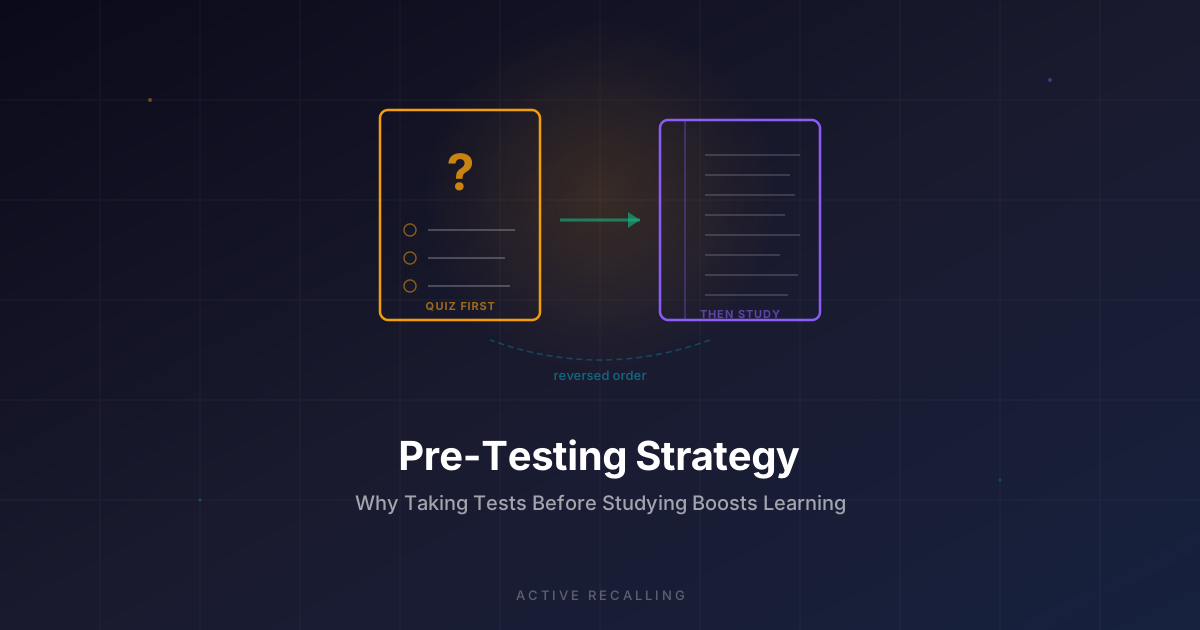
What if someone told you that taking a test on material you have never studied could actually help you learn that material better when you do study it? It sounds counterintuitive, perhaps even absurd. How can answering questions about things you do not yet know possibly help you learn?
Yet this is precisely what decades of cognitive science research have demonstrated. Pre-testing, the practice of attempting to answer questions about material before studying it, is one of the most underutilized learning strategies available to students. It works not despite the fact that you get most answers wrong, but partly because of it.
In this article, we will explore the science behind pre-testing, examine the mechanisms that make it effective, review the research evidence, and provide practical strategies for incorporating pre-testing into your study routine.
The Prequestion Effect
The prequestion effect refers to the finding that answering questions before studying the relevant material enhances subsequent learning and retention of that material. This phenomenon has been documented in research going back to the 1960s, but it has received renewed attention in recent years as part of the broader interest in desirable difficulties and active learning strategies.
In a typical prequestion study, participants are given a set of questions about an upcoming passage or lecture. They attempt to answer these questions despite having no prior exposure to the material. Naturally, they get most answers wrong. They then study the material normally and are later tested on it. Consistently, participants who received prequestions remember the material better than those who studied the same material without prequestions.
A key study by Richland, Kornell, and Kao (2009) demonstrated this effect clearly. Participants who attempted to answer questions about a passage before reading it recalled significantly more of the passage on a later test than participants who simply read the passage with the same amount of study time. The benefit was specific to the material addressed by the prequestions, but in many studies, it also extended to related material that was not directly questioned.
Why Pre-Testing Works: The Mechanisms
Several cognitive mechanisms work together to make pre-testing effective.
Curiosity Activation
One of the most powerful mechanisms behind pre-testing is curiosity activation. When you attempt to answer a question and discover that you do not know the answer, you experience a knowledge gap, an awareness that you are missing information that you want to have. This gap creates curiosity, which is a powerful driver of attention and learning.
Research by Gruber, Gelman, and Ranganath (2014) using brain imaging showed that curiosity activates the brain's reward system, including the hippocampus and dopaminergic circuits in the midbrain. When these systems are active, the brain is in an enhanced state for encoding new information. In other words, curiosity does not just make you want to learn; it literally makes your brain better at learning.
When you take a pre-test and encounter questions you cannot answer, you create multiple knowledge gaps simultaneously. Each gap generates curiosity, and when you subsequently study the material, your brain is primed to attend to and encode the information that fills those gaps.
Attention Direction
Pre-testing also works by directing your attention to the most important information in the material you are about to study. Without guidance, students often distribute their attention somewhat randomly across study materials, spending time on interesting but tangential details while missing key concepts.
Pre-test questions act as advance organizers that signal what is important. When you encounter the relevant information during your subsequent study, you recognize it as the answer to a question you previously attempted, which triggers deeper processing. Research by Hausman and Rhodes (2022) confirmed that pre-testing improves learning partly by guiding attention to question-relevant information during subsequent study.
Schema Activation
When you attempt to answer pre-test questions, you naturally search your existing knowledge for anything that might be relevant. Even if you cannot answer the question correctly, this search process activates related prior knowledge and creates a cognitive framework, or schema, into which new information can be integrated.
Learning is not a process of writing information onto a blank slate. It is a process of connecting new information to existing knowledge structures. By activating these structures before studying, pre-testing ensures that the new material has something to attach to, which makes it more meaningful and memorable.
The Generation Effect
Attempting to generate an answer, even an incorrect one, triggers what psychologists call the generation effect. This is the finding that information you actively generate is better remembered than information you passively receive. When you guess at a pre-test answer, you create a prediction about what the correct answer might be. When you then learn the actual answer, you process it more deeply because you are comparing it to your prediction, noting where you were right, where you were wrong, and why.
Research by Kornell, Hays, and Bjork (2009) showed that even unsuccessful generation attempts enhanced later learning, as long as the correct answer was provided afterward. The act of trying to generate an answer creates a "mental hook" that the correct answer can attach to more firmly.
Error Correction and Surprise
When you take a pre-test and get answers wrong, the subsequent discovery of the correct answers involves an element of surprise. This surprise is not just an emotional reaction; it reflects a prediction error in the brain that triggers enhanced encoding. Neuroscience research has shown that prediction errors activate dopaminergic signaling that strengthens memory formation.
The more confident you were in your incorrect answer, the stronger this effect tends to be. This is related to the hypercorrection effect, discussed more in our article on learning from mistakes, where high-confidence errors are more likely to be corrected and remembered than low-confidence errors.
Research Evidence for Pre-Testing
The evidence supporting pre-testing comes from a wide range of studies across different populations and learning contexts.
In Classroom Settings
St. Hilaire and Bhatt (2019) conducted a study in a university psychology course where students received pre-test questions at the beginning of each lecture. Students who received pre-tests performed significantly better on subsequent exams compared to a control group, with the benefit being greatest for the specific material targeted by the pre-test questions. Importantly, the benefit persisted on the final exam, suggesting that pre-testing enhanced long-term retention, not just short-term performance.
With Different Types of Material
Pre-testing has been shown to benefit learning across a variety of content types. It enhances learning from text passages, video lectures, in-person lectures, and multimedia presentations. The effect has been demonstrated with factual knowledge, conceptual understanding, and even the ability to make inferences and apply knowledge to new situations.
Across Age Groups
While most pre-testing research has been conducted with college students, studies have also demonstrated the effect with younger students and with adult learners in professional training contexts. The mechanism appears to be robust across development, suggesting that it taps into fundamental properties of human learning.
Compared to Other Strategies
Interestingly, pre-testing has been shown to produce benefits above and beyond simply telling students what to pay attention to. In studies that compared pre-testing to advance statements like "pay attention to X," pre-testing produced superior learning. This suggests that the active attempt to generate answers provides a unique benefit that cannot be replicated by passive cues.
How to Implement Pre-Testing in Your Study Routine
Knowing that pre-testing works is valuable, but the real power comes from incorporating it into your actual study practice. Here are practical strategies for doing so.
Before Reading a Textbook Chapter
Before you begin reading a new chapter, scan the chapter headings, subheadings, and any review questions provided at the end of the chapter. Many textbooks include learning objectives at the beginning of each chapter and review questions at the end. Use these as your pre-test. Attempt to answer the review questions before reading the chapter, writing your best guesses. Then read the chapter with the awareness that you are searching for the answers to those questions.
Before Attending a Lecture
If your instructor provides lecture slides, outlines, or learning objectives in advance, use them to generate pre-test questions. Turn each heading or objective into a question and attempt to answer it before the lecture. If no advance materials are available, review the textbook section that will be covered and generate your own questions based on the headings.
Using Study Tools for Pre-Testing
Digital study tools make pre-testing particularly convenient. With platforms like Active Recalling, you can create quizzes on upcoming material and attempt them before your study session. The quiz feature provides immediate feedback, which maximizes the learning benefit. You can also use flashcards in pre-test mode, attempting to answer each card before studying the underlying material.
The Pre-Test, Study, Post-Test Cycle
The most effective implementation of pre-testing follows a three-step cycle:
Step one: Pre-test. Take a test on the material you are about to study. Accept that you will get most answers wrong. Pay attention to which questions you find particularly challenging or surprising.
Step two: Study. Read, listen to, or watch the material with the pre-test questions fresh in your mind. When you encounter information that answers a pre-test question, pause and note it. Compare the correct answer to whatever you guessed during the pre-test.
Step three: Post-test. After studying, take the same test again (or a similar one). This retrieval practice further strengthens your memory for the material. The contrast between your pre-test and post-test performance also provides valuable feedback about how well you learned the material.
Creating Effective Pre-Test Questions
Not all questions are equally effective as pre-tests. The best pre-test questions share several characteristics:
They target key concepts rather than trivial details. Focus your pre-test questions on the main ideas, important definitions, critical relationships, and core processes of the material.
They require generation, not recognition. Open-ended questions (What is...? Why does...? How does...?) are generally more effective than multiple-choice questions for pre-testing because they require you to generate an answer rather than simply recognize one.
They are challenging but not impossible. The ideal pre-test question is one where you might have some relevant prior knowledge to draw on, even if you do not know the specific answer. Questions that are completely disconnected from your existing knowledge are less effective because they do not activate useful schemas.
They cover a range of cognitive levels. Include some factual questions (What is the definition of...?), some conceptual questions (Why does...?), and some application questions (How would you use...?). This variety ensures that you are primed for deep engagement with the material at multiple levels.
Common Concerns About Pre-Testing
Will Wrong Answers Become Stuck in My Memory?
This is the most common concern about pre-testing, and it is understandable. If you guess incorrectly during a pre-test, will that wrong answer persist in your memory and interfere with the correct one?
The research is reassuring on this point. Multiple studies have found that incorrect pre-test responses do not persist as errors as long as the correct answers are provided during the subsequent study phase. In fact, the process of generating an incorrect answer and then learning the correct one appears to enhance rather than impair memory for the correct answer. The key is that the correction must occur. Pre-testing without subsequent study would indeed risk entrenching errors.
Is Pre-Testing Just Wasting Time?
Some students worry that the time spent on a pre-test could be better spent studying. However, the time invested in pre-testing typically pays for itself and more through enhanced learning during the subsequent study phase. Students who pre-test often need less total study time to achieve the same level of mastery because they learn more efficiently when they do study.
Do I Need Special Materials?
You do not need any special materials to practice pre-testing. Chapter headings, learning objectives, and end-of-chapter questions can all be turned into pre-tests. You can also create your own questions simply by turning key terms and concepts into questions. The process of creating pre-test questions is itself a form of elaborative processing that enhances learning.
Conclusion
Pre-testing is a beautifully paradoxical learning strategy. By testing yourself on material you have not yet studied, you activate curiosity, direct attention, create cognitive frameworks, and prime your brain for deeper processing. The initial failure of getting questions wrong is not a waste; it is the very mechanism that makes subsequent learning more effective.
The science is clear: taking tests before studying boosts learning. Whether you use textbook questions, create your own, or leverage quiz features in tools like Active Recalling, incorporating pre-testing into your study routine is one of the simplest and most effective changes you can make. Start your next study session with a pre-test, embrace the uncertainty of not knowing, and watch as the material you subsequently study becomes clearer, more meaningful, and more memorable than ever before.