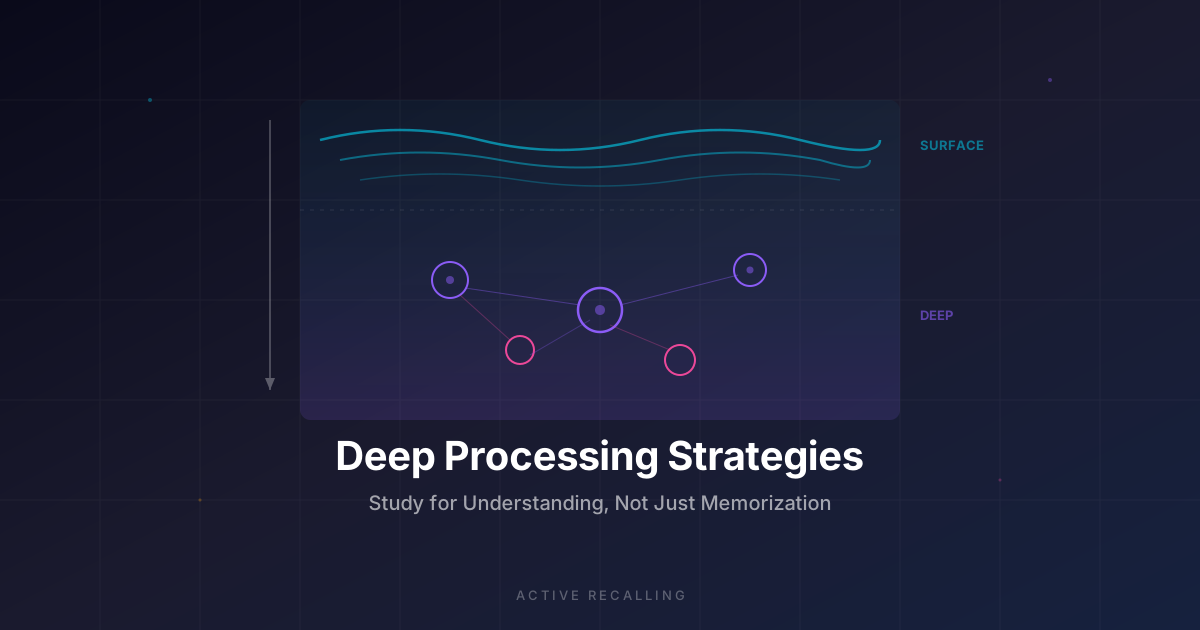
There are two fundamentally different ways to study. You can memorize facts and procedures well enough to reproduce them on a test, or you can develop genuine understanding that allows you to explain, apply, and extend what you have learned. The first approach might get you through tomorrow's quiz, but the second will serve you for the rest of your life.
The distinction between these two approaches has been studied extensively by cognitive scientists and educational researchers. Their findings are clear: deep processing produces learning that is more durable, more flexible, and more useful than surface-level processing. Yet many students default to surface strategies, not because they are lazy, but because they have never been explicitly taught how to process information deeply.
This article will explore the research on deep versus surface processing, trace its origins in the landmark work of Marton and Saljo, and provide practical strategies you can use to shift your study habits toward deeper, more meaningful engagement with whatever you are learning.
Surface Processing vs Deep Processing
What Is Surface Processing?
Surface processing involves engaging with learning material at a literal, superficial level. A surface approach focuses on memorizing individual facts, reproducing definitions verbatim, and treating the material as a collection of isolated pieces of information to be stored and retrieved. Students using a surface approach tend to:
- Read and reread material without actively questioning it
- Focus on memorizing specific facts, dates, formulas, and definitions
- Treat each piece of information as independent from others
- Study to pass the test rather than to understand the subject
- Accept information at face value without examining the reasoning behind it
- Feel that learning is an external imposition rather than an internal exploration
Surface processing is not always wrong. For some tasks, such as memorizing vocabulary in a foreign language or learning the periodic table, surface-level memorization is a necessary starting point. But when surface processing is the only strategy a student uses, the result is fragile, inflexible knowledge that quickly fades and cannot be applied to new situations.
What Is Deep Processing?
Deep processing involves engaging with material at a meaningful, conceptual level. A deep approach focuses on understanding the underlying principles, connecting new information to prior knowledge, and constructing a personal interpretation of the material. Students using a deep approach tend to:
- Ask why things are the way they are and how they relate to other concepts
- Look for the underlying logic, structure, and principles of the material
- Relate new ideas to their existing knowledge and experiences
- Think about real-world applications and implications
- Evaluate evidence and arguments critically
- Experience genuine interest and curiosity about the subject matter
Deep processing produces durable, transferable knowledge that persists long after the exam and can be applied in novel contexts. It is the kind of learning that transforms students from information repositories into genuine thinkers.
The Pioneering Work of Marton and Saljo
The distinction between surface and deep processing was first formally identified by Swedish researchers Ference Marton and Roger Saljo in their groundbreaking 1976 study. Their work fundamentally changed how educators and psychologists think about learning.
The Original Study
Marton and Saljo asked university students to read an academic article and then answer questions about it. Critically, they also interviewed the students about how they approached the reading task. From these interviews, two distinctly different approaches emerged.
Some students focused on memorizing specific facts and details from the article. They tried to remember as much of the literal content as possible, treating the task as an exercise in information storage. Marton and Saljo called this the surface approach.
Other students focused on understanding the author's argument and main message. They thought about the reasoning behind the claims, considered how different parts of the article related to each other, and tried to grasp the overall meaning. Marton and Saljo called this the deep approach.
The Key Finding
The critical finding was that students who adopted a deep approach demonstrated significantly better understanding and retention of the material than those who adopted a surface approach. Moreover, the deep approach students were better able to apply the ideas from the article to new questions and contexts.
Equally important was Marton and Saljo's observation that the approach students adopted was not a fixed trait but a response to the learning context. Students could be encouraged toward deeper or shallower processing depending on the nature of the task, the assessment they expected, and the learning environment. This finding opened the door to practical interventions that could shift students toward deeper processing.
Levels of Processing Framework
Marton and Saljo's work built on and extended the levels of processing framework proposed by Craik and Lockhart in 1972. This framework argued that memory is not simply a matter of how many times you encounter information but of how deeply you process it. Shallow processing, such as noting the physical features of words, produces weak memories. Deep processing, such as thinking about the meaning and implications of the words, produces strong, lasting memories.
A classic experiment by Craik and Tulving (1975) demonstrated this vividly. Participants were shown words and asked different types of questions: some about the physical appearance of the word (shallow), some about whether it rhymed with another word (intermediate), and some about whether it fit meaningfully into a sentence (deep). Despite identical exposure time, words processed at the deepest level were remembered three to four times better than words processed at the shallowest level.
Strategies for Deeper Processing
Understanding the theory is important, but the real value lies in knowing how to implement deep processing in your daily study practice. Here are proven strategies that promote deeper engagement with learning material.
Strategy One: Elaborative Interrogation
Elaborative interrogation is the practice of systematically asking "why" and "how" questions about the material you are studying. Instead of accepting facts at face value, you push yourself to explain the underlying reasons and mechanisms.
For every key concept or claim you encounter, ask:
- Why is this the case?
- How does this mechanism work?
- What causes this to happen?
- Why might this be different under other circumstances?
Research has consistently shown that elaborative interrogation produces significantly better retention and understanding than simply reading or even rereading material. The key is to genuinely attempt to answer the questions, not just pose them rhetorically.
Strategy Two: Self-Explanation
Self-explanation involves explaining the material to yourself as you study it, step by step. Pioneered by researcher Michelene Chi, this strategy requires you to articulate what each piece of information means, how it relates to what you already know, and how it connects to other parts of the material.
As you read a textbook passage, pause after each paragraph or key point and explain it in your own words. If you are working through a solved example in math or science, explain to yourself why each step was taken and how it follows from the previous step. When you encounter something you cannot explain, you have identified a gap in your understanding that needs attention.
Chi's research showed that students who self-explained while studying understood the material more deeply and could solve novel problems significantly better than students who did not self-explain, even when total study time was the same.
Strategy Three: Connecting to Prior Knowledge
Deep processing inherently involves relating new information to what you already know. You can make this process deliberate by explicitly asking yourself connection questions:
- What does this remind me of?
- How is this similar to or different from something I learned previously?
- Does this fit with or contradict my existing understanding?
- Can I think of a personal experience that relates to this concept?
These connections create multiple pathways to the new information in memory, making it easier to retrieve and more resistant to forgetting. The richer the web of connections, the more deeply the information is processed and the better it is understood.
Strategy Four: Teaching Others
One of the most powerful ways to process information deeply is to teach it to someone else. Teaching requires you to organize your knowledge coherently, identify and fill gaps in your understanding, generate examples and explanations, and anticipate questions. All of these activities force deep engagement with the material.
The Feynman Technique, named after the Nobel laureate physicist Richard Feynman, formalizes this approach. The method involves four steps: choose a concept, explain it in simple language as if teaching a child, identify gaps in your explanation, and return to the source material to fill those gaps. By repeating this cycle, you progressively deepen your understanding until you can explain even complex concepts in clear, simple terms.
You do not need an actual student to practice teaching. Explain concepts aloud to yourself, to an imaginary audience, or even to a rubber duck on your desk. The act of articulating your understanding is what drives the deep processing.
Strategy Five: Creating Analogies and Metaphors
Generating analogies between the material you are studying and something you already understand well is a powerful deep processing strategy. Analogies force you to identify the abstract structure of the concept and map it onto a different domain, which requires understanding at a level far beyond surface memorization.
For example, comparing electrical circuits to water flowing through pipes, or comparing the immune system to an army defending a castle, requires you to understand the functional relationships within each system and recognize the structural parallels between them.
Research by Gentner and colleagues has shown that analogical reasoning enhances both understanding and transfer. Students who learn through analogies are better able to apply their knowledge to new situations because they have grasped the underlying structure rather than just the surface details.
Strategy Six: Generating Examples
When you encounter a general principle or abstract concept, challenge yourself to generate your own specific examples. This is more effective than simply reading examples provided in the textbook because the generation process requires you to understand the concept well enough to recognize or create instances of it.
For each key concept in your study material, try to produce at least two or three original examples. If you struggle to generate examples, this difficulty is a signal that your understanding of the concept may be more superficial than you realized.
Strategy Seven: Comparing and Contrasting
Comparing and contrasting related concepts forces you to identify both their shared features and their distinguishing characteristics. This process deepens your understanding of each individual concept by clarifying what makes it unique and how it fits within a broader category.
Create comparison tables or Venn diagrams that lay out the similarities and differences between related ideas. For example, if you are studying different psychological theories, compare their assumptions, methods, key findings, and limitations side by side. The act of making these comparisons requires you to process each theory at a deeper level than simply reading about them individually.
Strategy Eight: Using Visual Representations
Creating visual representations of the material, such as concept maps, diagrams, flowcharts, and timelines, engages spatial and visual processing systems in addition to verbal systems. This dual encoding produces deeper, more integrated understanding.
Tools like the mindmap feature in Active Recalling allow you to create visual representations of how concepts in your study material relate to each other. The process of building these maps, deciding which concepts to include, how to organize them, and how to show their relationships, is itself a form of deep processing.
How Assessment Shapes Processing Depth
Marton and Saljo's research revealed that students' expectations about assessment strongly influence their processing approach. When students expect tests that require only recognition or recall of facts, they tend to adopt surface approaches. When they expect tests that require explanation, application, or critical analysis, they shift toward deeper processing.
You can use this insight to your advantage. Even if your actual exam will include multiple-choice questions, study as if you will need to explain every concept in an essay. Prepare as if you will be asked to apply each idea to a novel situation, defend each claim with evidence, and connect each concept to others. By setting a higher bar for yourself than the assessment requires, you ensure that you process the material at a depth that produces genuine understanding.
The Effort Paradox
Deep processing requires more effort than surface processing, and it often feels slower and more frustrating. Students who adopt a deep approach may initially feel like they are learning less because they are covering material at a slower pace. This is the effort paradox: the approaches that feel most productive are often least effective, and the approaches that feel most challenging are often most effective.
Embrace the difficulty. If studying feels easy, you are probably engaging in surface processing. If it feels challenging and requires genuine mental effort, you are likely engaging in deep processing. The difficulty is not a sign that something is wrong. It is a sign that meaningful learning is occurring.
Conclusion
The choice between surface and deep processing is ultimately a choice between two different kinds of knowledge. Surface processing produces knowledge that is narrow, fragile, and quickly forgotten. Deep processing produces knowledge that is broad, robust, and enduring. The strategies outlined in this article, elaborative interrogation, self-explanation, connection-making, teaching, analogy creation, example generation, comparison, and visual representation, are all tools for achieving deeper processing.
As Marton and Saljo showed nearly fifty years ago, the approach you take to learning matters at least as much as the time you spend. By deliberately and consistently choosing deep processing, you transform studying from a chore of memorization into a practice of genuine understanding, the kind of learning that serves you long after the final exam is over.