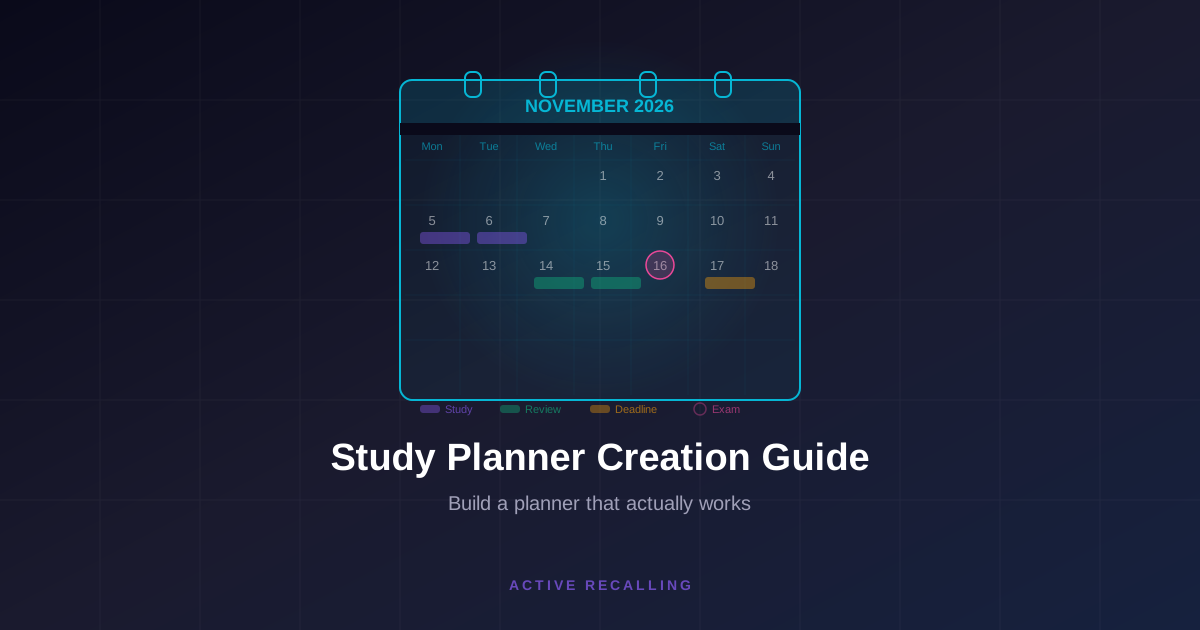
Most students have tried creating a study plan at some point. And most of those plans have been abandoned within a week. The problem is rarely a lack of discipline — it is a lack of planning methodology. A study planner that ignores how human motivation actually works, overestimates available time, or fails to account for the unexpected is designed to fail before you even start.
This guide teaches you how to create a study planner that survives contact with reality. We cover the full process from semester-level strategy down to daily execution, with specific techniques for avoiding the common pitfalls that doom most study plans. By the end, you will have a concrete framework for building a planner tailored to your courses, schedule, and learning style.
Why Most Study Plans Fail
Before building a better plan, it is worth understanding why conventional approaches break down.
Overcommitment is the number one killer. Students routinely plan eight or ten hours of studying per day, leaving no room for breaks, errands, socializing, or the mental fatigue that inevitably arrives after a few hours of concentrated work. When the plan proves impossible on day one, motivation collapses and the entire planner is abandoned.
Lack of specificity is the second most common problem. "Study biology" is not a plan — it is a wish. Without specifying what you will study, how you will study it, and what outcome you are aiming for, you are likely to spend your study session either staring at a textbook or jumping between topics without making real progress.
No built-in flexibility makes plans brittle. Unexpected events — illness, a friend in crisis, an assignment taking longer than expected — are not exceptions; they are the norm. A plan that shatters at the first disruption is worse than no plan at all because it adds guilt and frustration to the disruption.
Ignoring review is a structural flaw that costs students enormously. Plans that focus exclusively on learning new material without scheduling time to review and reinforce previous material guarantee that earlier content will be forgotten by exam time.
Step One: Semester-Level Planning
Effective study planning starts with the big picture and zooms in progressively. Before worrying about what to study on Tuesday afternoon, you need a clear view of the entire semester.
Map Your Deadlines
Gather every syllabus and create a master deadline calendar that shows every exam, paper, project, and assignment across all your courses for the entire semester. Use a physical wall calendar, a digital calendar, or a spreadsheet — the format matters less than having everything visible in one place.
This birds-eye view immediately reveals the pressure points in your semester: weeks where multiple deadlines cluster. These are the weeks that will feel impossible if you arrive unprepared, but manageable if you have spread the preparation over preceding weeks.
Estimate Workload by Course
Not all courses require equal study time. A math-heavy course with weekly problem sets demands consistent daily practice. A reading-heavy humanities course requires large blocks of uninterrupted reading time. A lab course has preparation and report writing that bookend each session.
Estimate the weekly study hours each course requires outside of class. A common rule of thumb is two to three hours of study for every hour of class time, but this varies widely. Be honest in your estimates — underestimating here will cascade into problems throughout the semester.
Identify Your Hardest Weeks
With deadlines mapped and workloads estimated, identify the three to five hardest weeks of the semester. For these weeks, plan to start preparation early. If week ten has two exams and a paper due, you should be starting the paper and beginning exam review no later than week eight. Mark these early-start dates on your calendar as firmly as the deadlines themselves.
Step Two: Weekly Breakdown
With the semester mapped, you can create detailed plans one week at a time. This is best done during a weekly planning session on Sunday evening or Monday morning.
Inventory Your Available Time
Start by blocking out all your fixed commitments for the week: classes, work, commuting, meals, sleep, and any non-negotiable personal obligations. Count the remaining hours. This is your total available study time for the week.
Most students are shocked at how little time remains once fixed commitments are accounted for. A student with 15 hours of class time, a 10-hour-per-week part-time job, and eight hours of sleep per night has roughly 35-40 usable hours per week for studying, errands, exercise, and socializing. This reality check is essential for creating a plan you can actually follow.
Allocate Hours to Courses
Distribute your available study hours across courses based on their difficulty, upcoming deadlines, and your current standing. A course where you are struggling or have an upcoming exam deserves more hours than a course where you are ahead and have no imminent deadlines.
This allocation should shift from week to week based on changing demands. A rigid "four hours per course per week" approach ignores the reality that academic workload fluctuates. Your planner should be a dynamic document, not a static template.
Define Specific Tasks
Break each course's allocated hours into specific, actionable tasks. Instead of "study chemistry — 4 hours," write:
- Read chapter 12 and take notes (1.5 hours)
- Complete practice problems 1-20 (1 hour)
- Review flashcards from chapters 10-11 (30 minutes)
- Watch supplementary lecture on reaction mechanisms (1 hour)
Specificity does two things. It eliminates the decision paralysis of sitting down to "study" without knowing what to do. And it gives you a clear signal of completion — you know when you are done because you have finished the specific tasks, not just put in time.
Build in Buffers
Add buffer time to your weekly plan — at least two to three hours of unscheduled study time that can absorb overruns from tasks that take longer than expected or accommodate unexpected new tasks. Without buffers, a single assignment that takes an extra hour throws off the rest of your week like dominoes.
Place your buffer time later in the week (Thursday or Friday) so it can catch any overflow from the earlier days. If you do not need it, the buffer becomes bonus study time or personal time — a win either way.
Step Three: Daily Schedules
Your daily schedule is where planning meets execution. Keep daily schedules simple and focused — they should guide your actions, not overwhelm you.
The Three Priorities Rule
Each day, identify your three most important tasks. These are the non-negotiable items that, if completed, would make the day a success regardless of what else happens. Write them down first thing in the morning or the night before.
Having three clear priorities prevents the common trap of busying yourself with small, easy tasks while avoiding the important but difficult work. If you complete your three priorities and nothing else, you have had a productive day.
Time-Task Matching
Assign your three priorities to specific time blocks based on the nature of the work and your energy levels. Deep thinking tasks — writing, problem-solving, reading dense material — should go in your peak energy slots, typically mid-morning. Review and lighter tasks can go in lower-energy periods.
Be realistic about session length. Most students can sustain deep focus for 60-90 minutes before needing a genuine break. Plan accordingly. A two-hour study block should include a 10-15 minute break in the middle.
End-of-Day Review
Spend two minutes at the end of each day reviewing what you accomplished against your plan. Note what went well, what did not get done, and why. This brief reflection builds self-awareness about your planning accuracy and helps you calibrate future estimates.
If a task did not get done, explicitly reschedule it for a specific day later in the week. Tasks that remain on a vague "I'll get to it" list rarely get completed. Give them a new home on a specific day.
Step Four: Review Scheduling
The component that separates an adequate study planner from an excellent one is systematic review scheduling. Without it, you learn material once and forget it steadily until you cram before the exam, losing most of the initial learning.
The Spacing Principle
Research on the spacing effect shows that distributing review sessions across multiple days produces dramatically better retention than concentrating the same total study time in a single session. Reviewing chapter five for 30 minutes on three separate occasions over two weeks is far more effective than reviewing it for 90 minutes once.
Build review sessions into your weekly plan as a regular, recurring block. Treat review time as non-negotiable — it is not optional extra studying but a core component of effective learning.
Using Spaced Repetition Tools
Manually tracking which topics need review and when is tedious and error-prone. This is where spaced repetition tools become invaluable. Platforms like Active Recalling schedule your reviews automatically based on your performance, ensuring you revisit material at the optimal intervals for retention.
Integrate your spaced repetition review into your daily plan as a fixed block. Even 15-20 minutes of algorithmically scheduled review per day maintains retention across all your courses with minimal time investment.
Cumulative Review Before Exams
In the weeks leading up to an exam, shift your study plan to emphasize cumulative review over new material. A common mistake is spending the final week before an exam intensely reviewing the last few weeks of content while neglecting earlier material. Your planner should include progressively broader review sessions as the exam approaches, ensuring that the full scope of testable material is fresh in your memory.
Making Your Planner Stick
Start Smaller Than You Think
If you are new to structured study planning, start with a plan that feels too easy. Plan fewer hours than you think you need. Build the habit of following through on your plan before increasing the volume. It is far better to complete a modest plan consistently than to create an ambitious plan you abandon after three days.
Use the Right Medium
Your planner should live wherever you will actually see and use it. For some students, this is a physical planner they carry everywhere. For others, it is a Notion database or a Google Calendar. Some students prefer a simple notebook. The format does not matter — visibility and accessibility do.
The worst planner is the one you created enthusiastically on a Sunday evening and never looked at again. Put it somewhere you will encounter it multiple times per day.
Plan for Failure
Your plan will break. You will get sick, oversleep, underestimate a task, or face an emergency. The question is not whether disruptions will occur but how your system handles them.
Build explicit contingency plans into your study planner. For each important task, identify a backup time slot later in the week where it could be rescheduled. When disruptions occur, you can calmly shift tasks to the backup slot rather than spiraling into panic.
Weekly Adjustment
Every weekly planning session should include a retrospective on the previous week. What percentage of your planned tasks did you complete? Where did you overestimate or underestimate time? Which subjects need more or less attention next week?
This iterative refinement is what transforms a generic study plan into a system calibrated to your specific courses, work style, and life circumstances. After three or four weeks of adjustments, your plans will become remarkably accurate because they are based on your real performance data rather than optimistic assumptions.
Sample Weekly Study Planner Structure
A practical weekly study planner includes these components. At the top, list your three weekly priorities — the most important outcomes for the week. Below that, list all tasks organized by course with time estimates. Then create a day-by-day schedule showing when each task will be done, including fixed commitments, study blocks, review sessions, exercise, and personal time. At the bottom, include a buffer block and a brief section for the end-of-week review.
Keep the layout clean and scannable. If your planner requires more than a quick glance to understand what you should be doing right now, simplify it.
Adapting Your Planner Throughout the Semester
Your study planner should evolve as the semester progresses. Early in the semester, when the workload is lighter, your plan may focus on building good habits, getting ahead on readings, and creating study materials. As midterms approach, the plan shifts toward more intensive review and assignment completion. During the final exam period, it becomes a detailed day-by-day countdown focused on cumulative review.
The students who navigate exam season most successfully are not the ones who suddenly start planning during finals week. They are the ones whose planning habit has been running all semester, and who simply shift the intensity and focus of an existing system.
Conclusion
A study planner that actually works is not about perfect scheduling or superhuman discipline. It is about honest assessment of your available time, specific task definition, realistic expectations, systematic review scheduling, and iterative improvement based on real experience.
Start with the semester overview to see the big picture. Break it down into weekly plans during a regular planning session. Execute daily using the three priorities rule and time-task matching. Build in review sessions and use spaced repetition tools to maintain retention. And when the plan breaks — which it will — adjust calmly and keep going.
The planner is not the goal. Learning is the goal. The planner is simply the structure that makes consistent, effective learning possible.