The most successful students share a common trait that has nothing to do with raw intelligence. They are skilled at managing their own learning. They plan their study sessions deliberately, monitor their understanding as they go, adjust their strategies when something is not working, and reflect on their performance afterward. In the research literature, this cluster of skills is known as self-regulated learning, and it is one of the strongest predictors of academic success across all age groups and subject areas.
Self-regulated learning is not about studying longer or trying harder. It is about studying smarter by taking conscious control of the learning process itself. It is the difference between driving a car with your eyes open, adjusting the steering based on the road ahead, and driving with your eyes closed, hoping you end up where you want to go. Both drivers may cover the same distance, but only one will reliably reach the destination.
In this article, we will explore the most influential model of self-regulated learning, developed by Barry Zimmerman, examine each phase of the self-regulation cycle in detail, and provide practical strategies for developing these critical skills.
What Is Self-Regulated Learning?
Self-regulated learning (SRL) refers to the process by which learners actively take charge of their own cognition, motivation, and behavior to achieve their learning goals. Self-regulated learners do not passively absorb information. They set goals, select strategies, monitor their progress, and adapt their approach based on feedback.
Research consistently identifies SRL as one of the most important factors in academic achievement. A meta-analysis by Dent and Koenka (2016) found that self-regulation was a stronger predictor of academic performance than prior achievement, meaning that how you manage your learning matters at least as much as what you already know.
Crucially, self-regulated learning is not a fixed trait. It is a set of learnable skills that can be developed through practice and instruction. Even students who currently struggle with self-regulation can learn to become more strategic and autonomous learners.
Zimmerman's Cyclical Model of Self-Regulated Learning
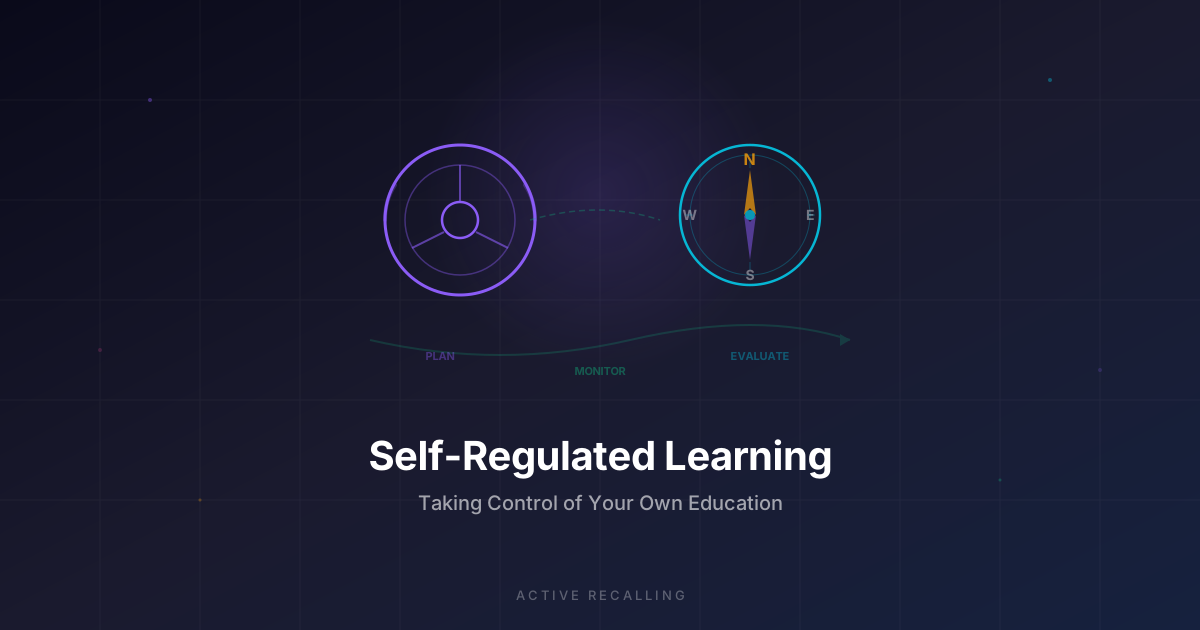
The most widely used and researched model of SRL was developed by Barry Zimmerman in the late 1980s and refined over the following decades. Zimmerman's model describes self-regulated learning as a cyclical process consisting of three phases: the forethought phase, the performance phase, and the self-reflection phase. These phases form a continuous loop, with the insights from each reflection feeding back into the planning for the next learning episode.
Phase One: Forethought (Planning)
The forethought phase occurs before you begin studying. It involves all the preparatory cognitive and motivational processes that set the stage for effective learning.
Task Analysis
The first component of forethought is task analysis, which involves two key activities: goal setting and strategic planning.
Goal setting means establishing specific, concrete learning objectives for the study session. Rather than sitting down with a vague intention to "study," self-regulated learners define exactly what they want to accomplish. For example: "By the end of this session, I want to be able to explain the three causes of World War I and answer practice questions about each one."
Strategic planning involves selecting the study methods and approaches you will use to achieve your goals. Will you use active recall? Flashcards? Practice problems? A self-regulated learner chooses strategies deliberately based on the nature of the material and their learning goals, rather than defaulting to whatever method feels easiest or most familiar.
Self-Motivation Beliefs
The second component of forethought involves the motivational beliefs that influence your engagement with the task.
Self-efficacy, your belief in your ability to succeed at the task, is one of the most powerful motivational factors in learning. Research consistently shows that students with higher self-efficacy set more ambitious goals, invest more effort, persist longer in the face of difficulty, and recover more quickly from setbacks. Self-efficacy is built through mastery experiences (succeeding at increasingly challenging tasks), vicarious experiences (seeing others similar to you succeed), and verbal encouragement.
Intrinsic interest refers to genuine curiosity and engagement with the material. Self-regulated learners actively cultivate interest by connecting the material to their personal goals, finding real-world applications, and asking questions that spark curiosity.
Outcome expectations are your beliefs about the likely consequences of your study efforts. If you believe that studying effectively will lead to good grades, deeper understanding, and career advancement, you are more motivated to invest effort. Self-regulated learners maintain realistic but positive outcome expectations.
Phase Two: Performance (Monitoring)
The performance phase occurs during the study session itself. It involves the cognitive and behavioral processes that occur while you are actively engaged in learning.
Self-Control Strategies
Self-control refers to the deliberate actions you take to stay on task and maintain the quality of your study efforts.
Attention focusing involves managing your concentration during the study session. Self-regulated learners are aware of their attention levels and take deliberate steps to maintain focus, such as eliminating distractions, using the Pomodoro Technique, or changing activities when attention begins to wane.
Task strategies are the specific cognitive techniques you employ during studying. These include active recall, elaboration, summarization, self-explanation, and other evidence-based learning strategies. Self-regulated learners not only use effective strategies but are prepared to switch strategies if their current approach is not producing results.
Environmental structuring involves arranging your physical and digital study environment to support learning. This includes choosing an appropriate study location, managing noise levels, organizing materials, and minimizing potential distractions such as phone notifications and social media.
Self-Observation
Self-observation is the monitoring component of the performance phase. It involves tracking your own cognitive processes, behaviors, and progress during the study session.
Metacognitive monitoring is the ongoing assessment of your own understanding. As you study, you continuously ask yourself: "Do I understand this? Could I explain it to someone else? Can I apply this to a new example?" This internal questioning allows you to detect comprehension failures in real time rather than discovering them during the exam.
Research by Dunlosky and Rawson (2012) showed that students who are skilled at monitoring their own comprehension make better decisions about how to allocate their study time. They spend more time on material they do not yet understand and less time on material they have already mastered, leading to more efficient and effective studying.
Behavioral tracking involves monitoring your observable study behaviors: how long you have been studying, how many problems you have completed, whether you are following your planned strategy, and whether you are maintaining focus. Keeping a study log or using time-tracking tools can support this form of self-observation.
Phase Three: Self-Reflection (Evaluating)
The self-reflection phase occurs after the study session (or after a test, assignment, or other learning event). It involves evaluating your performance and drawing conclusions that will inform future learning.
Self-Judgment
Self-judgment involves evaluating your performance against your goals and standards.
Self-evaluation means comparing what you actually accomplished with what you planned to accomplish. Did you achieve your learning objectives? Can you recall and apply the material you studied? How did you perform on the practice quiz?
Causal attribution involves identifying the reasons for your performance. Self-regulated learners tend to make adaptive attributions, attributing success to effort and effective strategies (which are controllable) rather than to innate ability or luck (which are not). Similarly, they attribute failures to insufficient effort, poor strategy selection, or lack of understanding rather than to fixed limitations.
These attributions matter enormously because they shape future motivation and behavior. If you believe you failed because you used an ineffective strategy, you will try a different strategy next time. If you believe you failed because you are "not smart enough," you may give up entirely.
Self-Reaction
Self-reaction encompasses the emotional and behavioral responses to your self-evaluation.
Adaptive reactions include satisfaction with good performance, which reinforces effective study behaviors, and constructive responses to poor performance, such as identifying what went wrong and planning improvements. Adaptive learners view poor performance as information rather than as a personal failure.
Maladaptive reactions include anxiety, avoidance, and helplessness in response to poor performance. These reactions are associated with a fixed mindset and tend to undermine future learning efforts.
Adaptive inferences involve drawing constructive conclusions about what to change for next time. "I need to use active recall instead of rereading" or "I need to start reviewing earlier" are adaptive inferences that improve future performance. Self-regulated learners routinely extract these lessons from their experiences and use them to refine their approach.
Developing Self-Regulation Skills
Self-regulated learning skills do not develop overnight, but they can be systematically cultivated through deliberate practice.
Start with the Planning Phase
Many students skip planning entirely, sitting down to study without any clear goals or strategy. Begin by spending just two minutes before each study session to answer three questions:
- What specifically do I want to learn or accomplish in this session?
- What strategy will I use?
- How will I know whether I have succeeded?
These three questions address goal setting, strategic planning, and self-evaluation criteria, covering the essential elements of the forethought phase. Over time, this brief planning ritual will become automatic and increasingly sophisticated.
Build Monitoring Habits
During your study sessions, set a timer to go off every 15 to 20 minutes as a monitoring prompt. When the timer rings, pause and ask yourself:
- Am I still focused, or has my mind been wandering?
- Do I understand what I just studied, or am I just going through the motions?
- Is my current strategy working, or should I try something different?
- Am I making progress toward my session goal?
These regular check-ins build the metacognitive monitoring skills that are central to the performance phase. Initially, you may need the external timer prompt. Over time, monitoring will become more automatic.
Practice Reflection After Every Session
After each study session, spend two to three minutes reflecting on what happened. Write brief answers to these questions:
- What did I accomplish?
- What worked well?
- What did not work as planned?
- What will I do differently next time?
This reflection is the self-reflection phase in action. Keeping a study journal where you record these reflections creates a valuable record of your learning process that you can review to identify patterns and track your development as a self-regulated learner.
Use Study Tools That Support Self-Regulation
Effective study tools can scaffold the self-regulation process. Platforms like Active Recalling support self-regulated learning in several ways:
Goal setting is facilitated by organizing material into folders and chapters, which naturally defines study goals at different levels of granularity.
Strategy selection is supported by offering multiple study modes, including flashcards for retrieval practice, quizzes for self-testing, and mindmaps for elaboration and connection building.
Monitoring is aided by quiz scores and flashcard performance data that provide objective feedback about your understanding.
Reflection is supported by the ability to track your performance over time, identify areas of weakness, and adjust your study focus accordingly.
Develop Self-Efficacy Through Mastery Experiences
Self-efficacy is built most powerfully through mastery experiences: the direct experience of succeeding at challenging tasks. To build self-efficacy:
Set appropriately challenging goals that stretch you but are achievable. Consistent success at challenging tasks builds confidence in your ability to handle even harder material.
Track and celebrate progress, no matter how small. Keeping a record of your improvements, such as increasing quiz scores or decreasing study time needed to master material, provides concrete evidence that your efforts are paying off.
Reflect on past successes when facing new challenges. Remind yourself of times when you successfully learned difficult material. The memory of past mastery strengthens your belief in your ability to succeed again.
The Metacognitive Component
At the heart of self-regulated learning is metacognition, the ability to think about your own thinking. Metacognition involves two components:
Metacognitive knowledge is what you know about how you learn. It includes knowledge about yourself as a learner (what strategies work best for you, when you are most alert, what your strengths and weaknesses are), knowledge about tasks (what different types of tasks require), and knowledge about strategies (what strategies exist and when each is most effective).
Metacognitive regulation is the ability to use your metacognitive knowledge to control your learning process. It includes planning, monitoring, and evaluating, the three phases of Zimmerman's model.
Developing metacognition takes time and deliberate effort, but it is arguably the most valuable intellectual skill you can develop. A student with strong metacognition can learn effectively in almost any context because they understand the learning process itself and can adapt to new situations and challenges.
Building Metacognitive Knowledge
Experiment with different study strategies and observe which ones produce the best results for you. Try active recall, spaced repetition, elaborative interrogation, interleaving, and dual coding across different subjects and types of material. Keep notes on what works and what does not.
Study the science of learning itself. Understanding the research behind effective study strategies gives you a mental toolbox that you can draw on when planning your study approach. Reading articles like this one builds your metacognitive knowledge about the learning process.
Seek feedback from multiple sources. Your own self-assessment, quiz and exam scores, feedback from instructors, and input from study partners all provide different perspectives on your learning that contribute to a more complete and accurate metacognitive picture.
Overcoming Common Self-Regulation Challenges
Procrastination
Procrastination is fundamentally a self-regulation failure: the inability to initiate or sustain goal-directed behavior in the face of competing impulses. Combat procrastination by using implementation intentions ("If it is 7 PM, then I will sit at my desk and open my textbook"), reducing the friction of starting (set up your study materials in advance), and breaking large tasks into small, manageable steps (study for 10 minutes rather than committing to two hours).
Distraction
Managing distraction requires environmental restructuring (removing distractions before they occur) and attention monitoring (noticing when your focus has drifted and redirecting it). Put your phone in another room, use website blockers during study time, and establish clear boundaries with people around you about your study periods.
Inconsistency
Many students regulate well for a few days but then fall off track. Build consistency by anchoring study to existing routines, tracking your completion of planned activities, and having a recovery plan for when you inevitably miss a session. Missing one session is not failure. Failing to get back on track after a miss is.
Overconfidence
A common self-monitoring error is overestimating your understanding because the material feels familiar. Combat overconfidence by using objective measures of learning such as practice tests, recall exercises, and teaching the material aloud. If you cannot retrieve and explain the material without looking at your notes, your understanding is not yet solid regardless of how familiar it feels.
Conclusion
Self-regulated learning is the master skill that makes all other study strategies effective. Without self-regulation, even the best techniques are applied inconsistently, inefficiently, and without the feedback needed for improvement. With strong self-regulation, you become an autonomous learner capable of identifying what you need to learn, selecting the best strategies, monitoring your progress, and continuously refining your approach.
Zimmerman's model of forethought, performance, and self-reflection provides a practical framework for developing these skills. Start small by spending a few minutes planning before each study session and reflecting afterward. Build your metacognitive monitoring with regular check-ins during studying. Use tools like Active Recalling to provide objective feedback and structure your practice.
Over time, these self-regulation skills will become second nature, transforming you from a passive student who hopes for good results into an active learner who consistently creates them. In a world where the ability to learn independently is increasingly valuable, self-regulated learning is not just an academic advantage; it is a life skill that empowers you to grow, adapt, and succeed in whatever you choose to pursue.